Commentary
Who was Tehamana?
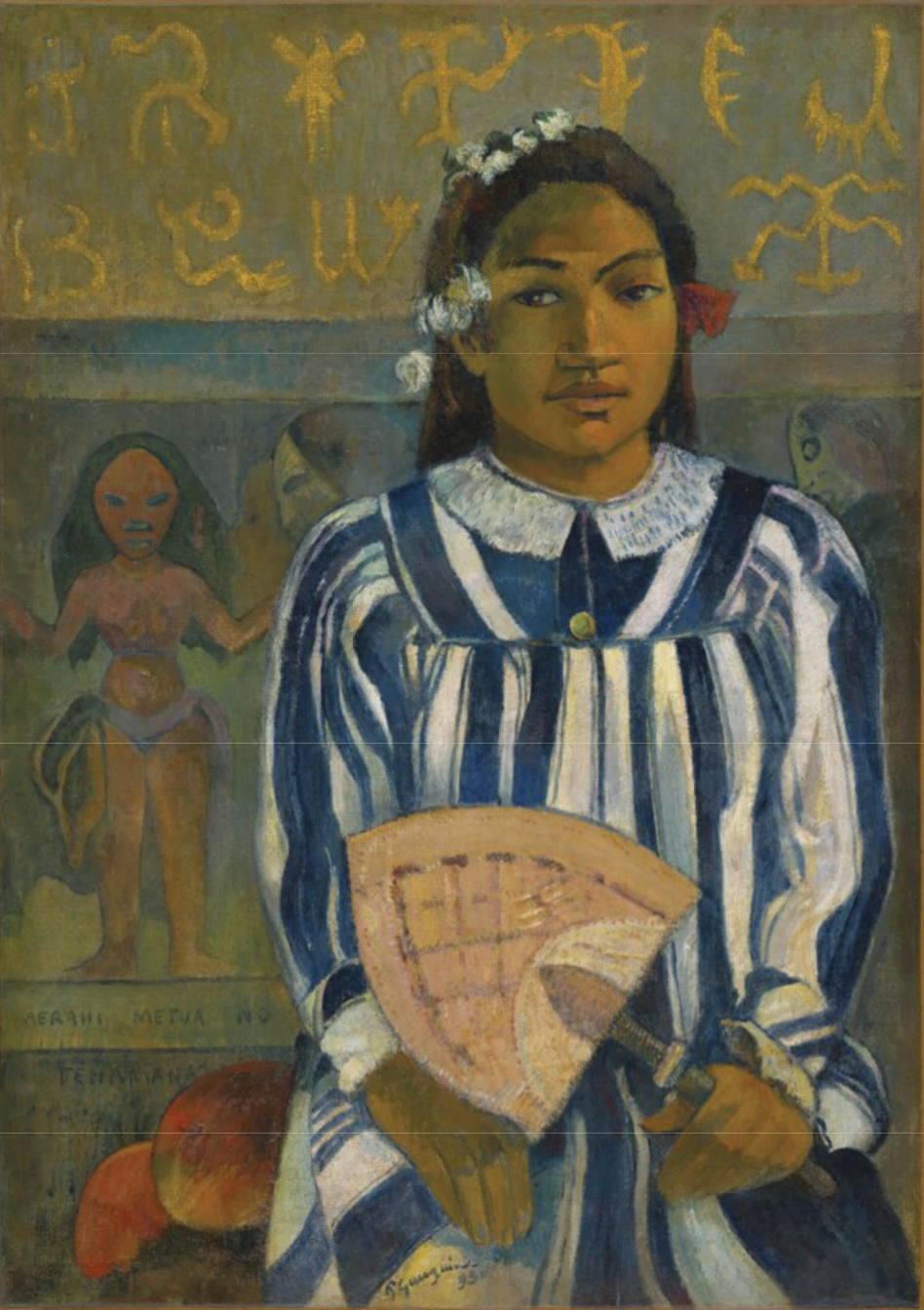
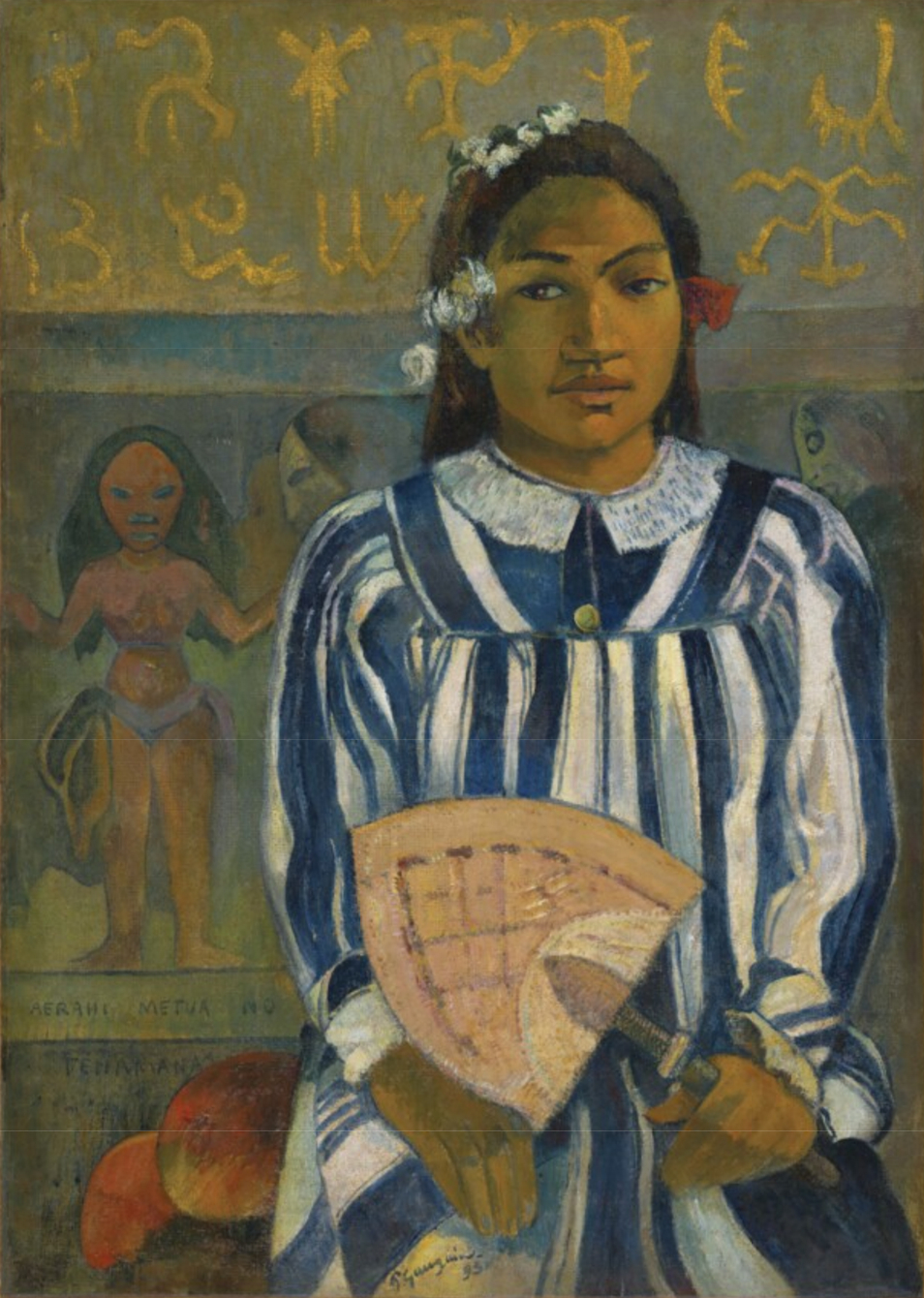
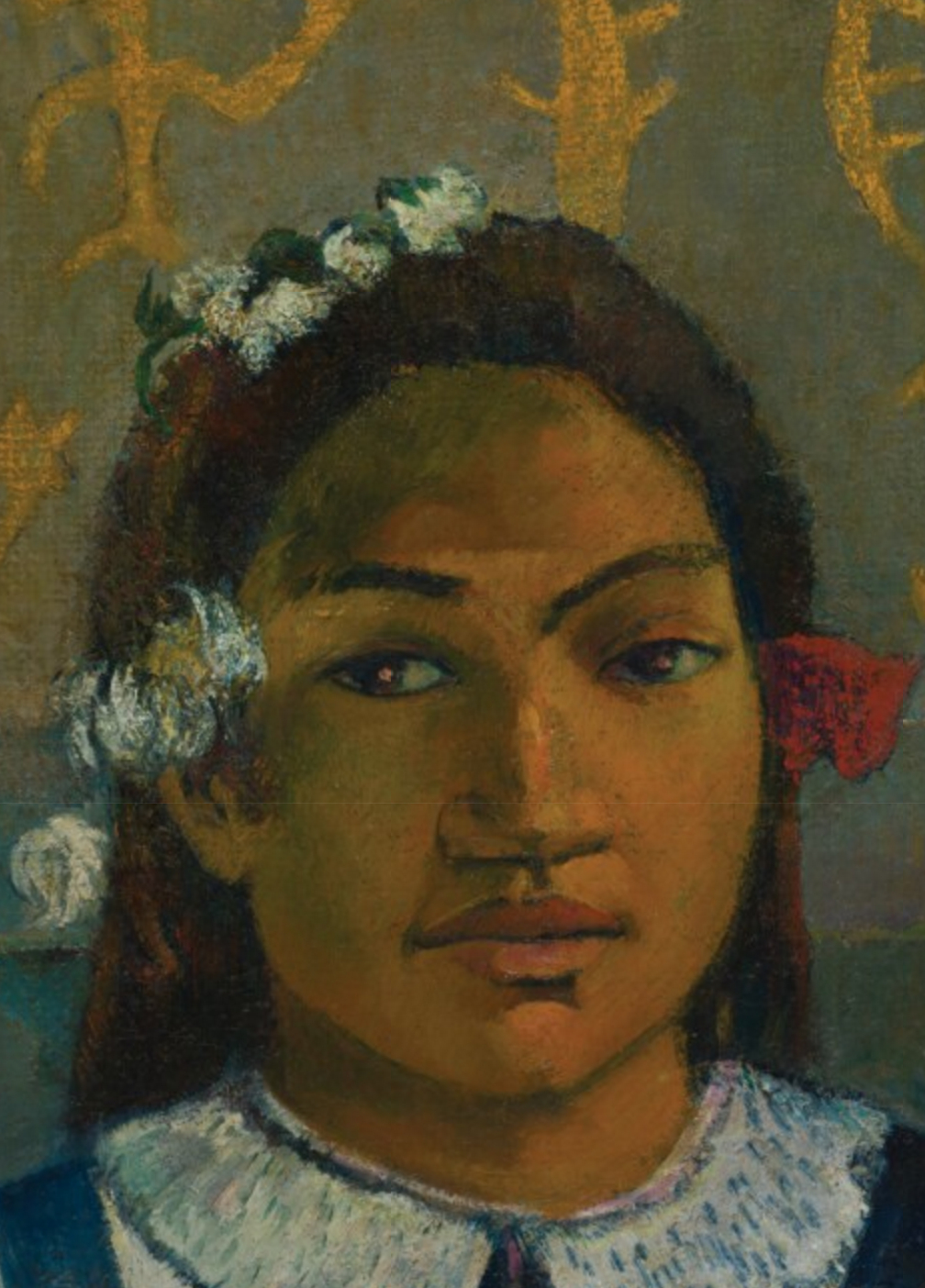
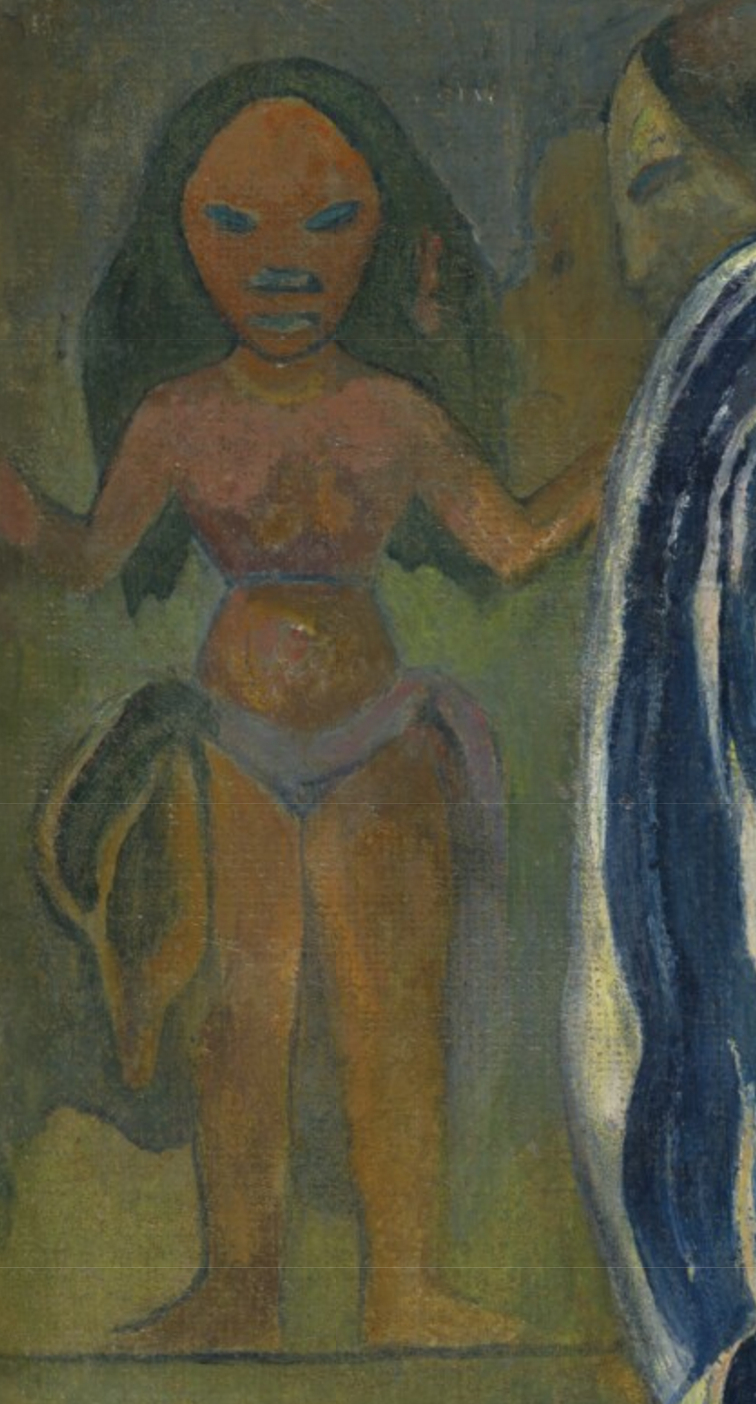
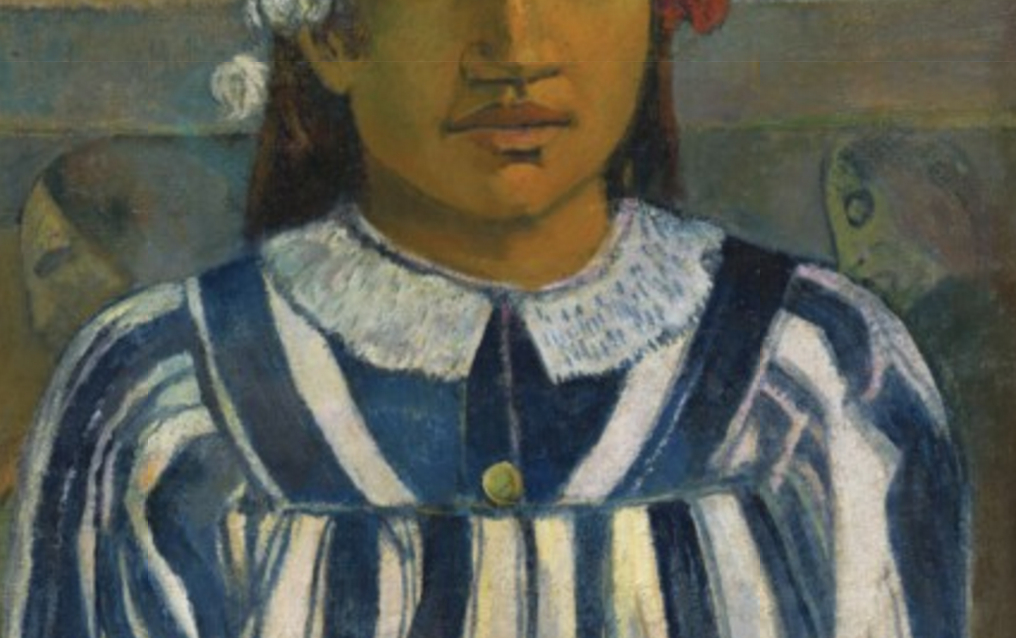
In this portrait, a young Tahitian woman with flowers in her hair holds a plaited fan and wears a long, high-collared dress of the sort imposed by missionaries on the local population. Her regal bearing and slight smile introduce a sense of something profound and mysterious. The frieze painted on the wall behind her reinforces her inscrutability. In the topmost register appear two rows of enigmatic hieroglyphs; below are a full-length figure of Hina (goddess of the moon) and three heads in profile, two above the sitter’s proper right shoulder and one over her other shoulder. Next to the figure, at the lower left corner, are two gold and red-orange mangoes.
Executed near the end of Gauguin’s first sojourn in Tahiti (1891–93), the subject of this painting is the artist’s vahine (lover), Tehamana. We learn the most about how the artist first met the thirteen-year-old, and how their relationship developed, from his semifictionalized account of this period, Noa Noa, Voyage de Tahiti. In Gauguin’s first draft of the manuscript, he explained that he came to meet Tehamana in the village of Faone, about twenty-two miles from where he lived in Mataiea. After talking with many of her family members, he was allowed to take Tehamana back to his home. Gauguin repeats this story in the second draft of Noa Noa, although he changes her name to Tehura. The couple stayed together from 1891 until he returned to France in 1893. In most of the literature, she is described as his wife, and, if the evidence of her fictionalized self in Gauguin’s text is correct, they appear to have had a monogamous relationship.
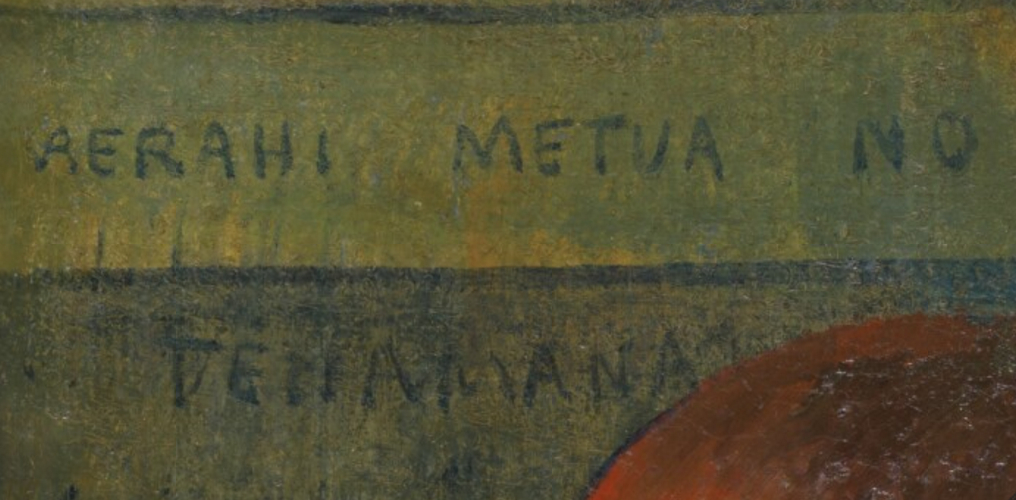
The artist inscribed the title of the painting—Merahi metua no Tehamana—at the lower left. Scholars have translated these words in two prevailing ways. In his important study of Gauguin’s Tahitian titles, Bengt Danielsson argued that Tehamana Has Many Parents would be the direct translation from the Tahitian. His rendering takes on additional significance in light of the fact that it was quite common in Polynesian culture for children to have both birth parents and foster parents. This practice meant that children grew up with an expanded support network. Gauguin described such an arrangement in Noa Noa—when courting Tehamana, he was required to curry favor with both her birth mother and foster mother. Another possible translation of Gauguin’s inscription is The Ancestors of Tehamana, which stems from the French title that accompanied the Tahitian one when the painting was exhibited at the Durand-Ruel gallery in 1893 as Les aïeux de Tehamana. This translation leads to another reading of the painting that focuses on Tahiti’s mysterious spiritual past.
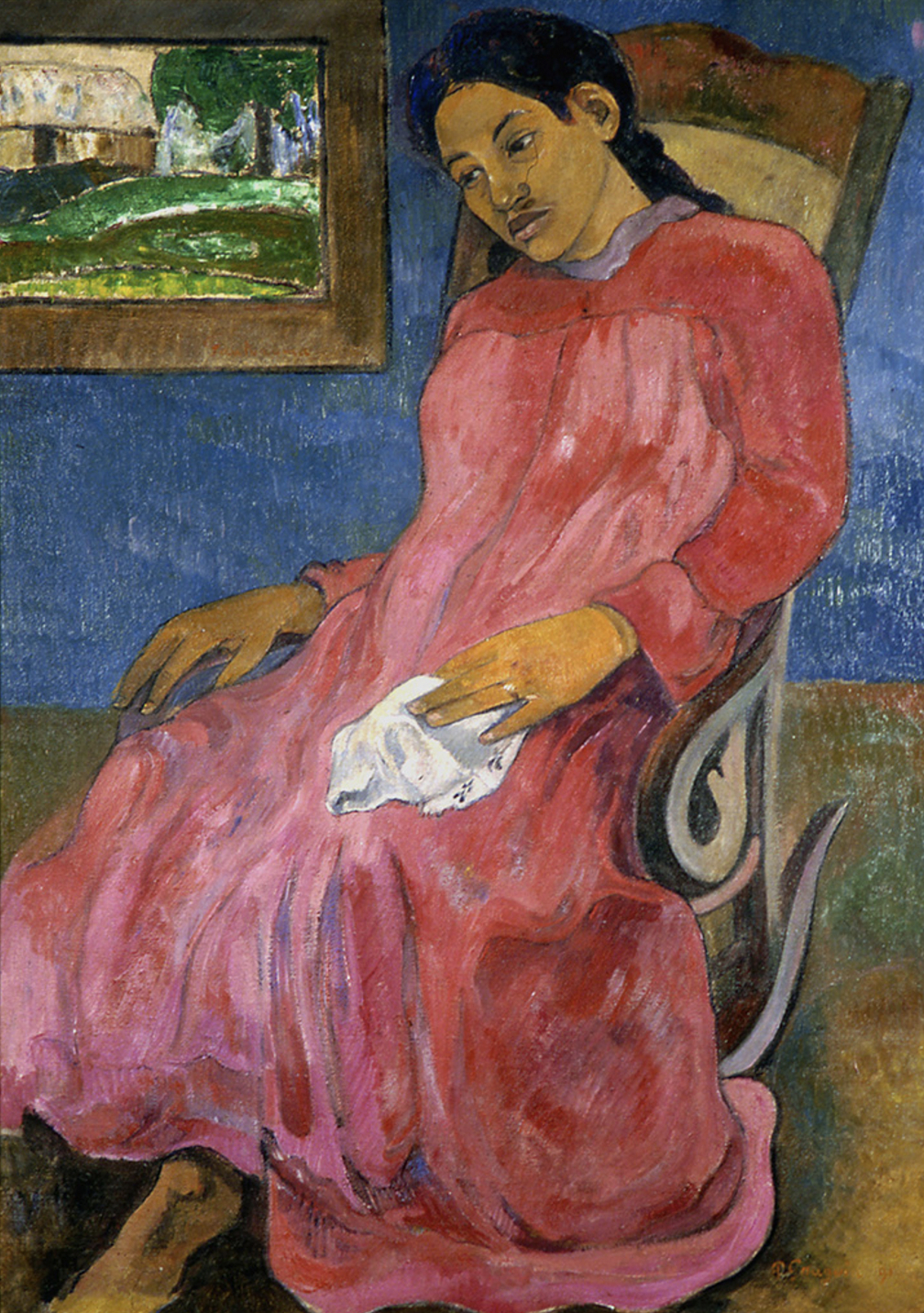
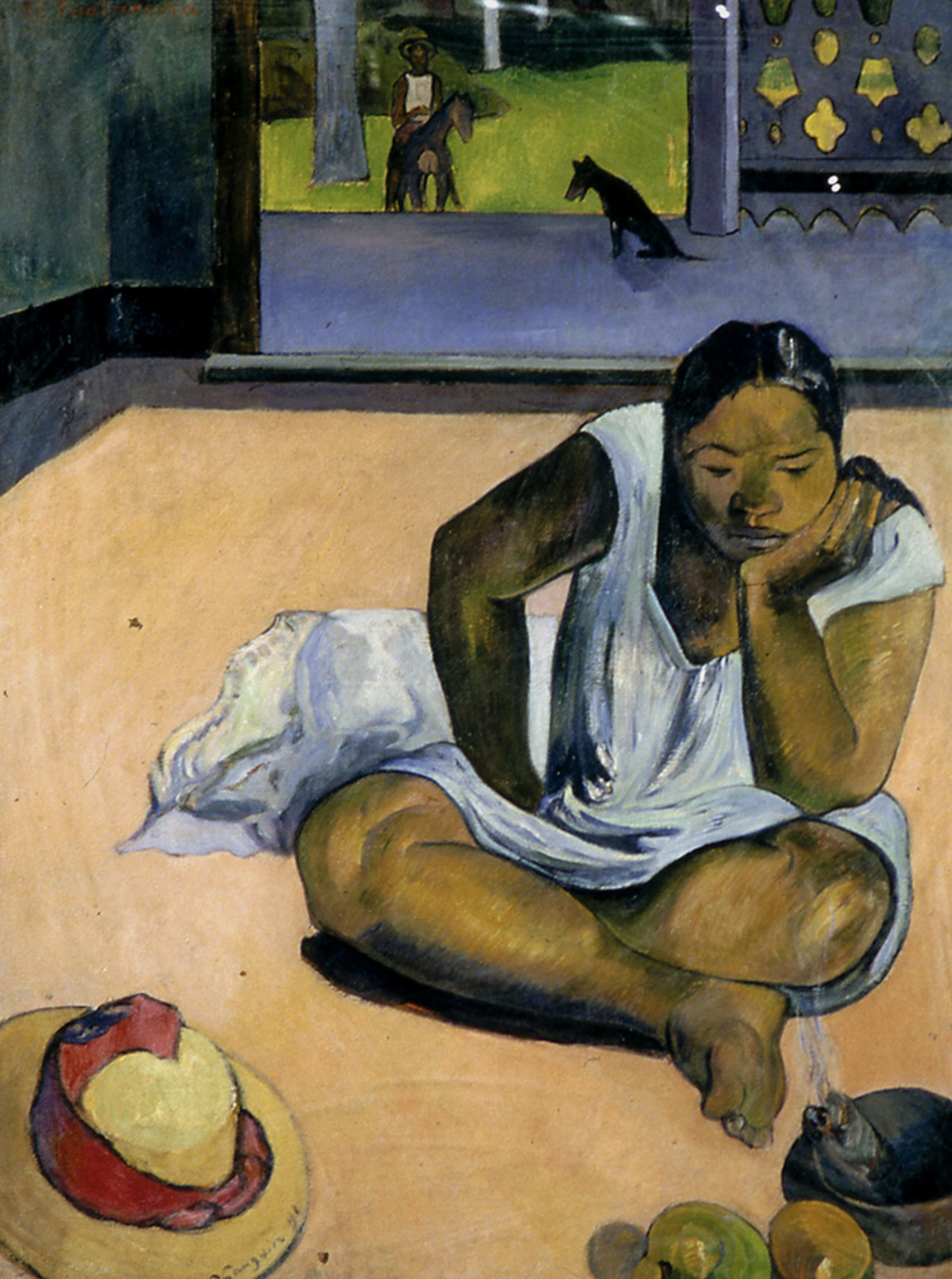
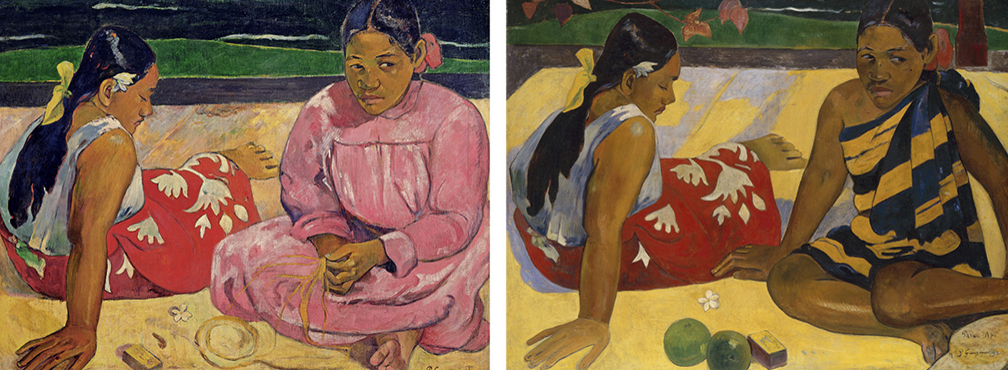
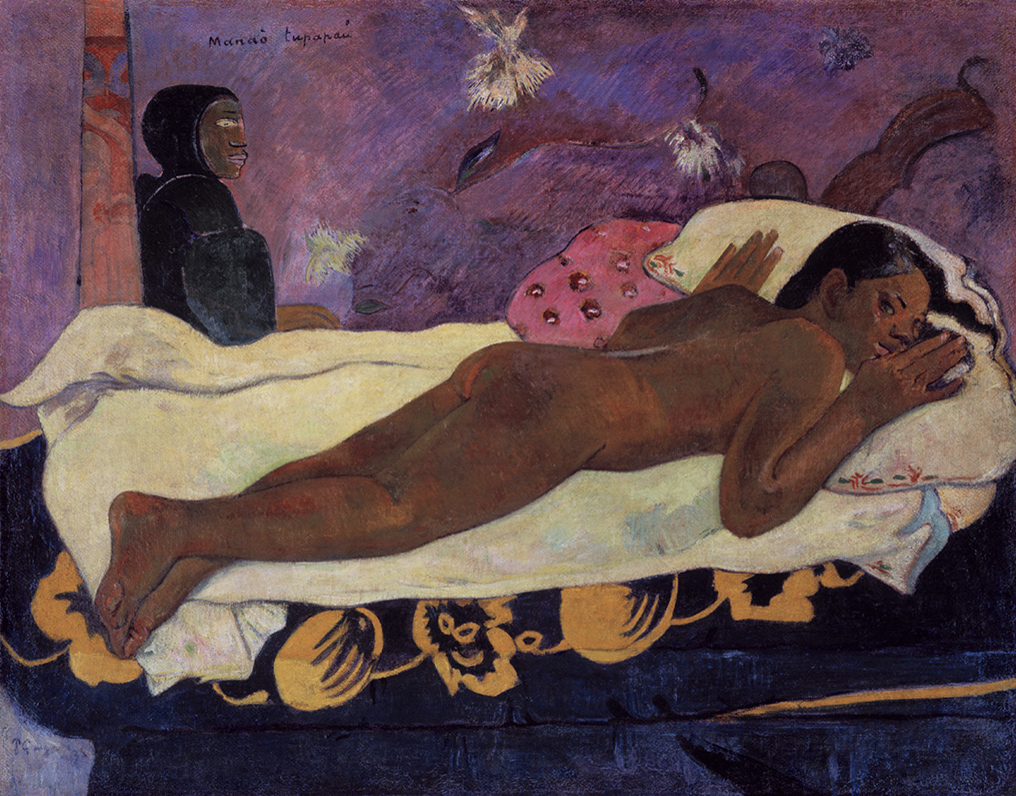
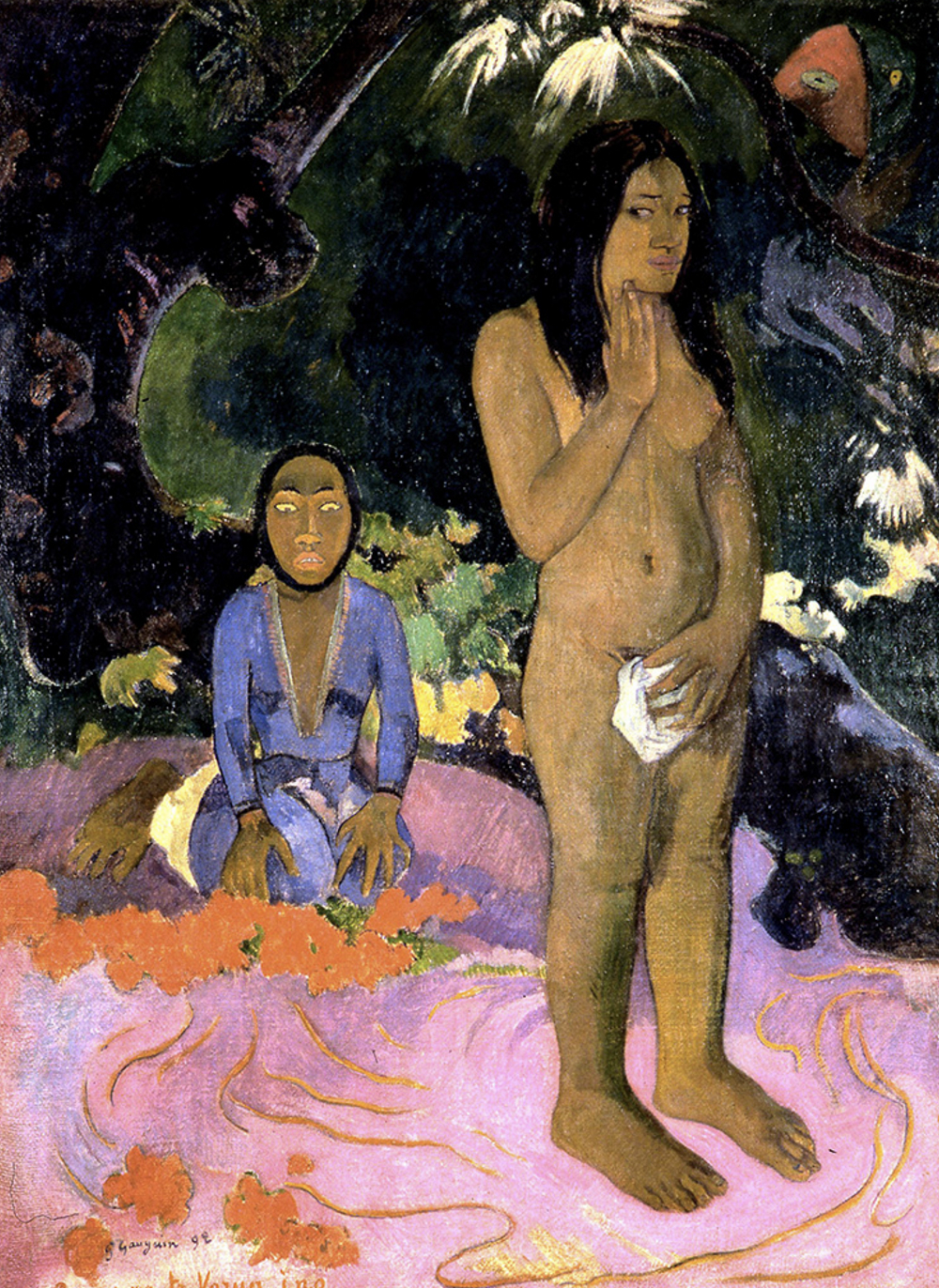
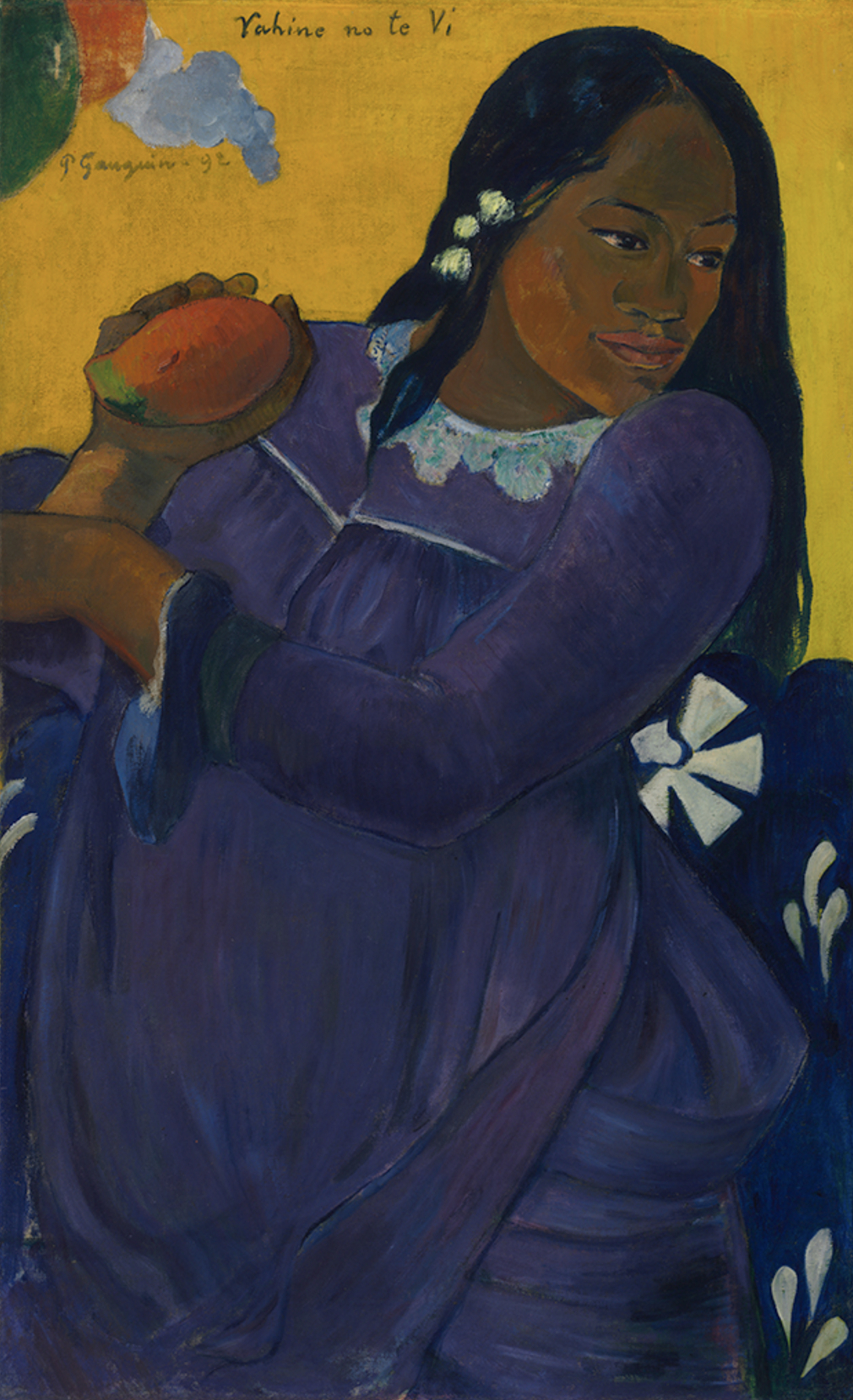
Even though this work is the only one that Gauguin inscribed with Tehamana’s name, many of his most famous paintings of 1891–93 are thought to represent her. It has been suggested that she is the woman in a rocking chair in his 1891 Faaturuma (Melancholic) (fig. 1.53 [[glossary:W] 424]) and that she is was depicted as the brooding woman seated inside a hut in Te Faaturuma (The Brooding Woman) of the same year (fig. 1.22 [[glossary:W] 440]). Tehamana is likely the forward-facing seated figure seen in two almost identical beach scenes, one dating to 1891 (fig. 1.24 left [glossary:W] 434]) and the other to 1892 (fig. 1.24 right [glossary:W] 466]). She is thought to be the recumbent nude in the 1892 Manaò tupapaú (Spirit of the Dead Watching) (fig. 1.25 [[glossary:W] 457]); she may also be the Tahitian Eve in Parau na te varua in o (Words of the Devil) of the same year (fig. 1.31 [[glossary:W] 458]). The figure in Vahine no te vi (Woman of the Mango) (fig. 1.36 [[glossary:W] 449]) may also represent Tehamana. There, set against a background of intense chrome yellow, she is seen holding a mango and wearing a purple missionary dress. Although the women depicted in all of these works bear a striking resemblance to Tehamana as she appears in the Chicago picture, we cannot determine their identities for certain, as in no case do we have the same clear evidence from inscriptions or Gauguin’s correspondence. Further, as Danielsson has suggested, such identifications may be not only impossible but also futile: while it may be “tempting to try to determine which other pictures she posed for. . . . the result of such an investigation . . . is both unsatisfactory and unreliable, because Gauguin was seldom interested in producing photographically accurate portraits.”
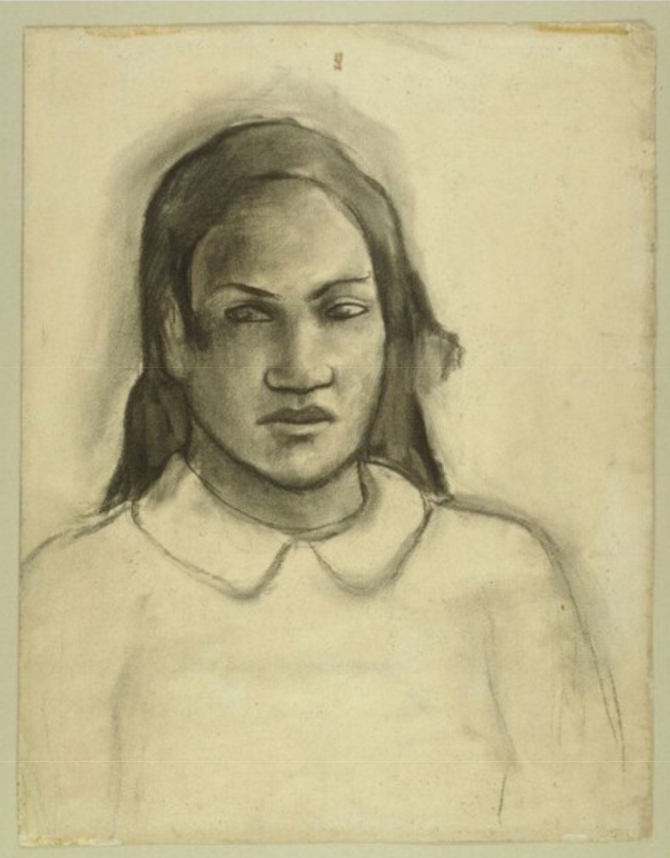
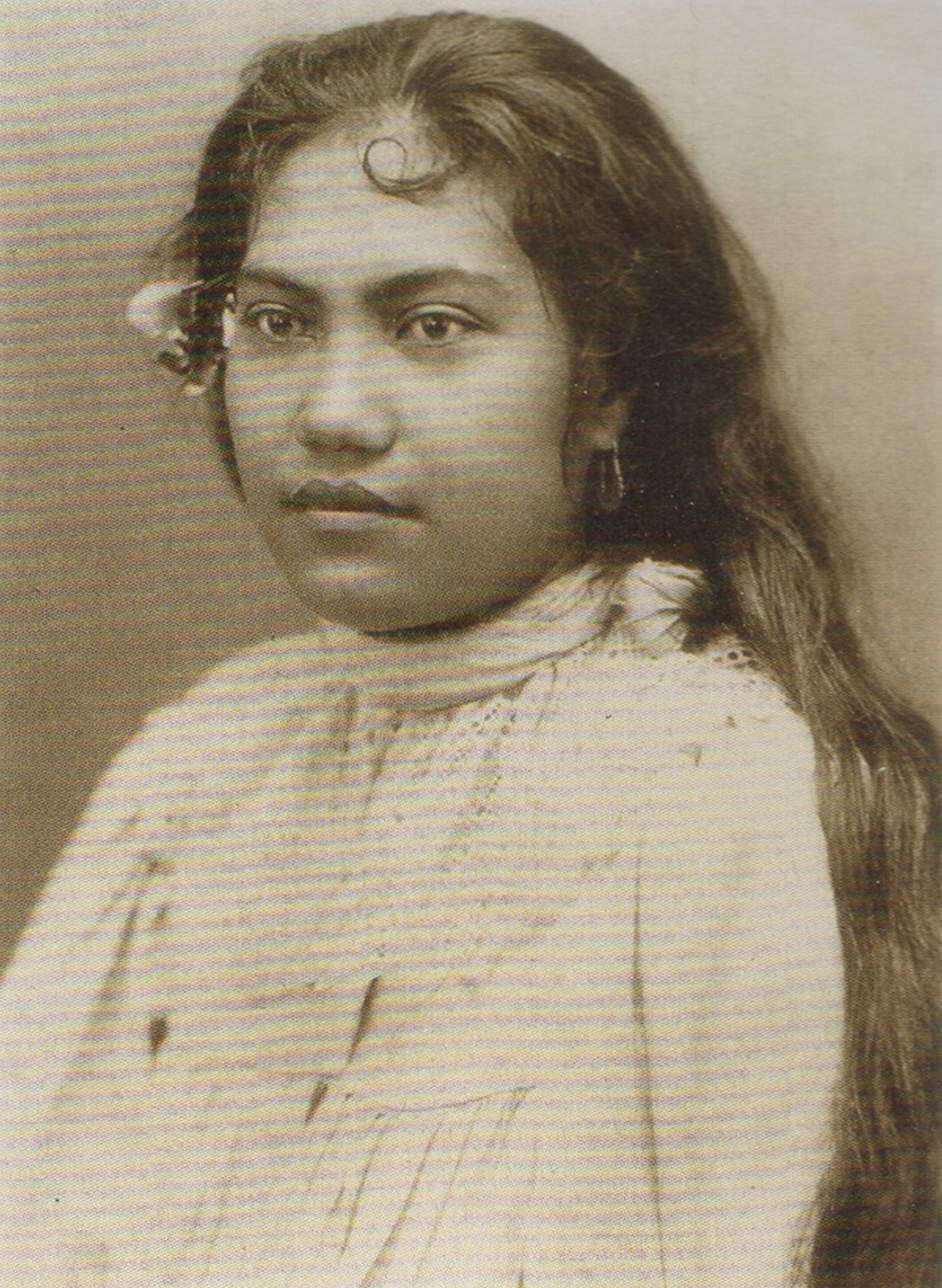
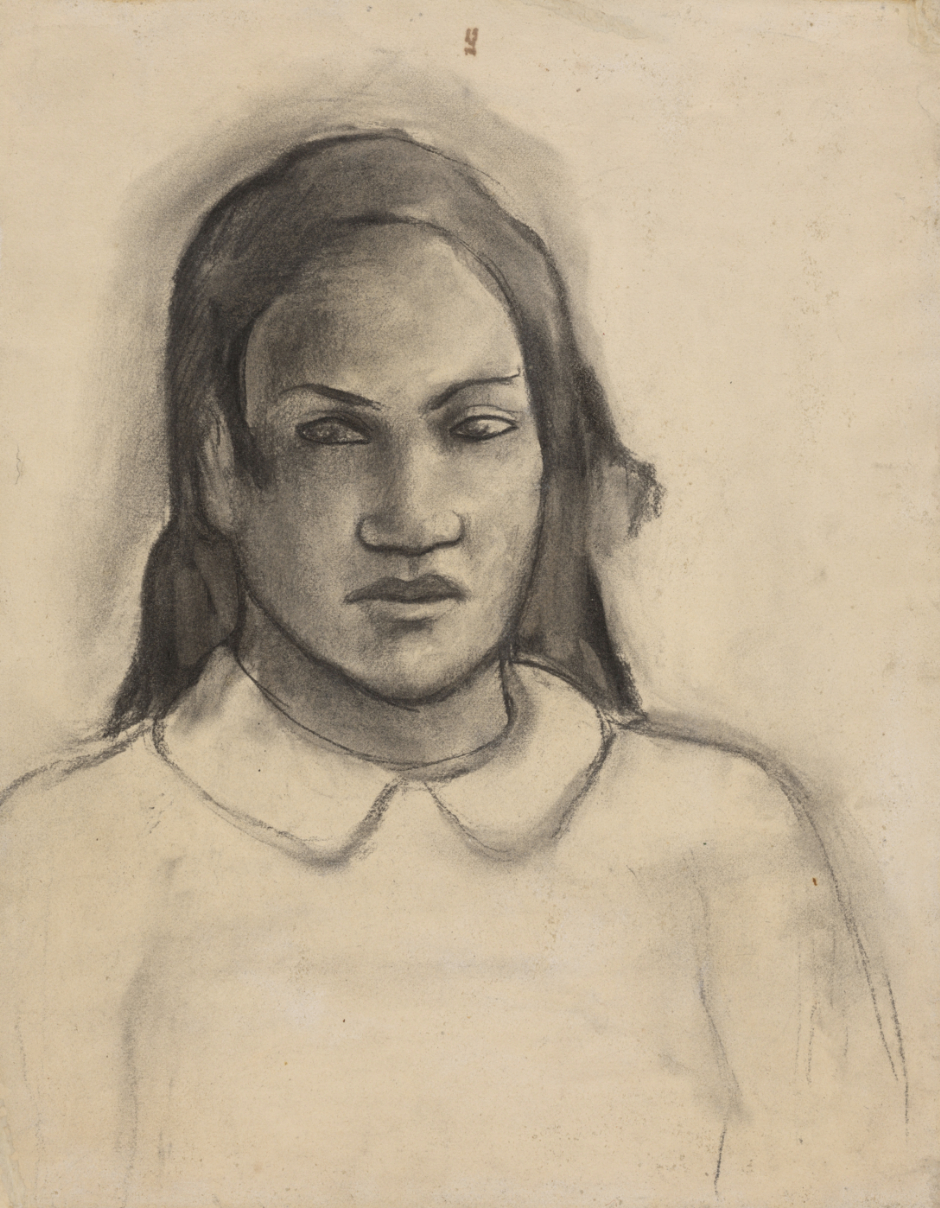
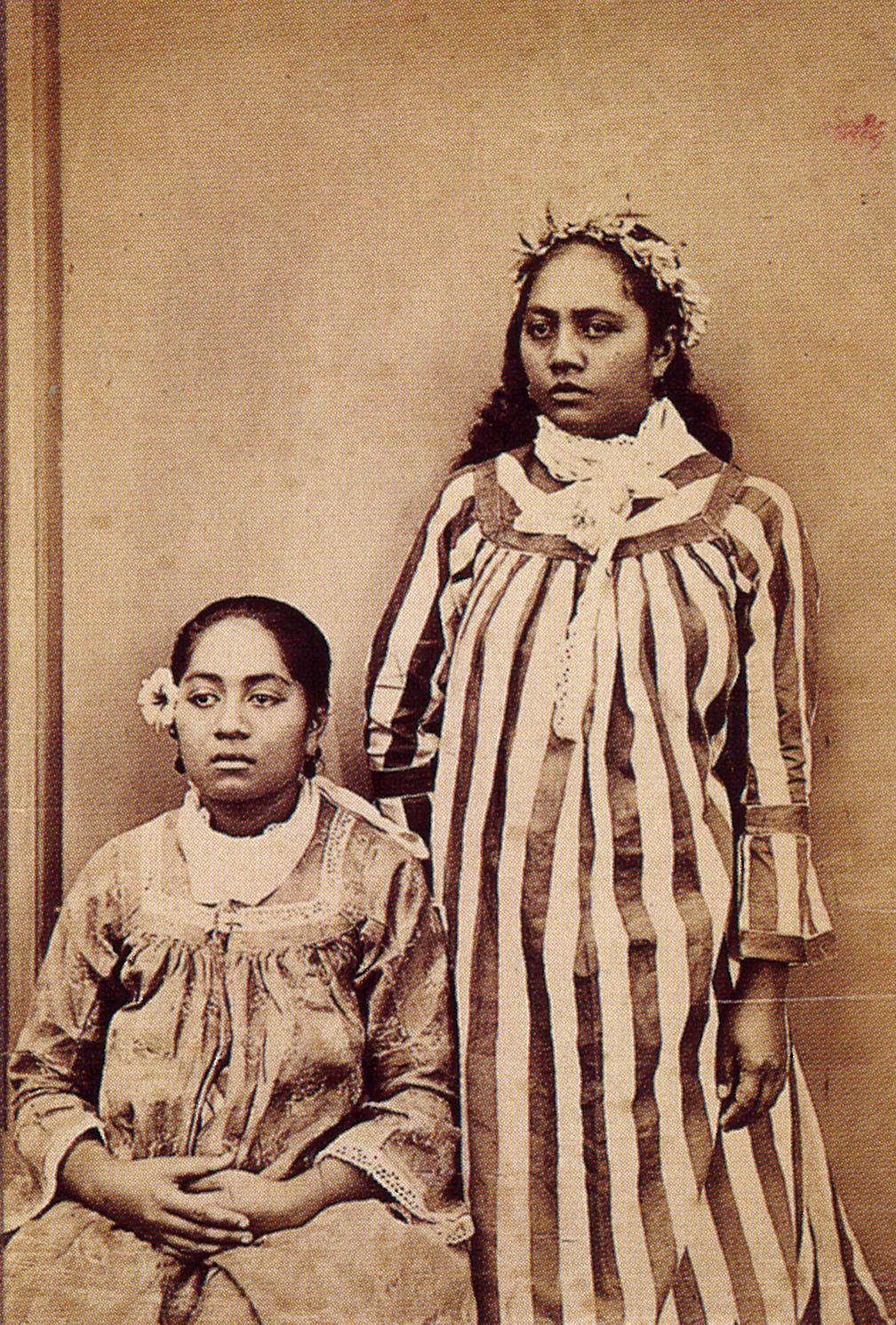
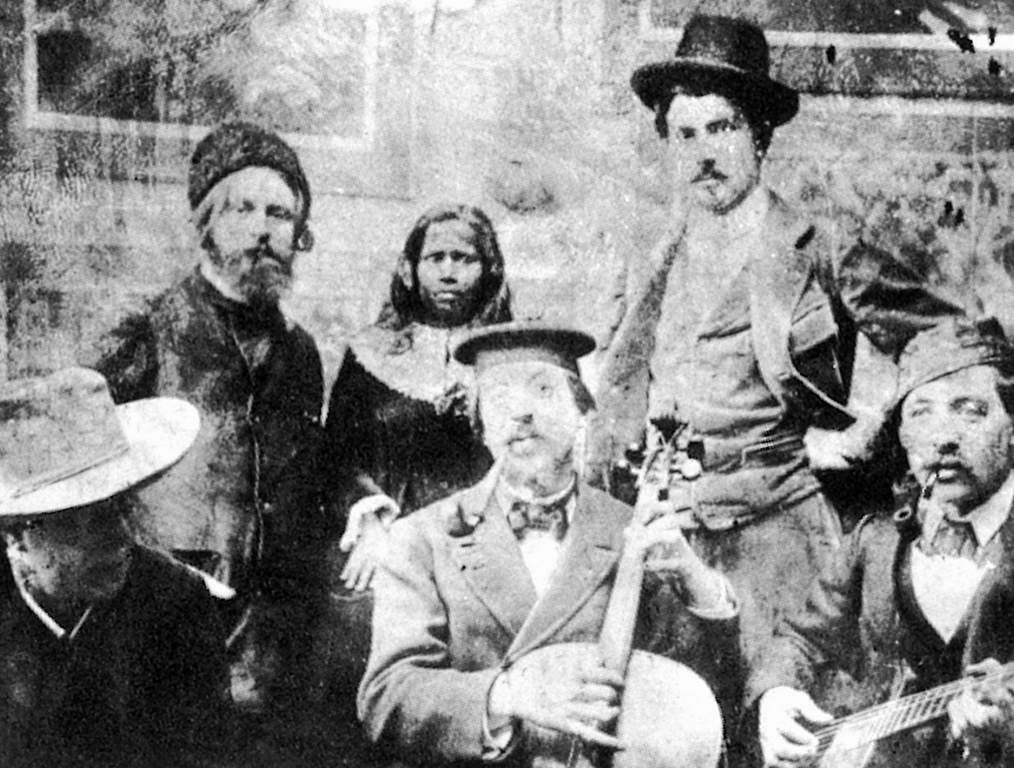
Tehamana remains one of the most puzzling mysteries of Gauguin’s first sojourn to Tahiti. The literature on Gauguin is filled with references to her, although he never mentioned her by name in any of his correspondence. In an attempt to determine her appearance, several scholars have sought to identify figures in Tahitian photographs of the period as Tehamana based on their resemblance to the young woman in the Chicago work and those in the paintings previously mentioned. One such photograph (fig. 10.59) was published in a facsimile edition of Noa Noa. However, since there seems to be no concrete evidence that the subject was Tehamana, and she could merely resemble the individual depicted in the Chicago painting, this has lead some scholars to question the picture’s relevance. Indeed, no other surviving photographs can be firmly identified as showing Tehamana, so we cannot be sure what she looked like. Even Gauguin’s description in Noa Noa, which describes her as having “slightly fuzzy hair [that] grew like a bush,” is not an exact match to the figure we see in the Chicago painting. In addition, a drawing of a young woman (also held by the Art Institute) exhibits features that resemble those in the portrait (fig. 10.60 [cat. 49] [[glossary:Rewald] 75]), but the faces are not identical: the model in the drawing possesses a slightly narrower face and higher forehead (see Technical Study). Moreover, none of the other drawings from 1891–93 that represent females with similarly round faces can be easily related to the sitter in the present painting.
When considering Gauguin’s art and writing, one must always bear in mind that he was a raconteur who purposefully, and creatively, wove scenarios with strands of reality and fantasy. Before he introduced Tehura in Noa Noa, he mentioned various encounters with women in Papeete (where he stayed until he departed for rural Tahiti to live alongside natives), including the mixed-race Titi and the androgynous Vaïtua. Gauguin wrote that, once he was settled in Mataiea, he painted the portrait of a female neighbor “of pure Tahitian lineage,” but not without difficulty. He described the session, saying that when he tried to sketch her “enigmatic smile,” she fled the room only to reappear one hour later “clad in a beautiful gown with a flower behind her ear.” For him she was a study in contrasts: a woman who was “not very pretty but attractive in a different way” and who expressed “fear of the unknown and the misery of bitterness mixed with pleasure, offering submission and then revealing a dominatrix in its wake.” It was her dual nature, as he saw it, that he wished to capture. “I invested in the portrait that which my heart allowed my eyes to see, and perhaps more so, what my eyes alone could not: the intense blaze of a repressed force. . . . And even the flower behind her ear was under the spell of her fragrance.” The description he provided evokes the way Tehamana appears in the Chicago painting, with her enigmatic smile and hair decorated with flowers.
The Meaning of the Dress
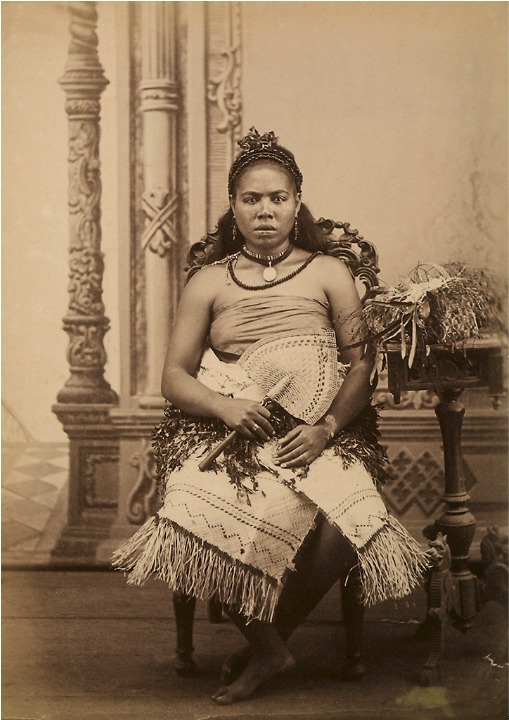
While Gauguin’s biographer David Sweetman refers to the type of outfit Tehamana wears here—which covered a woman from her neck to below her knees—as a “shapeless Mother Hubbard,” most scholars call it a missionary dress. All agree that Christian Europeans, who colonized Polynesia in the early part of the nineteenth century, introduced the costume: encouraging indigenous women to conceal their nudity, they provided the cheap printed cotton cloth from which the dresses were made. In Gauguin’s Noa Noa, Tehura chose to wear such a dress, thinking of it as European finery that was essential to respectable self-presentation. His description of how she prepared for Sunday Mass reflects her adaptation of the Western toilette to Tahitian circumstances: “She washed her hair with soap, dried it in the sun and finally rubbed it with aromatic oil. Wearing a gown [presumably a missionary dress] with one of my handkerchiefs in hand, a flower behind her ear and barefoot, she headed to the Temple, repeating the psalms that she would later recite.” Judging by nonnative photographers’ many images of Tahitian women posing in missionary dresses (see, for example, fig. 1.56), Tehura was perhaps not alone in her preferences.
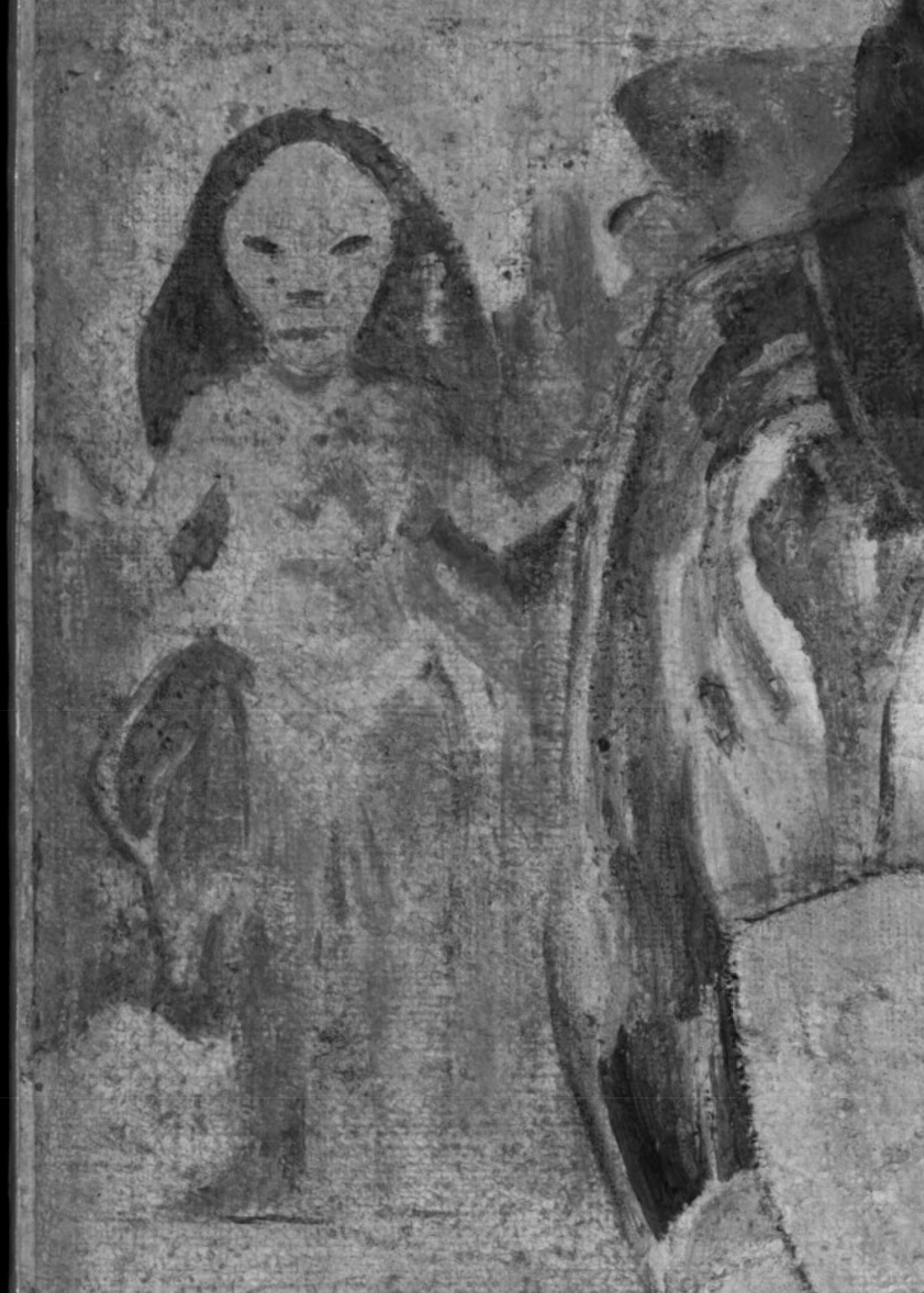
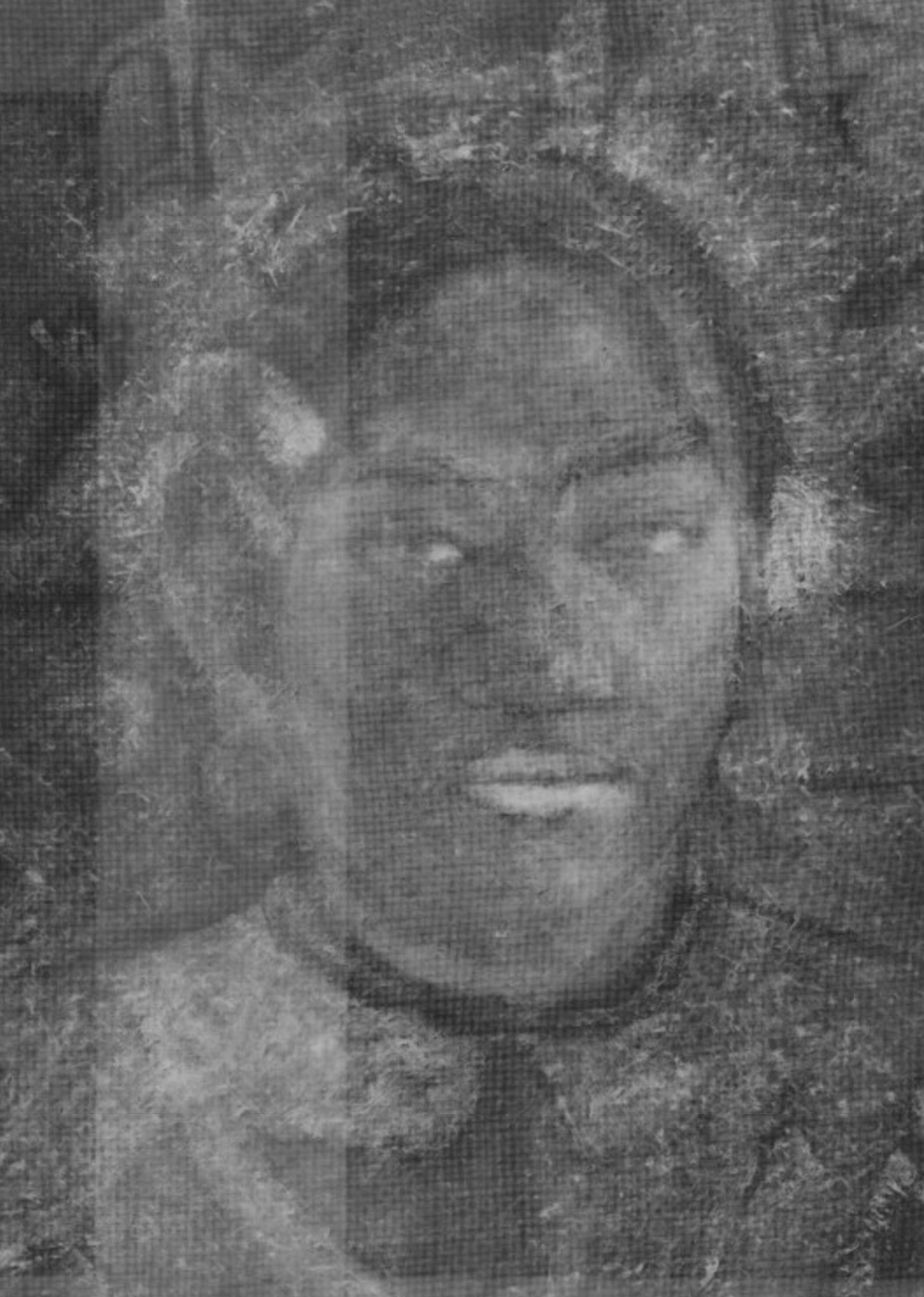
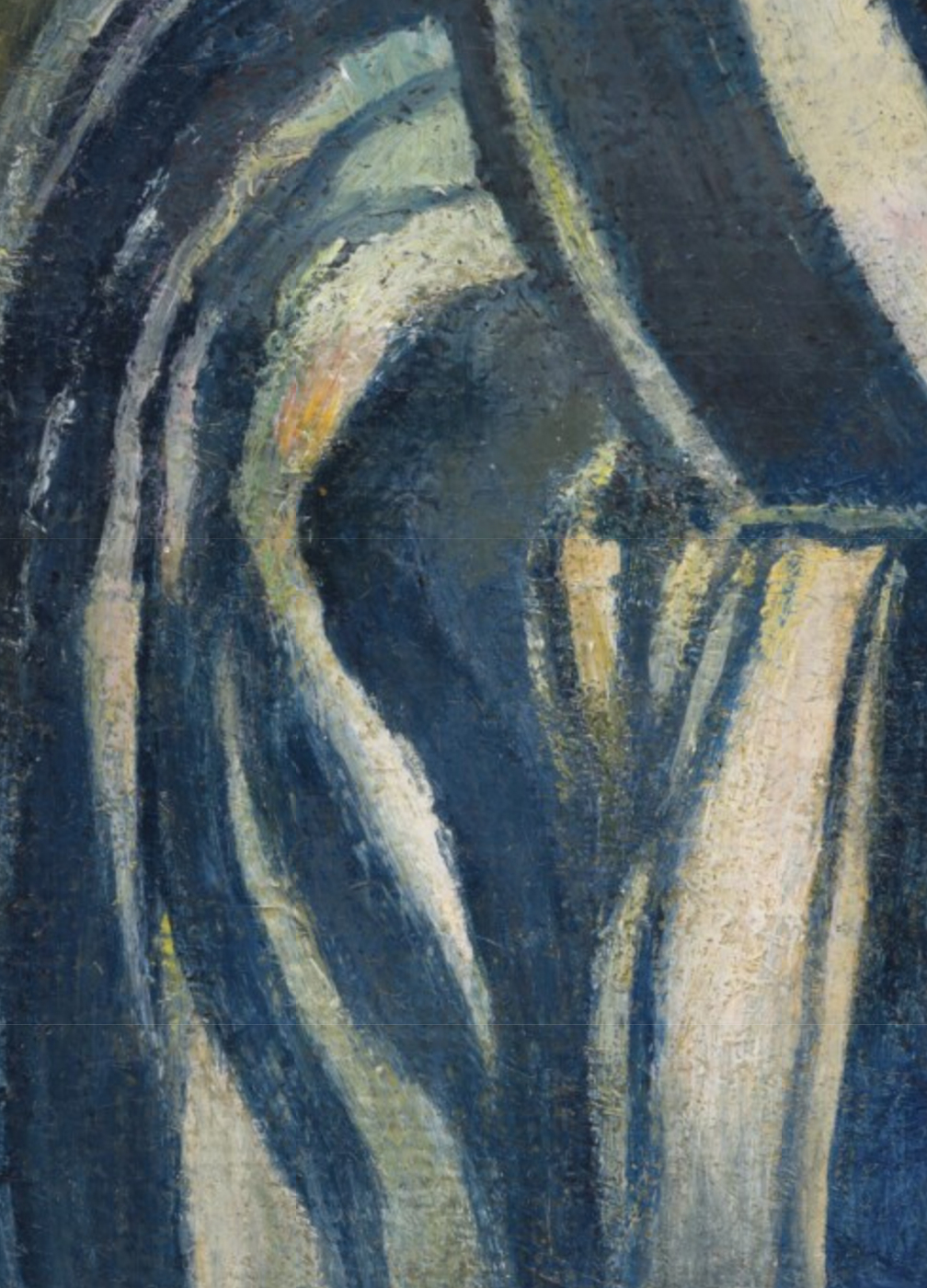
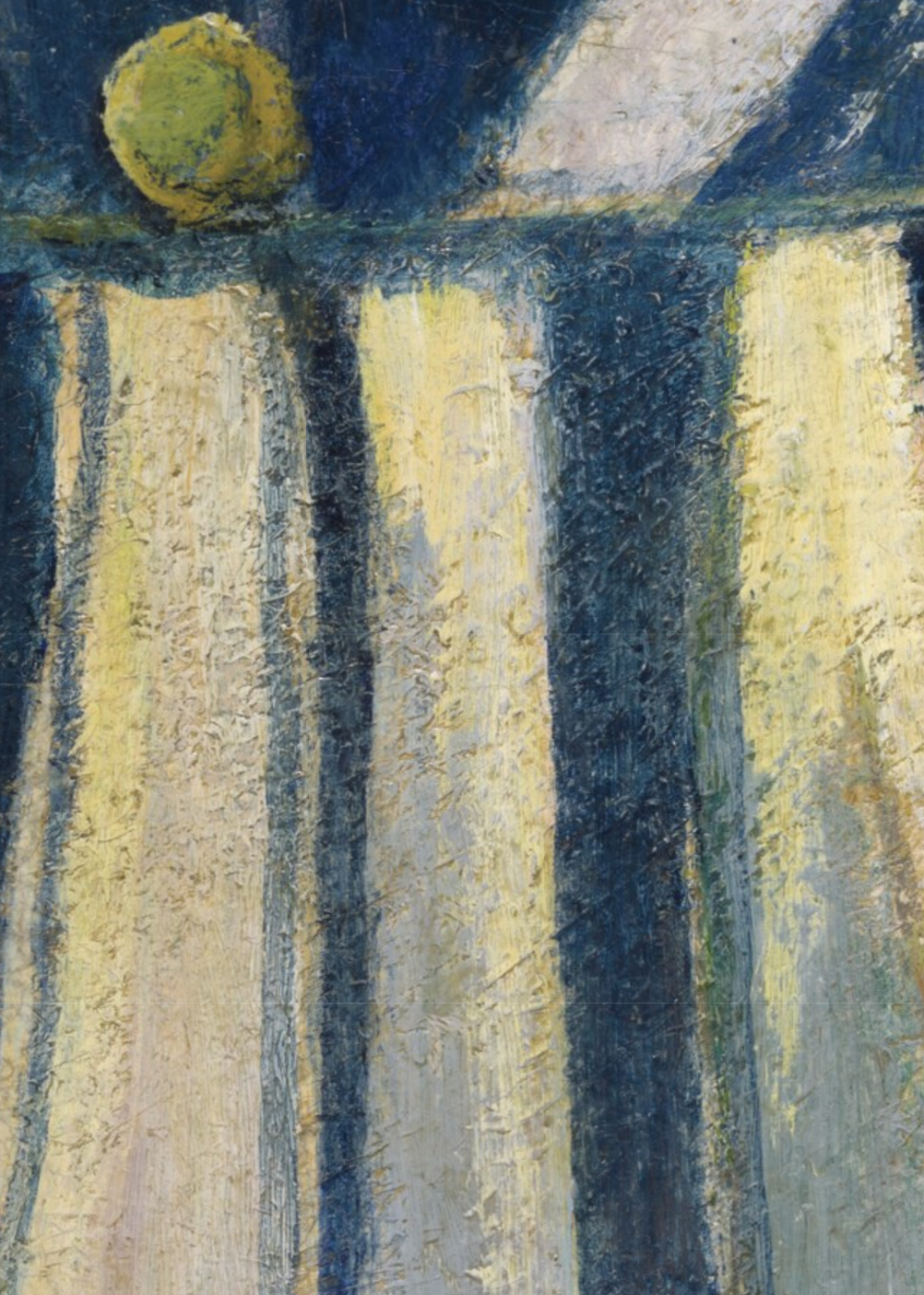
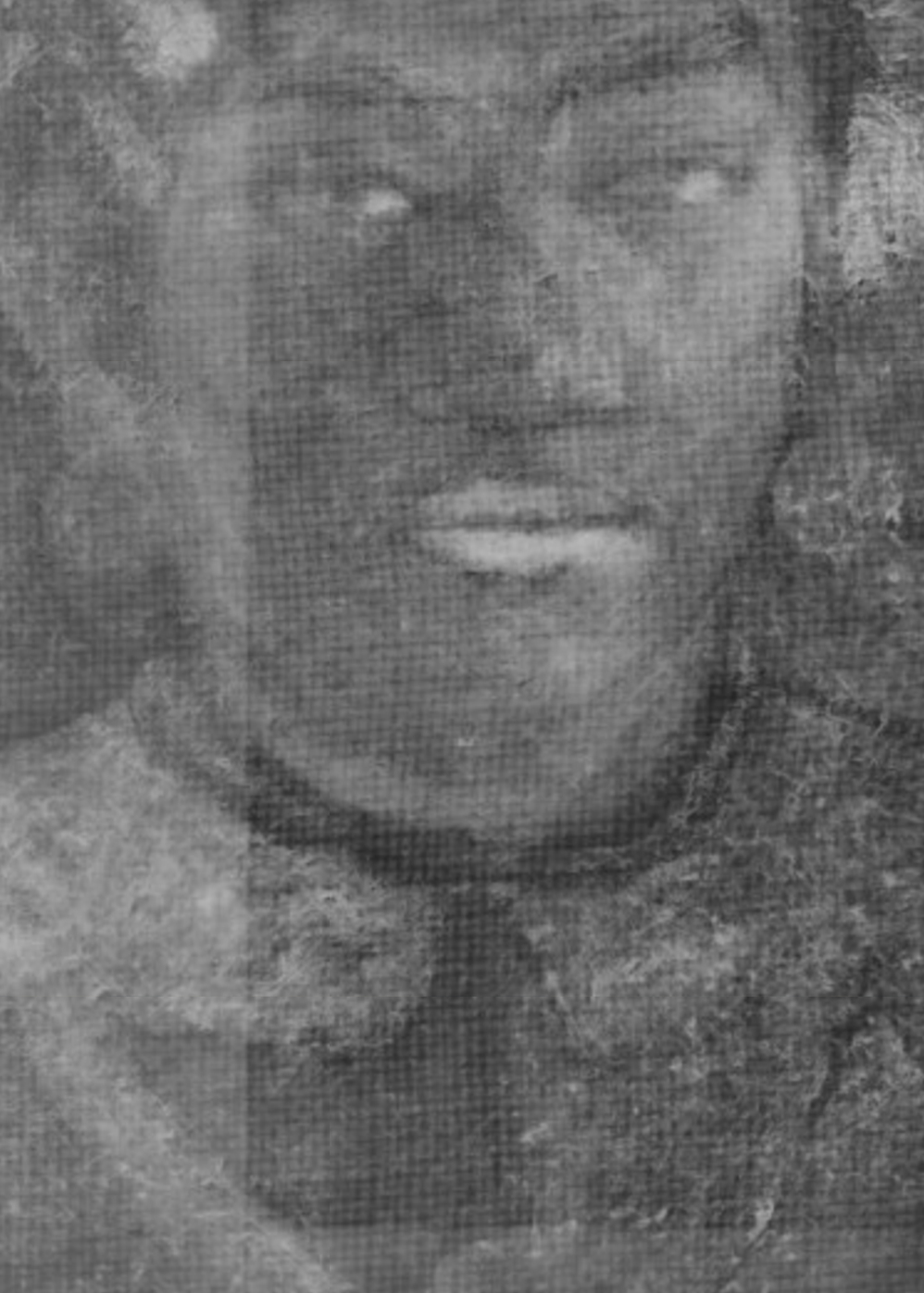
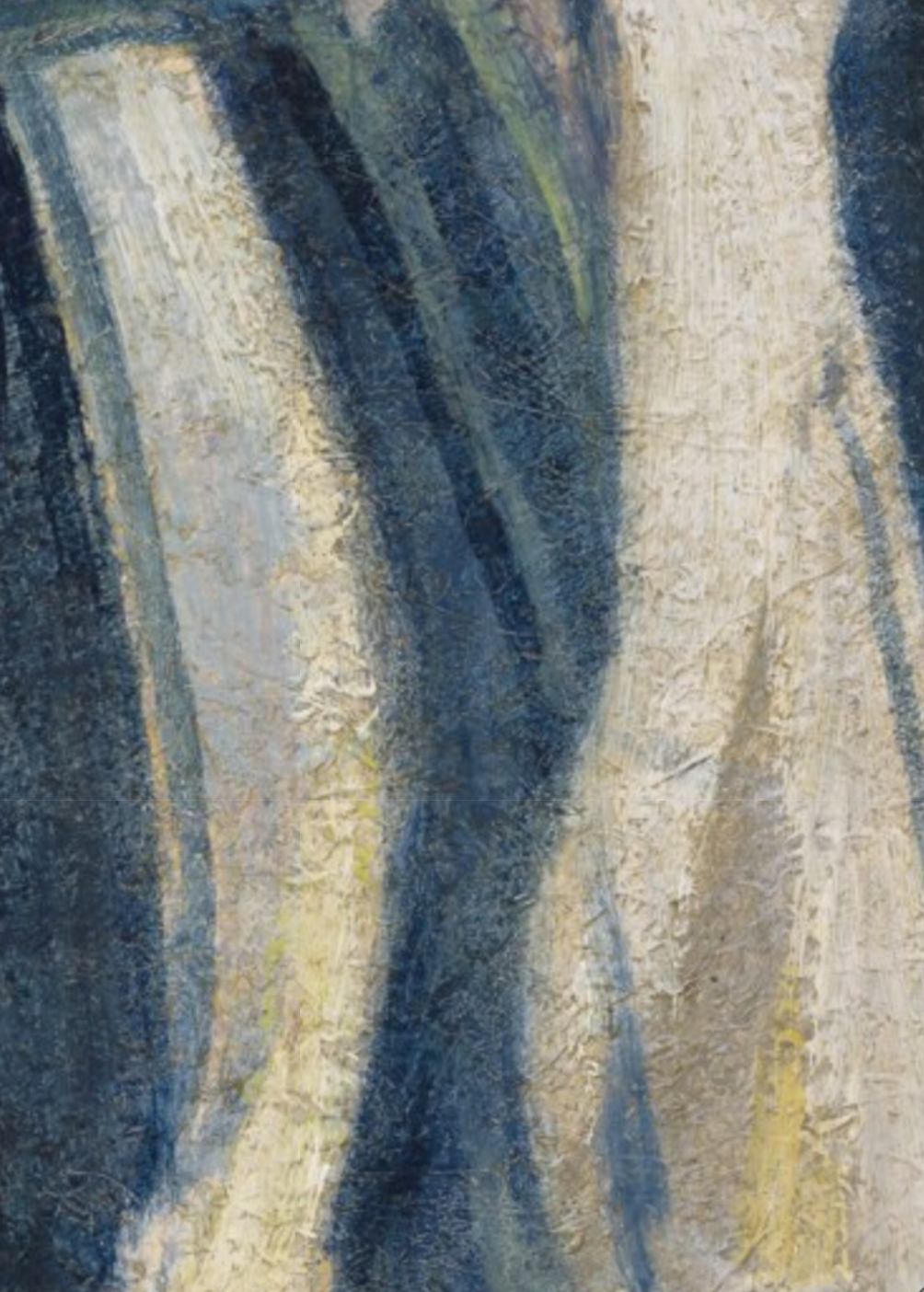
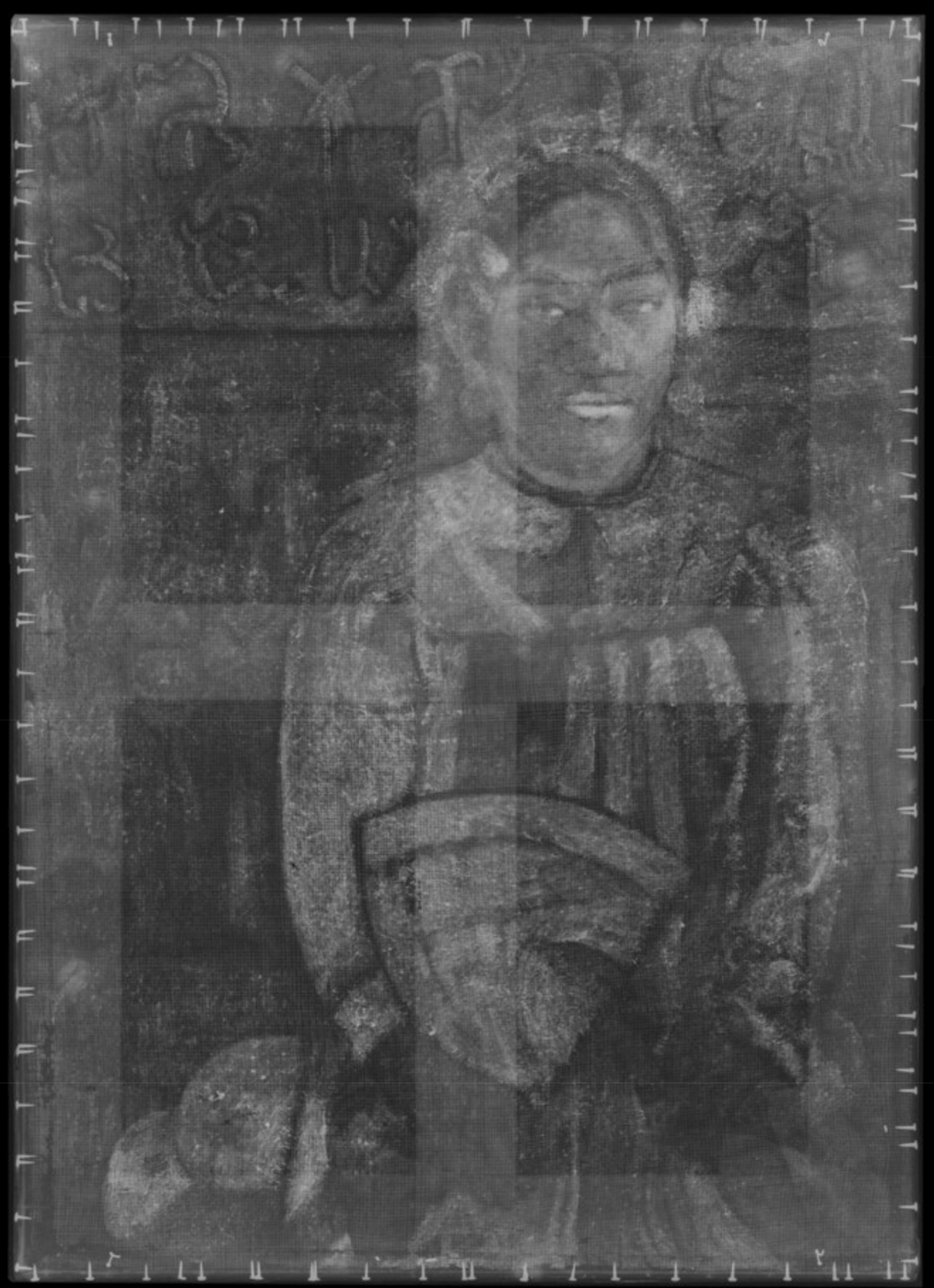
While Gauguin was clearly intent upon capturing in the Chicago portrait what he saw as his beloved’s unfathomable character, he seems to have been equally taken with her attire. The artist carefully delineated the garment's construction using large bands of color. He used multiple colors and washes to represent both the white and blue stripes in a variety of curving shapes and sizes, which together transform the dress into the major source of pictorial electricity in this otherwise somberly composed painting (see Technical Study). The large, yellowish (perhaps metal) button (or small brooch) stands out against the field of blue and white, serving to draw viewers’ attention to the decorative collar. Tahitian women, according to Sally Helvenston Gray, “used the yoke as a showcase for embroidery and lace and attached decorative lace collars and cuffs to their Mother Hubbards.” Gray’s point is that these collars were not purely decorative—they both highlighted a wearer’s technical skills and helped to individualize her dress. In Noa Noa, Gauguin describes Tehura’s momentary desire for another kind of decorative finery: a pair of copper earrings. As the episode unfolds, she demands that he purchase the earrings, but he protests, “This is madness! I will not pay twenty francs for this garbage!” After a tearful negotiation, Gauguin concedes and buys them, but, to his dismay, she all but forgets them just two days later. An [glossary:X-ray] of the Chicago painting (fig. 1.52) reveals that the artist originally included two circles, possibly intended as earrings, which he later covered by extending Tehamana’s hair (see Technical Study). If they indeed represent earrings, these elements are worth consideration in light of this story.
In Noa Noa, Gauguin offered a generalized take on the Tahitian woman, likening her to a “Black Venus,” a term he happily offered as a violation of Western notions of classical beauty. “She is so masculine,” he wrote, “that to many she seems brutal and offensive: so much so, that another painter in the same environment with a passion for the “truth” would have concealed this Black Venus’ dangerous charm, because her model denies our very own.” While Tehamana’s loose-fitting European dress was intended to cover her body, in a way the traditional pareu did not, Gauguin made sure its stripes define the curves of her form and the swell of her breasts beneath the cloth. And her eyes, alive with reflections of firelight—as Gauguin wrote in Noa Noa, “fluorescent sparks seemed to flow from her stare”—become windows onto what the artist imagined to be her true, primal nature.
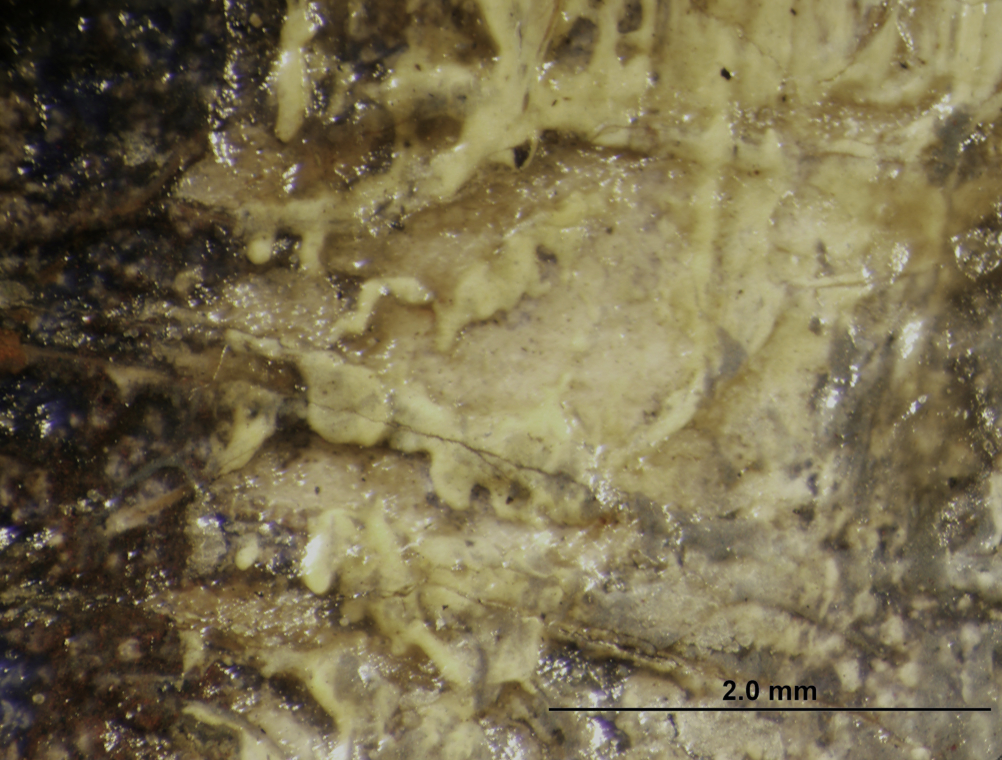
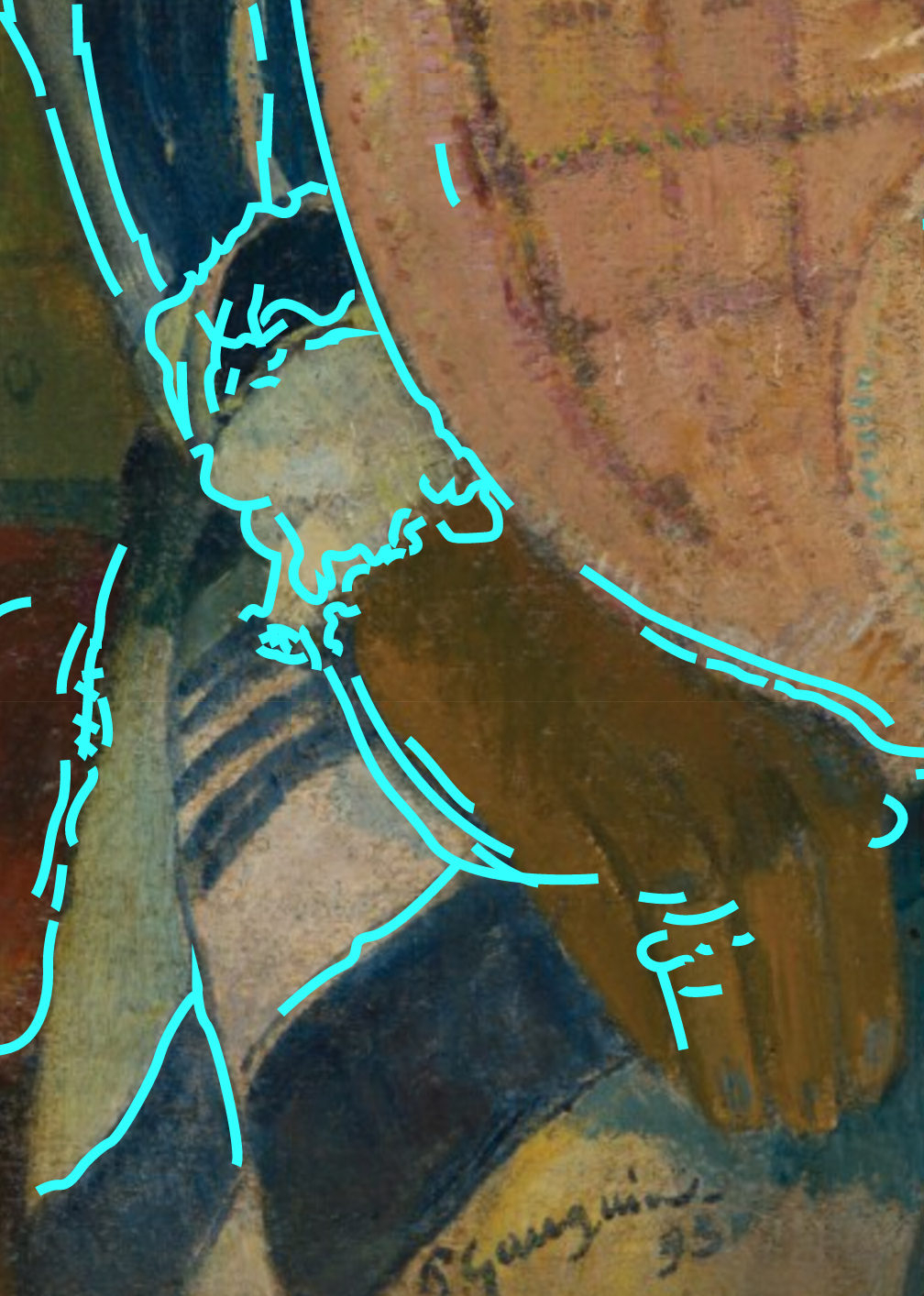
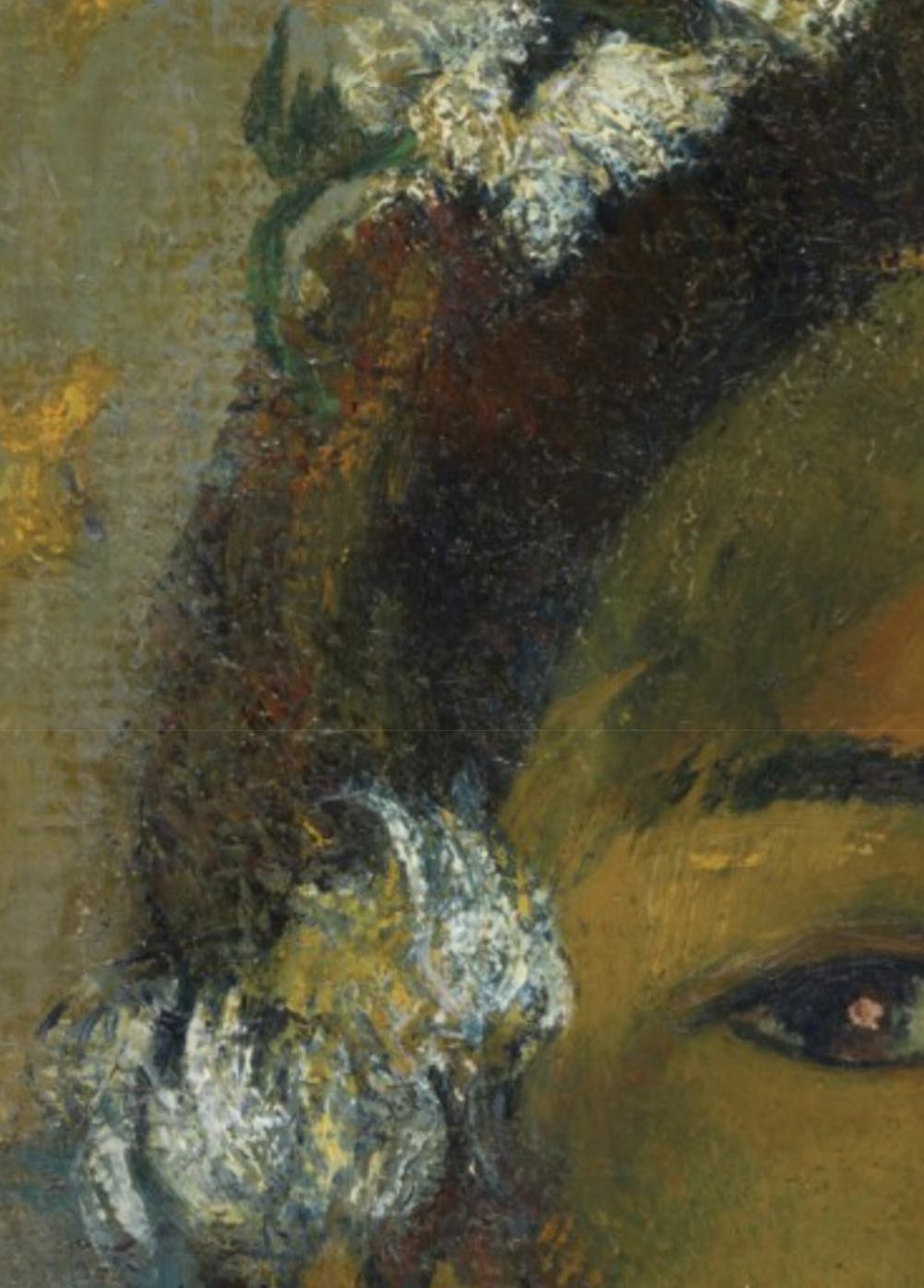
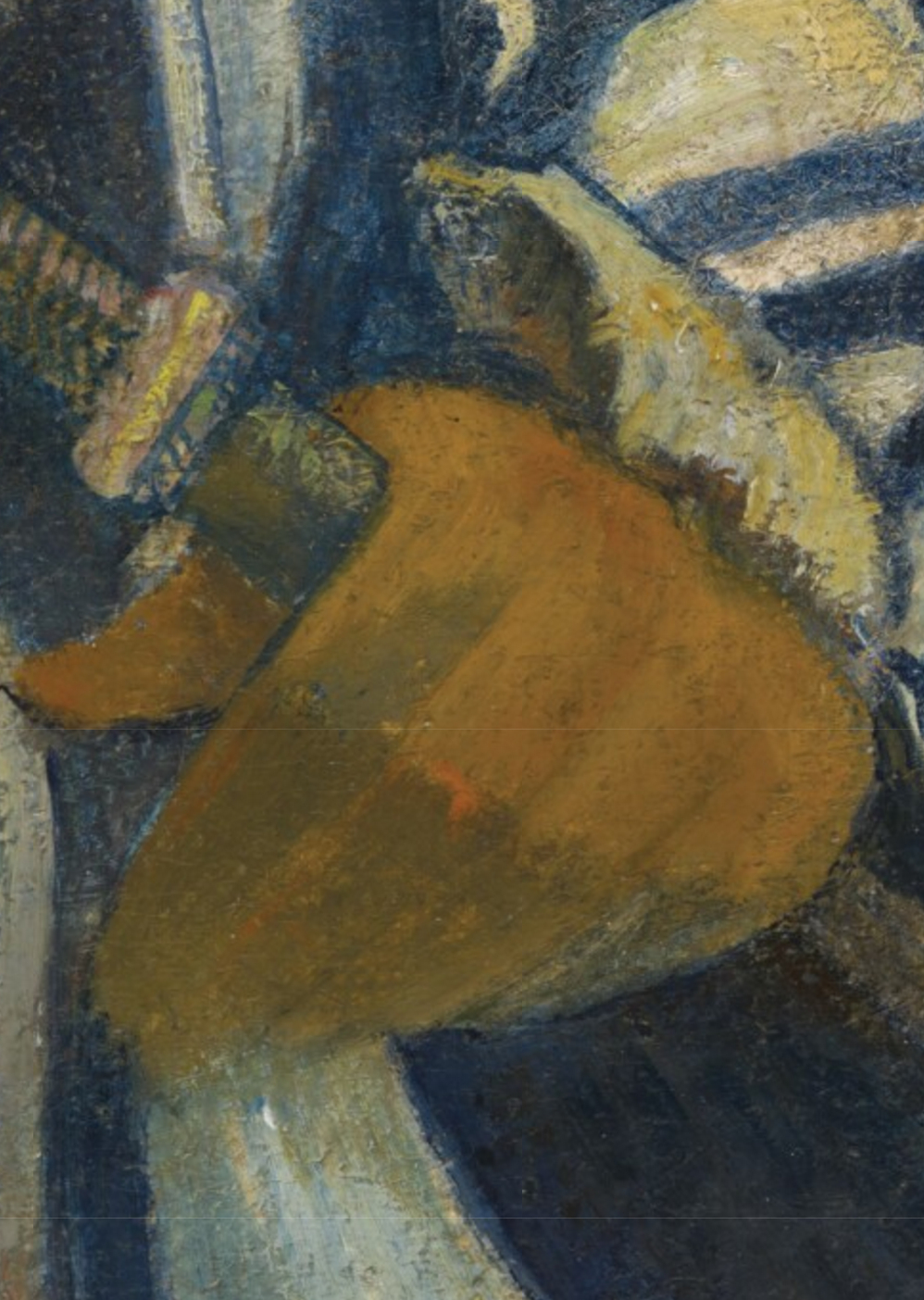
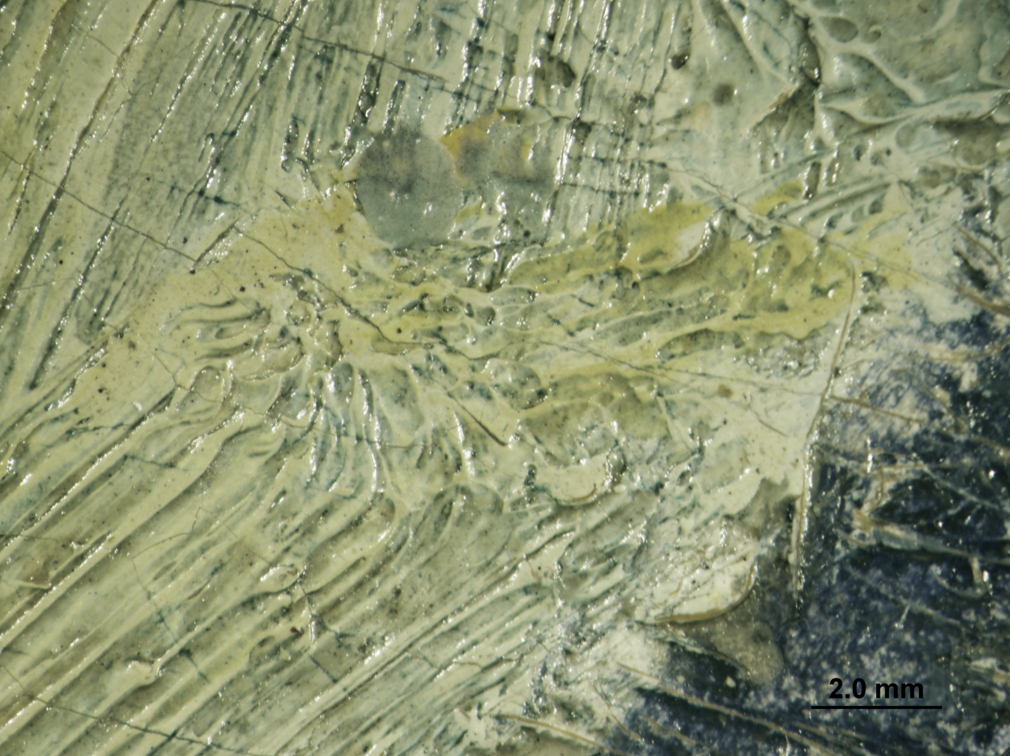
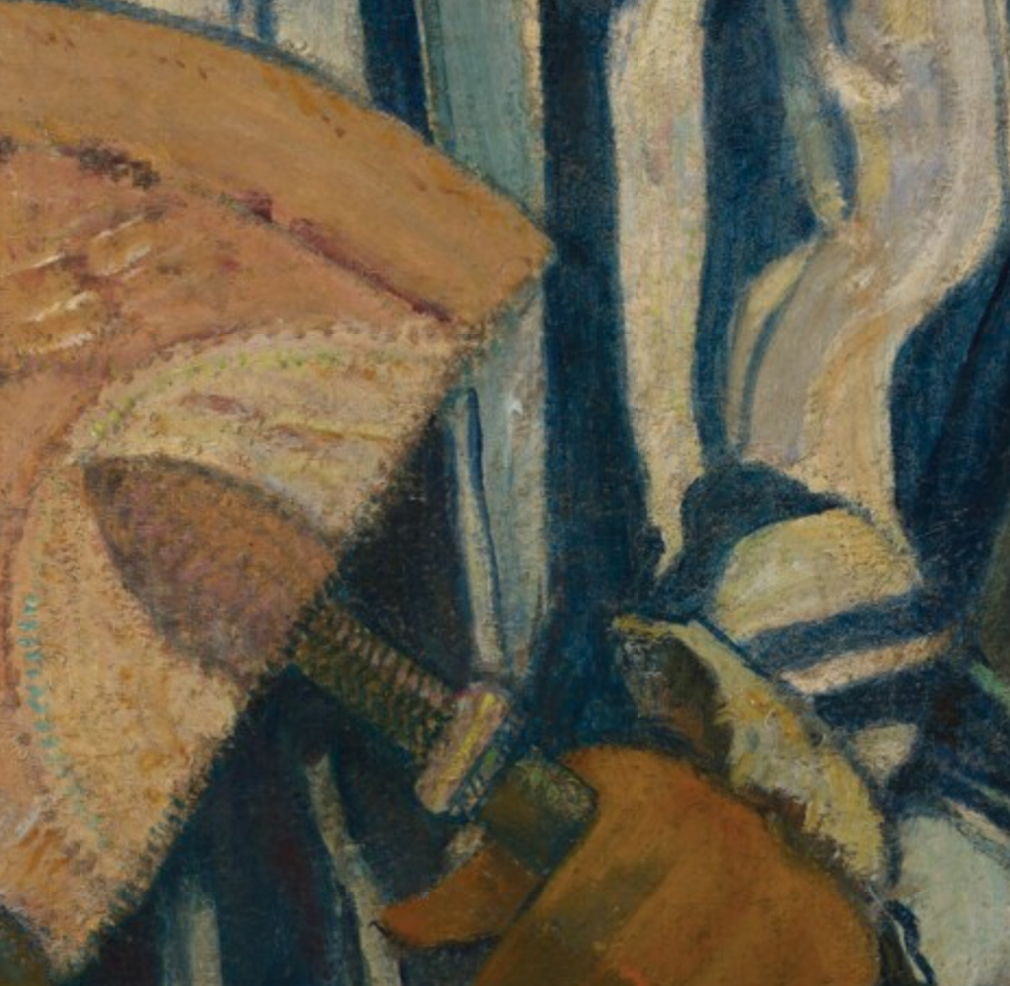
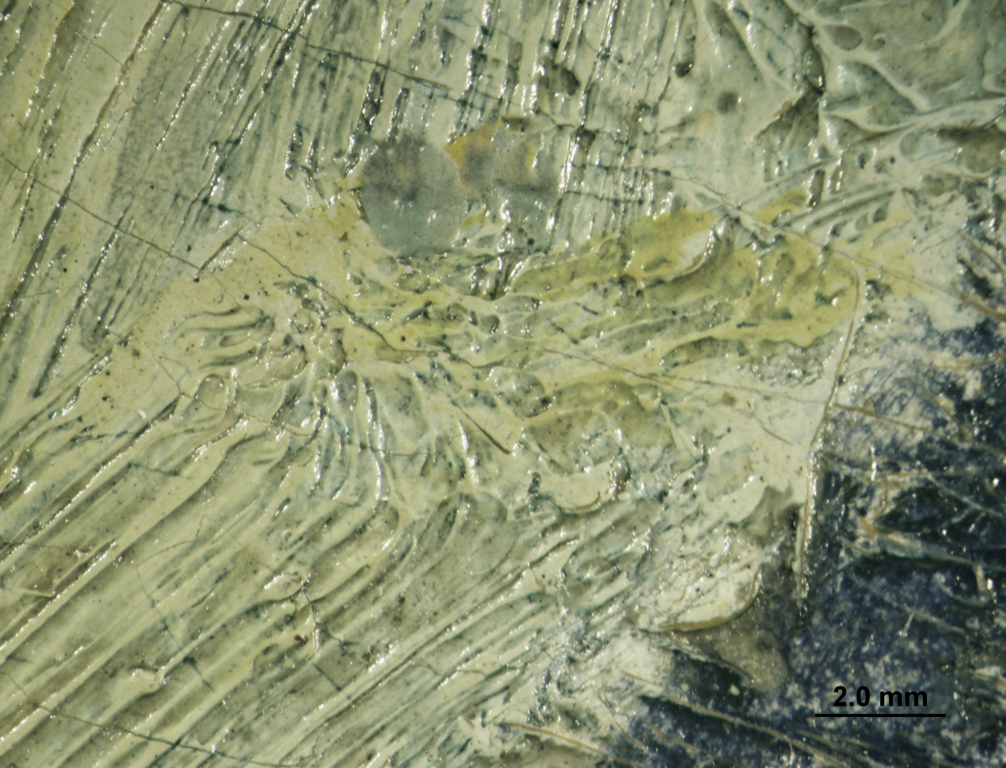
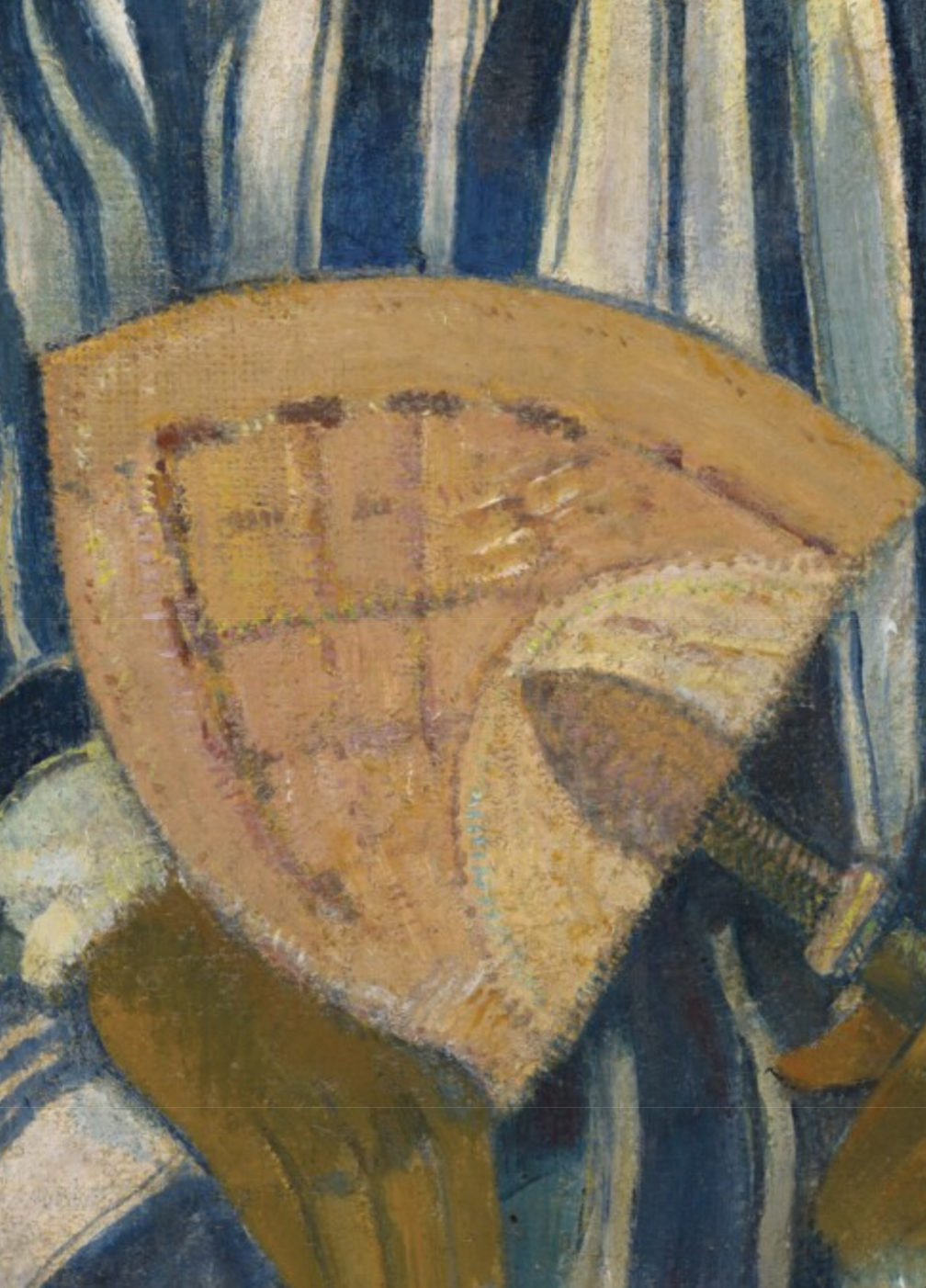
Tehamana’s attire arguably is a synthesis, a complex weaving of European influences and the changes they were affecting to Tahitian culture. This is also true of her fan, whose shape and style suggest those typically found in Samoa, which were constructed by braiding together strips of pandanus or coconut leaves (fig. 1.29). June Hargrove has suggested that this accessory serves as “a marker of rank in the South Pacific, [and] indicates noble lineage.” Both of Tehamana’s parents were Polynesian, from the Cook Island southwest of Tahiti known as Rarotonga, and Tehamana herself was born on Huahine, which is located among the Society Islands in French Polynesia, just northwest of Tahiti. It is perhaps her “pure Tahitian lineage” that Gauguin meant to signal by depicting Tehamana with this fan. Technical study has revealed that the artist reworked this detail. Reflected infrared imaging shows several different contour lines that Gauguin drew when first planning the placement of the fan (see Technical Study). He used a mix of techniques to depict it, employing a palette knife to smooth and blend some areas while using staccato brushstokes of bright blue and green to suggest the texture (fig. 10.61). Claire Frèches-Thory has suggested that with the fan and missionary dress, “Gauguin intended to characterize Tehamana as a hybrid of East, West, past, and present.” Arguably, these props also capture a conflation of indigenous and foreign cultures, a pluralism with which Gauguin himself grappled as he sought to balance his own Peruvian and French-European selves (see cat. 25, Commentary).
Reading the Wall
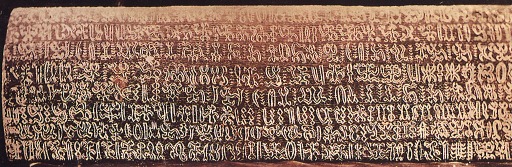
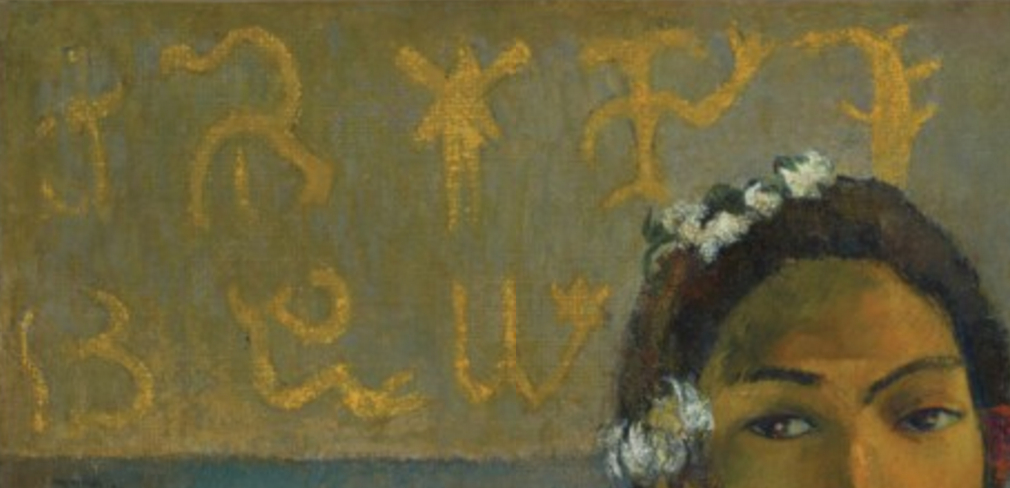
When interpreting this painting, scholars have tended to concentrate on the wall behind Tehamana. Gauguin defined the space with three horizontal zones, which, it has been suggested, represent the intellectual, spiritual, and physical realms. In the top register, two rows of glyphs fill the area around the figure’s head. These outsized symbols were derived from the renowned Easter Island artifacts known as the rongorongo tablets. The glyphs appear to originate from one specific tablet called the Tahua tablet. Scholars have found that Gauguin copied at least ten signs from this source. Once owned by Bishop Florentin Étienne “Tepano” Jaussen of Tahiti, the tablet was sent to Paris in 1887. It appears that the artist procured a photograph of the object (fig. 10.62) during one of his frequent visits to the 1889 Exposition Universelle in Paris, where several tablets were on view. Gauguin added the photograph to the collection of “friends” that he brought with him to Tahiti and from which he appropriated forms.
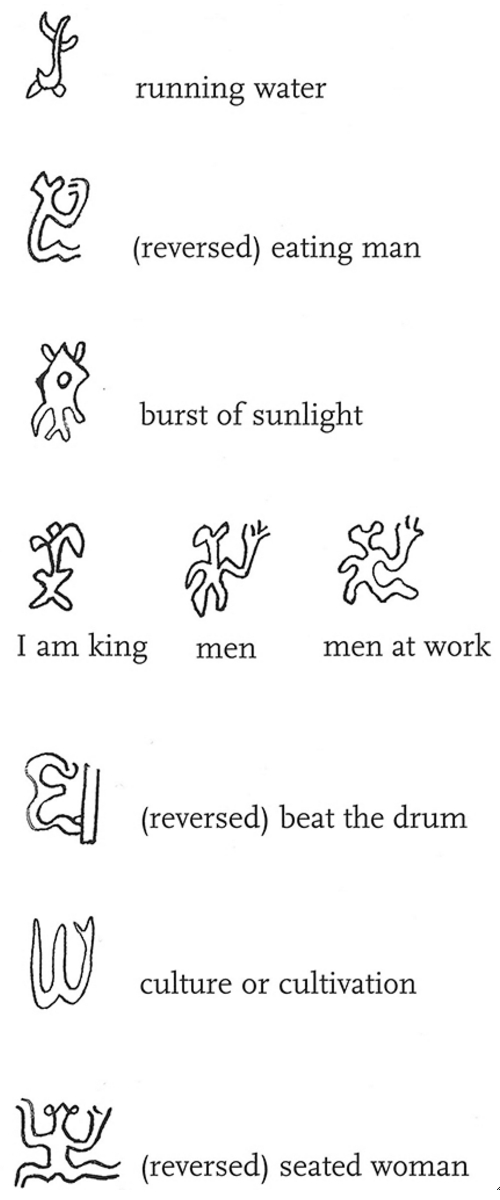
Gauguin was interested in secret languages and cryptography, as were many in turn-of-the-century Paris, and the Tahua tablet clearly piqued his curiosity. Neither he nor the natives with whom he lived understood the meaning of its glyphs, and the artist likely made use of these symbols precisely because they were mysterious and unintelligible. Among the glyphs Gauguin depicted in the background, Frèches-Thory has suggested possible meanings for several, including “king,” “beat the drum,” and “burst of sunlight” (fig. 10.63). These identifications are based on Jaussen’s study of the tablet and, according to Frèches-Thory, the specific symbols may correspond to the original function of the tablets, which were “meant to encourage interminable chanted recitals of genealogy as related to the cosmos.” We cannot know, however, whether Gauguin would have been aware of these meanings. In addition to their mysterious allure, he likely selected these glyphs based on their decorative appeal.
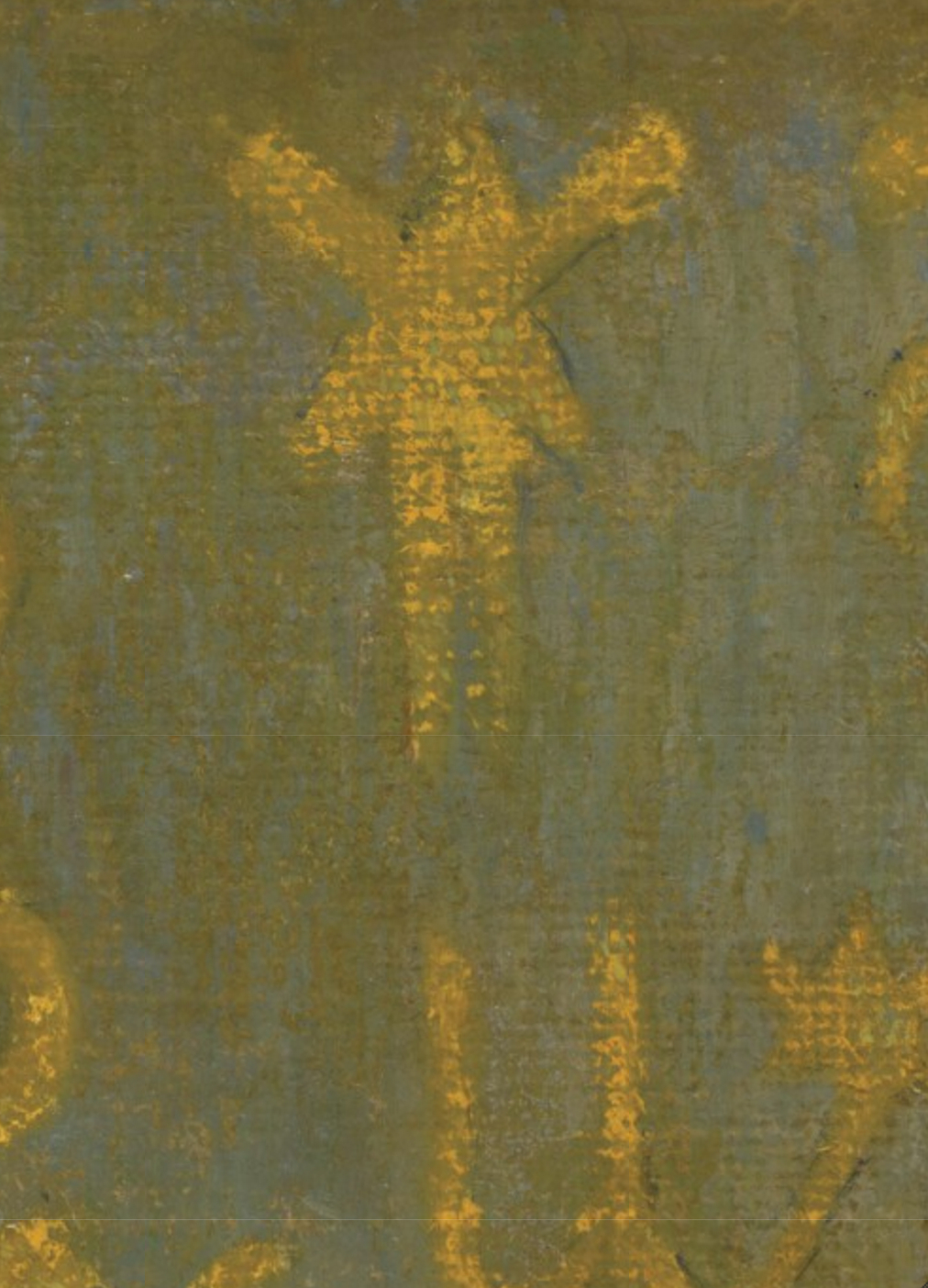
The photograph of the Tahua tablet shows that these glyphs are quite small and crowded together. In the painting, Gauguin enlarged them considerably, rendered them in a golden hue, and situated them with enough space between them to make each appear to be floating. This added to the sense that we are seeing phantom-like pictograms from an ancient, and nearly lost culture (see fig. 10.64). The symbols shine in the same light that gives Tehamana’s facial skin a deep bronze sheen. This effect is the result of several techniques the artist used, including scraping, blending, and smoothing with a palette knife (see Technical Study).
In the middle zone, behind Tehamana, Gauguin depicts figures evoking her very nearly forgotten spiritual ancestors. When he arrived in Tahiti in 1891, he was horrified to find that years of colonial rule had almost eliminated all knowledge and practice of the native religion. Since contemporary Tahitians were by then several generations removed from such understanding, Gauguin gleaned what he could through reading, especially Jacques-Antoine Moerenhout’s 1837 account Voyages aux îles du Grand Océan. He then used Tehura in Noa Noa as an expression of what he had learned. He wrote:
At night while in bed, we [Tehura and Gauguin] have long conversations, long and often times very serious. In the soul of this child I look for traces of her long lost past. All of my questions are answered even though her legacy has long been extinct. Or perhaps they have simply forgotten their history, seduced or enslaved by modern civilization and our conquest. These ancient gods, however, have been kept alive in the memory of these native women. Tehura puts on quite a marvelous and unique spectacle indeed, when gradually I see her native gods revived through her, disturbing the veil under which the protestant missionaries believed to have buried them.
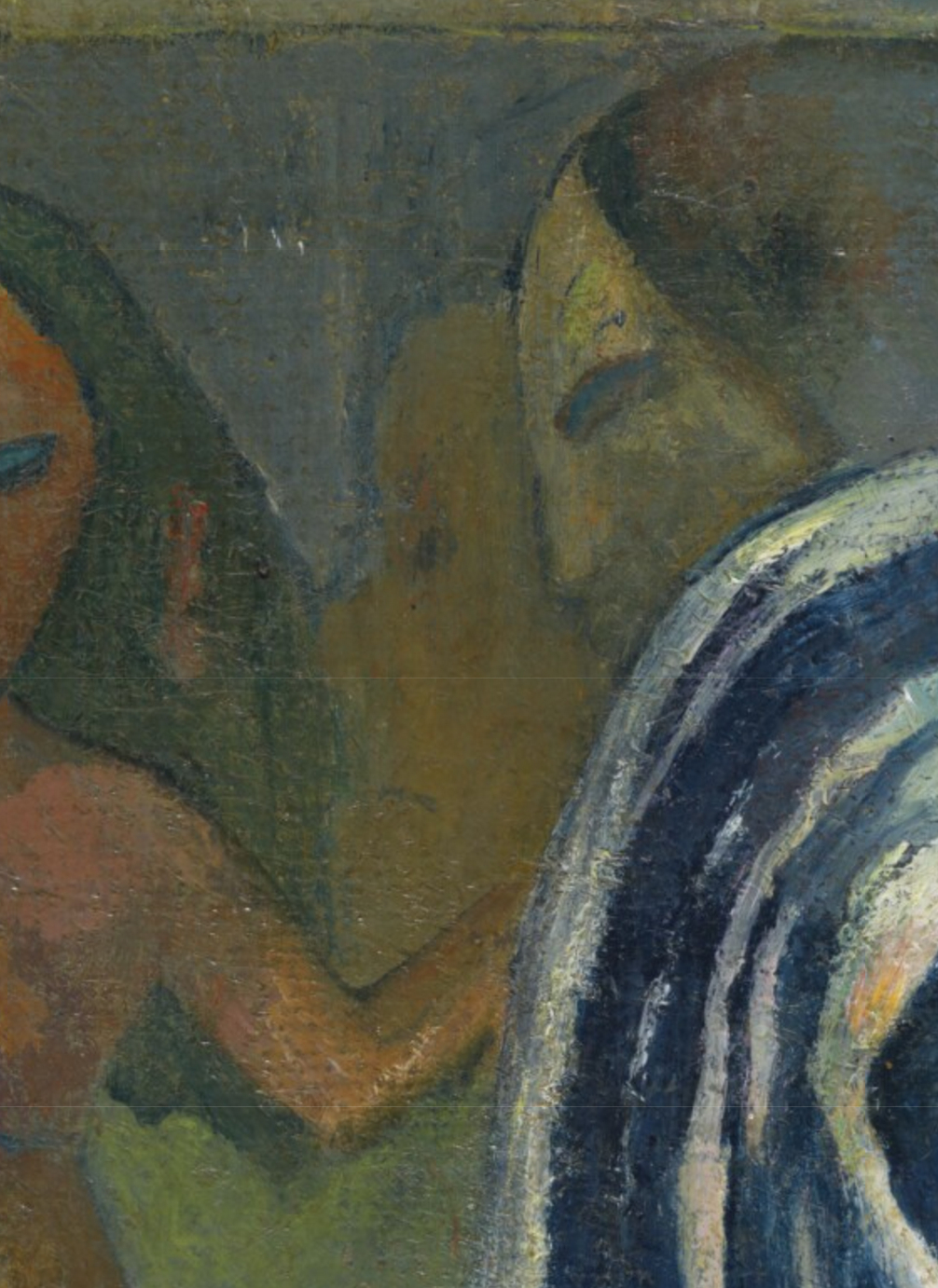
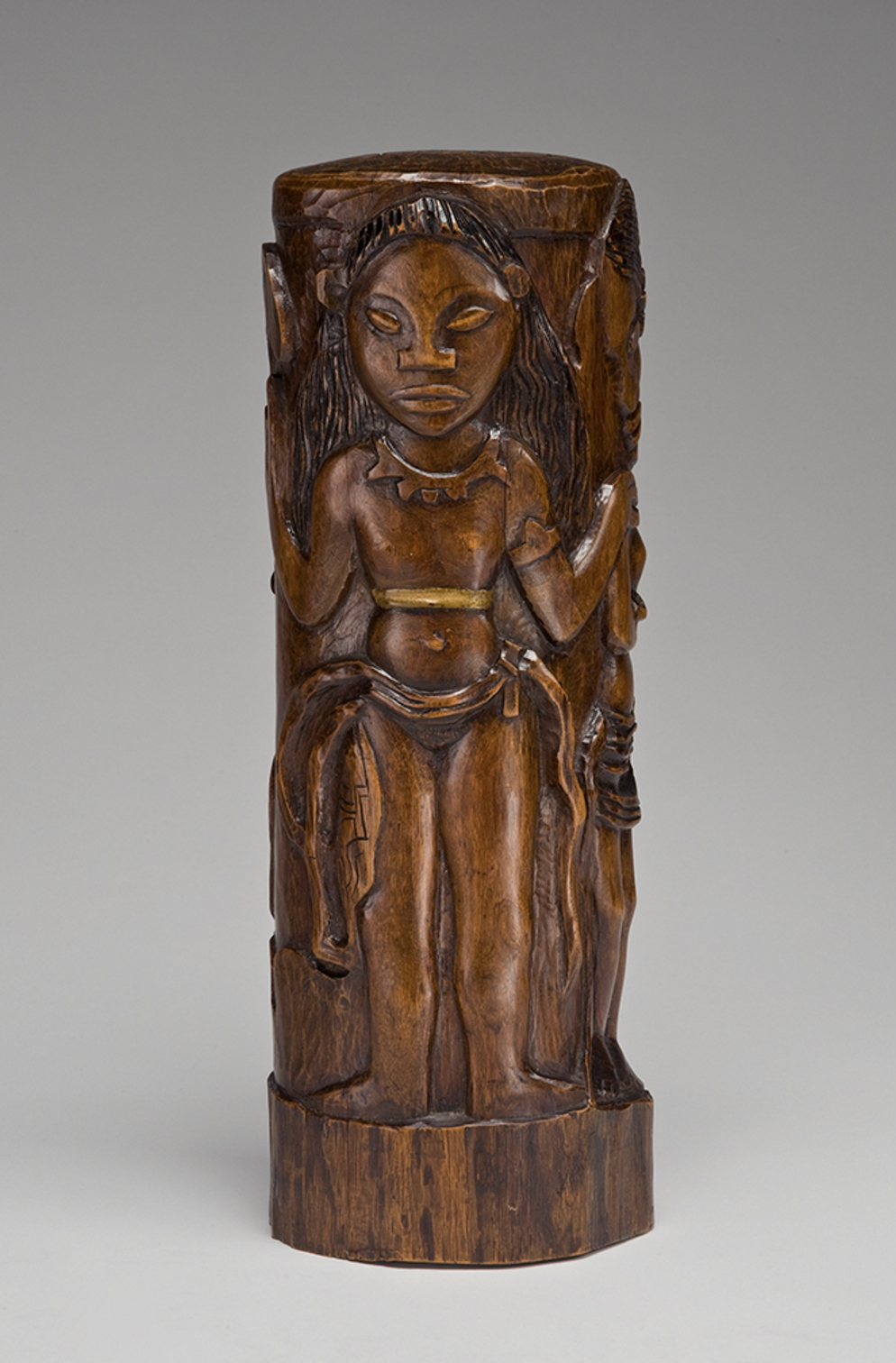
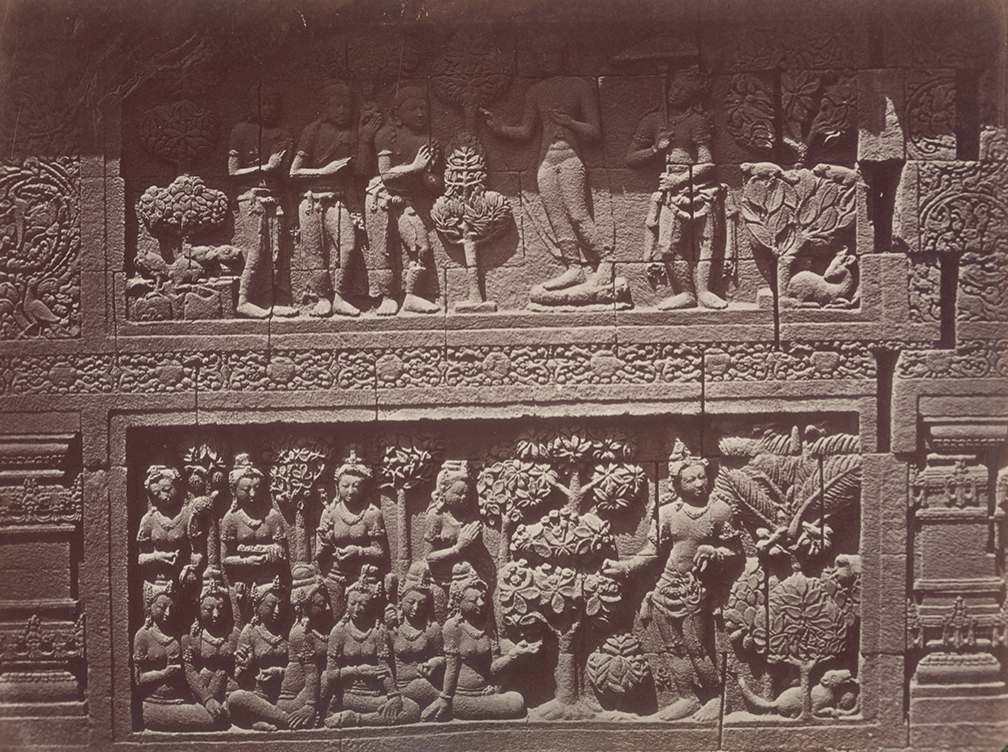
These figures are perhaps more readable than the glyphs because in creating them, Gauguin borrowed from his own repertoire of representations. The profile heads that flank Tehamana, for example, are of the tūpāpa‘u (spirits of the dead) that often feature in Gauguin’s work (see, for example, fig. 1.25). The moon goddess Hina (fig. 10.65) is also a frequent presence in paintings and works on paper (see cat. 53) as well as in sculpture; a wood cylinder, with a forward-facing figure of Hina and another female in profile, that predates the Chicago painting (fig. 10.66). The absence of visual examples of indigenous gods, however, prompted Gauguin to reinvent Polynesia’s mythic past by borrowing from other cultures. His sources included examples of Hindu and Buddhist art of Southeast Asia, which he found in photographs of sites and objects that he had brought with him from Europe (see fig. 10.67). Current anthropological theories regarded Southeast Asia as the cradle of Polynesian society, and Gauguin drew on such this thinking in figures such as Hina, which displays a fusion of Tahitian and Buddhist forms.
Next to the depiction of Hina are the three tūpāpa‘u heads (fig. 10.68), which recall the demon spirits that terrified Tehura in an episode of Noa Noa. After returning home late, he found his lover laying motionless and terrified in the dark: “She took me, with my anguished face, for one of those legendary demons or specters, the tūpāpa‘u that filled the sleepless nights of her people.” The tūpāpa‘u represent, as Dario Gamboni noted, “a ghost, or apparition, the supposed spirit of the dead” (see cat. 60). The dichotomy, or perhaps balance, between these two ancestral figures—the tūpāpa‘u and Hina—establishes a dialogue, Frèches-Thory suggested, “between good and evil or between life and death.”
On one level, these gods and goddesses represent the mystic past that Gauguin was working to resurrect both pictorially and through his writing. On another, bearing in mind Gauguin’s inscription on the painting, these “ancestors of Tehamana” may further represent her genealogy. As Jehanne Teilhet-Fisk explains, “In Polynesia [genealogy] always extends back to the creators, Ta‘aroa and Hina.” Arguably, then, these gods represent another set of parents.
Tehamana as a Love Poem and a Farewell
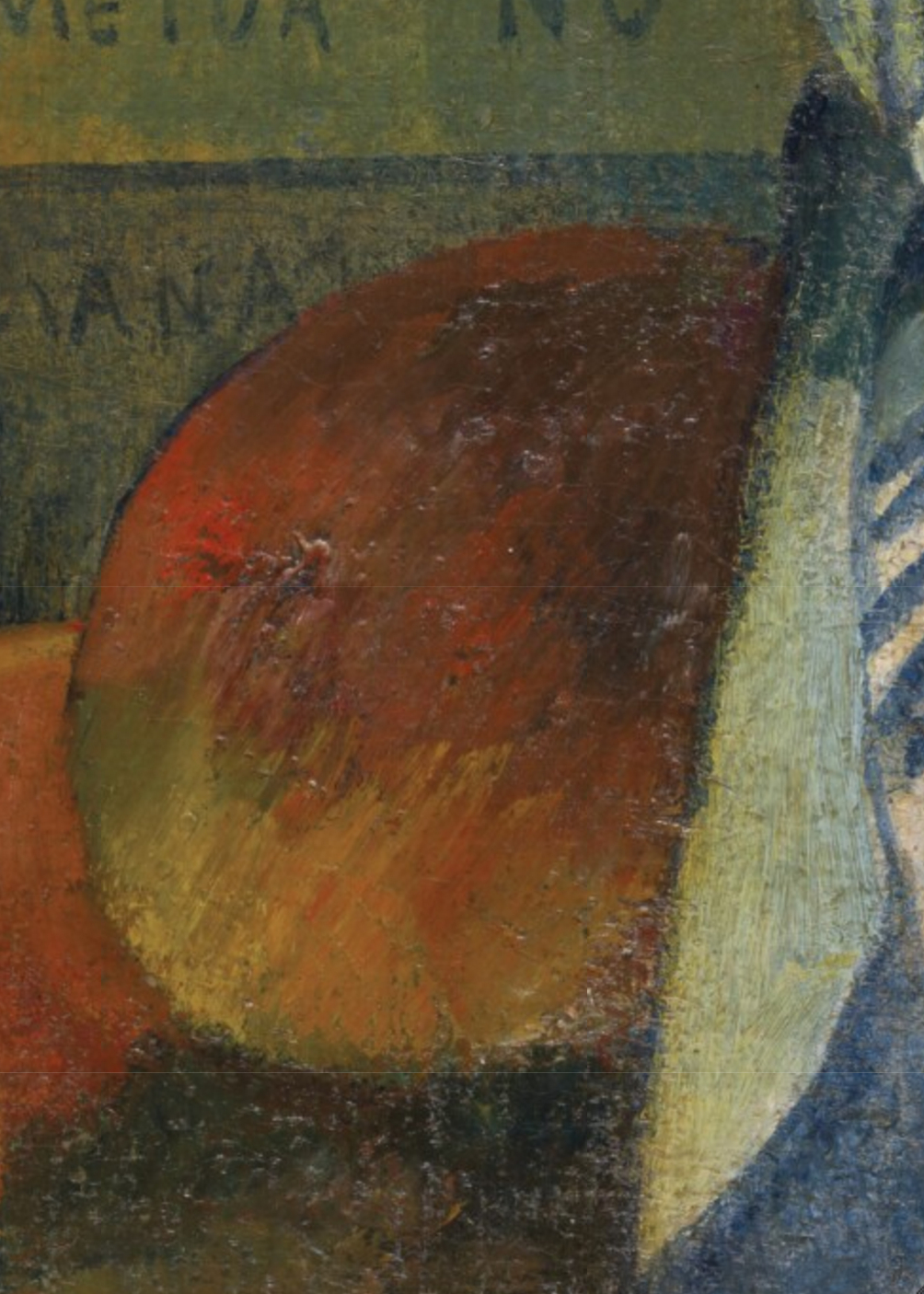
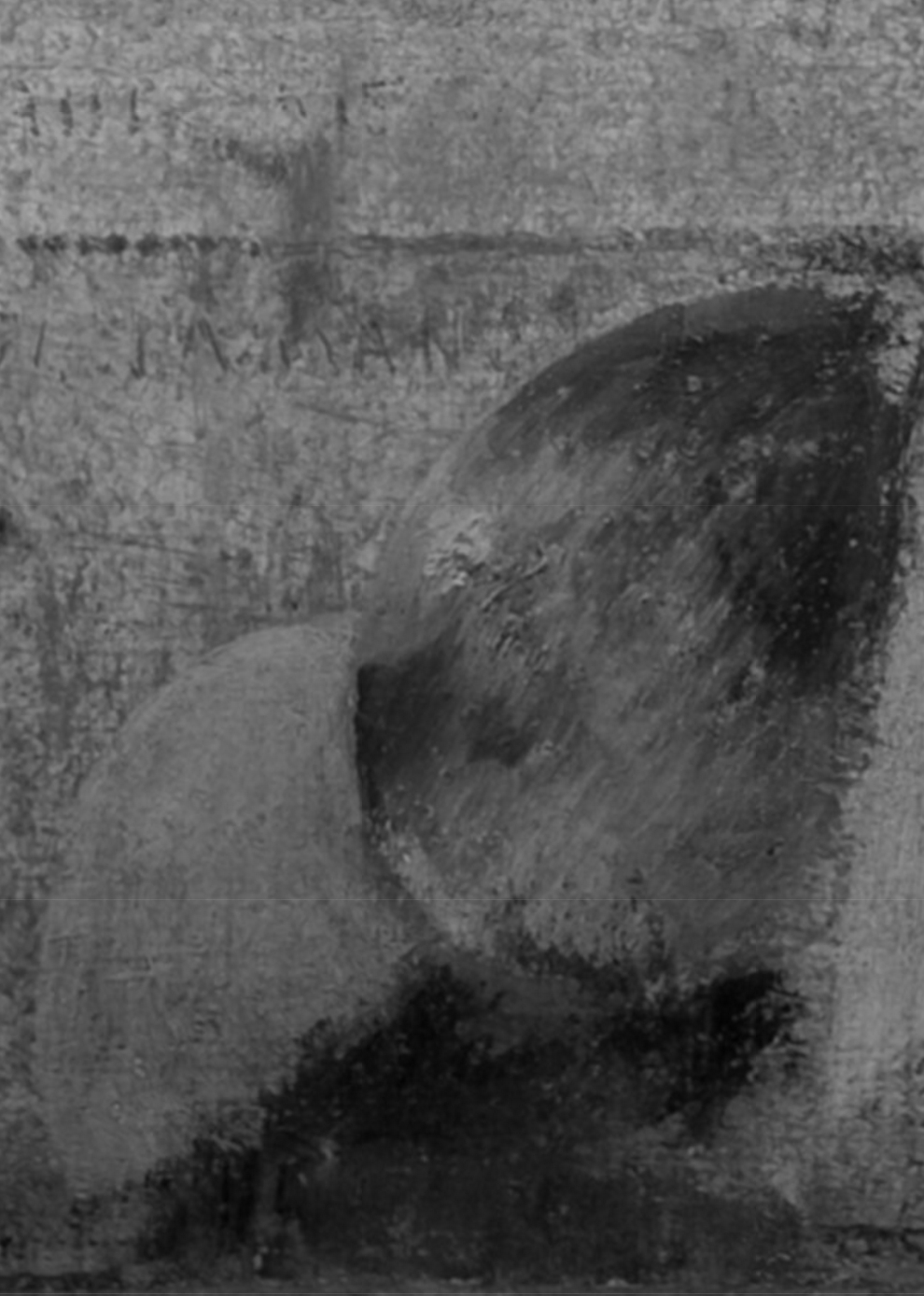
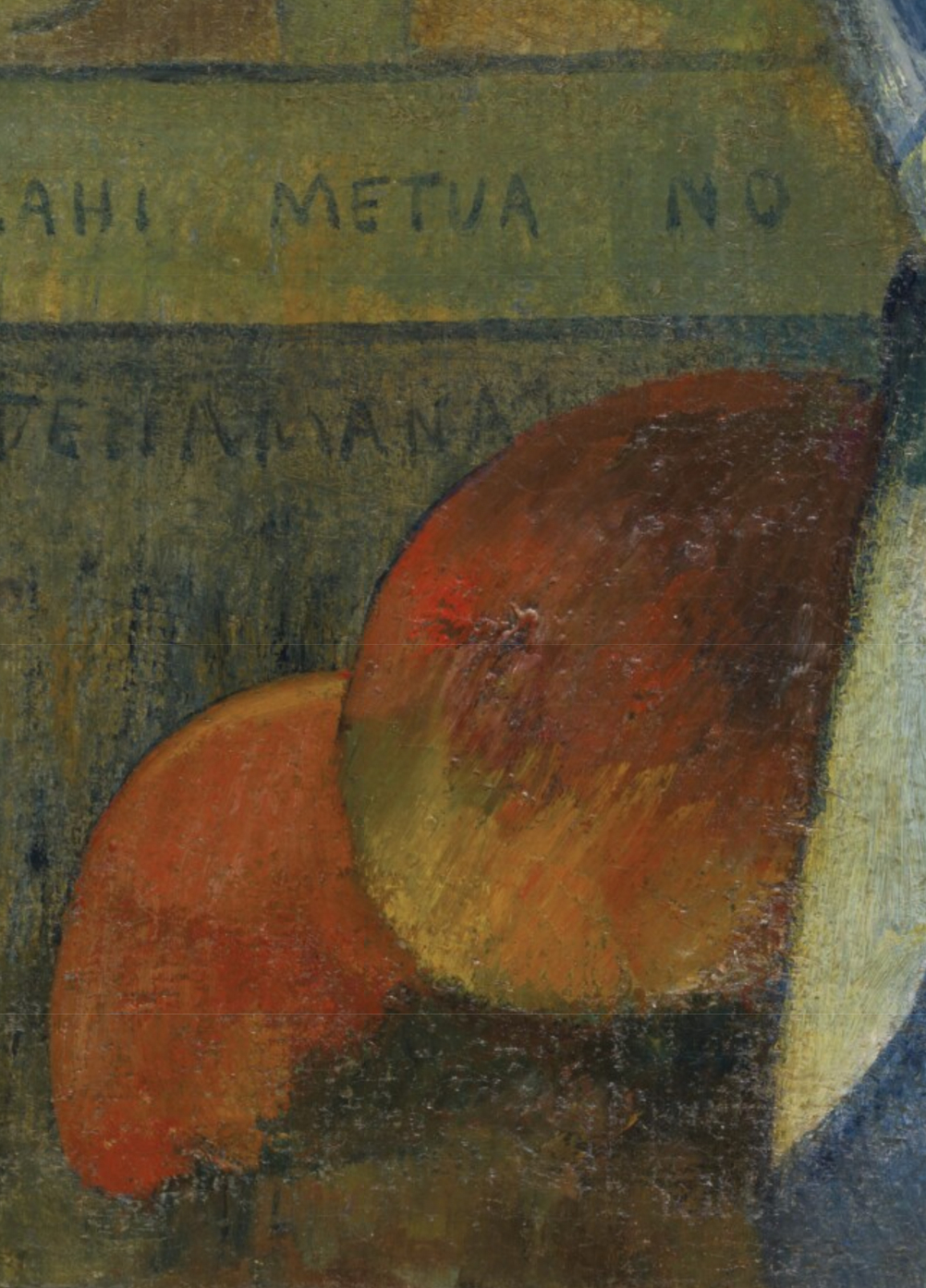
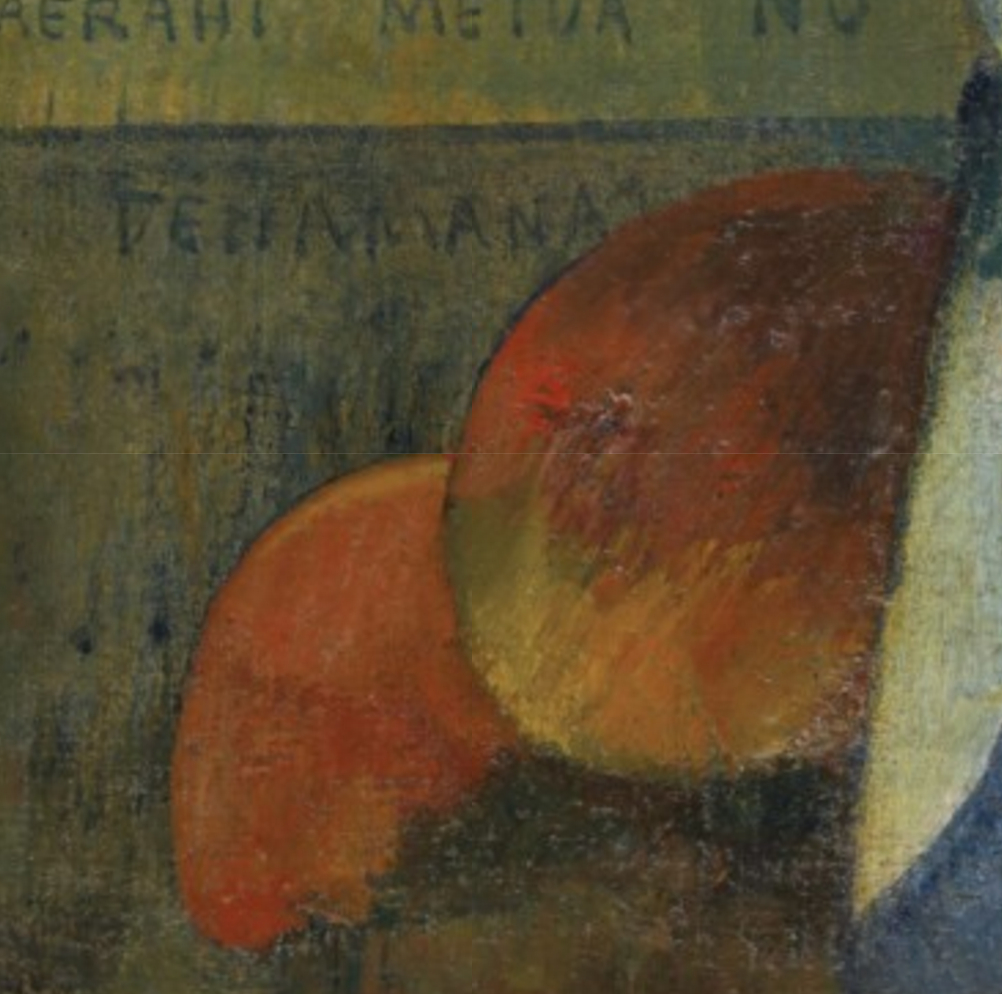
Some have interpreted the lowest band as a table on which two oversize mangoes are placed or as a bench on which Tehamana might be sitting—or both—but there is no evidence to identify it with certainty. The mangoes, located in the lower left corner, are fully defined at the top, with strokes inspired by Paul Cézanne’s brushwork; however, they seem to dissolve at the bottom (especially the lowest fruit on the far left) (fig. 10.75). To date, the meaning of these seemingly unfinished forms has eluded scholars. On the other hand, it seems clear that the fruits are meant to signal Tehamana’s fecundity due to their placement just below her name and next to her lower abdomen. This relationship is made more clearly in a slightly earlier work, Vahine no te vi (Woman with a Mango) (fig. 1.36 [[glossary:W] 449]), in which a seemingly pregnant Tehamana holds a mango the size of a giant conch shell.
The mangoes also symbolize an offering. According to lore of the Arioi—a defunct secret society that worshipped the god Oro—the beautiful mortal Vairaumati became the wife of Oro. He descended to her on a rainbow, and she greeted him with a banquet of fruit. Thus here, like the mythical Vairaumati, Tehamana presents mangoes to Gauguin.
Finally, this painting can be interpreted as a farewell to both Tehamana and Tahiti. Gauguin left her behind when he left Tahiti in August of 1893. While she is quietly composed in the Chicago picture, Gauguin writes of the sad ending to the story of her Noa Noa analogue Tehura:
When I left the dock before going out to sea, I looked back at Tehura for the last time. She had cried for several nights. . . . The flower she used to wear behind her ear had fallen, dying on her knees. All along the dock, many like Tehura looked on, tired and silent, their minds a blank as the ship’s thick smoke carried us away, lovers for a day. From the ship’s bridge and for a long time after, we all thought we saw their lips reciting an ancient Maori saying: “I speak to you light breezes of the South and East, coming to frolic and caress my hair; hurry now, go to the other side and there you will find the one who left me here, sitting under the shade of his beloved tree. Tell him that I wait for his return in tears.
Like his semifictionalized narrative in Noa Noa, Merahi metua no Tehamana most probably represents Gauguin’s layering onto the actual of an imagined ideal, a combination of several worlds, each too rehearsed to be real. When analyzing the wide range of elements included in this painting, one can only marvel at the sheer volume of information that the artist absorbed between 1891–93 and to which he alluded in this composition. The mysterious glyphs, the Hina and tūpāpa‘u figures, and Tehamana’s enigmatic expression, all lend a sense of mystery and allude to the deep yet lost cultural past of Tahiti.
Richard R. Brettell and Genevieve Westerby
Technical Study
Overview
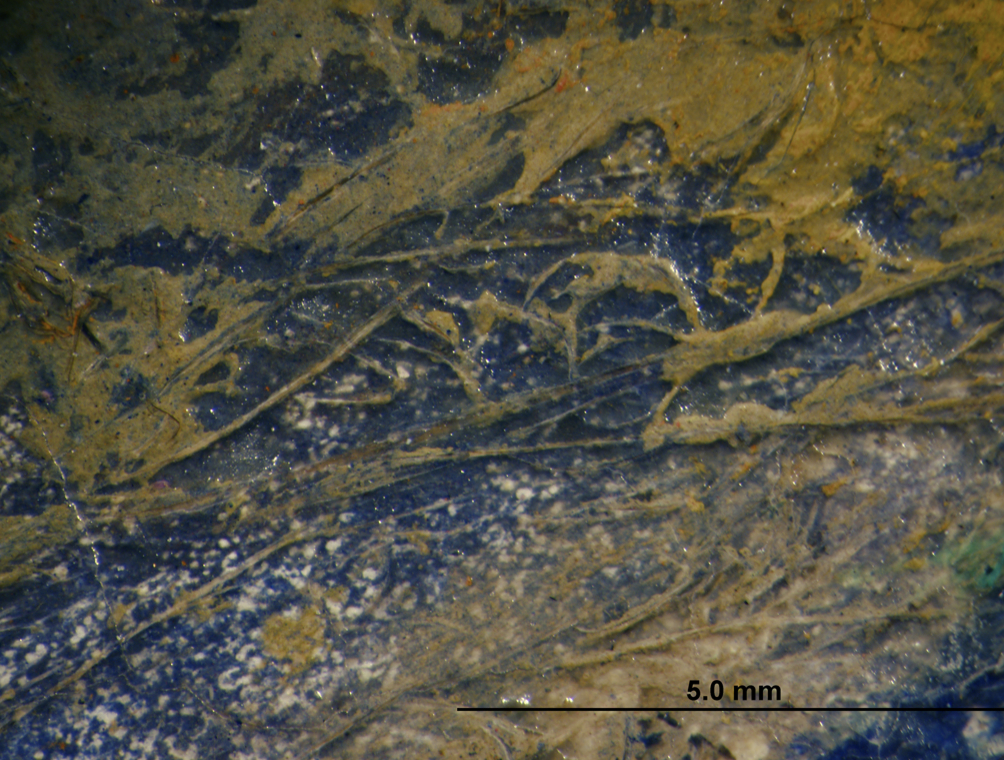
For Merahi metua no Tehamana (Tehamana Has Many Parents or The Ancestors of Tehamana) Gauguin used a non-[glossary:standard-format] [glossary:stretcher] and a [glossary:jute] [glossary:canvas], which he primed himself with a chalk [glossary:ground] that was too thin to smooth down the rough jute fibers. He drew contours for the major elements with charcoal and reinforced them with painted blue lines. The initial sketch included Tehamana (the main seated figure) and Hina (the small figure to the left of Tehamana), as well as the glyphs seen at the top of the composition, but not the ancestor heads (the faces of the other figures seen behind Tehamana). The stripes of Tehamana’s dress were outlined in the [glossary:underdrawing] and subsequent painted sketch, although the folds of the figure’s left sleeve were changed, and those of the right sleeve were painted freehand. Much of the dress was painted thinly, textured by webs of jute fibers that were not held down by the thin ground. The artist wiped back many of the blue stripes as he painted them, to create translucency, and shaded other parts more opaquely with gray and reddish brown. On the whites he modeled the folds with numerous glazes and scumbles of various pastel tints, so that fluctuating, delicate tones, as well as burgeoning form, enliven the surface of the fabric.
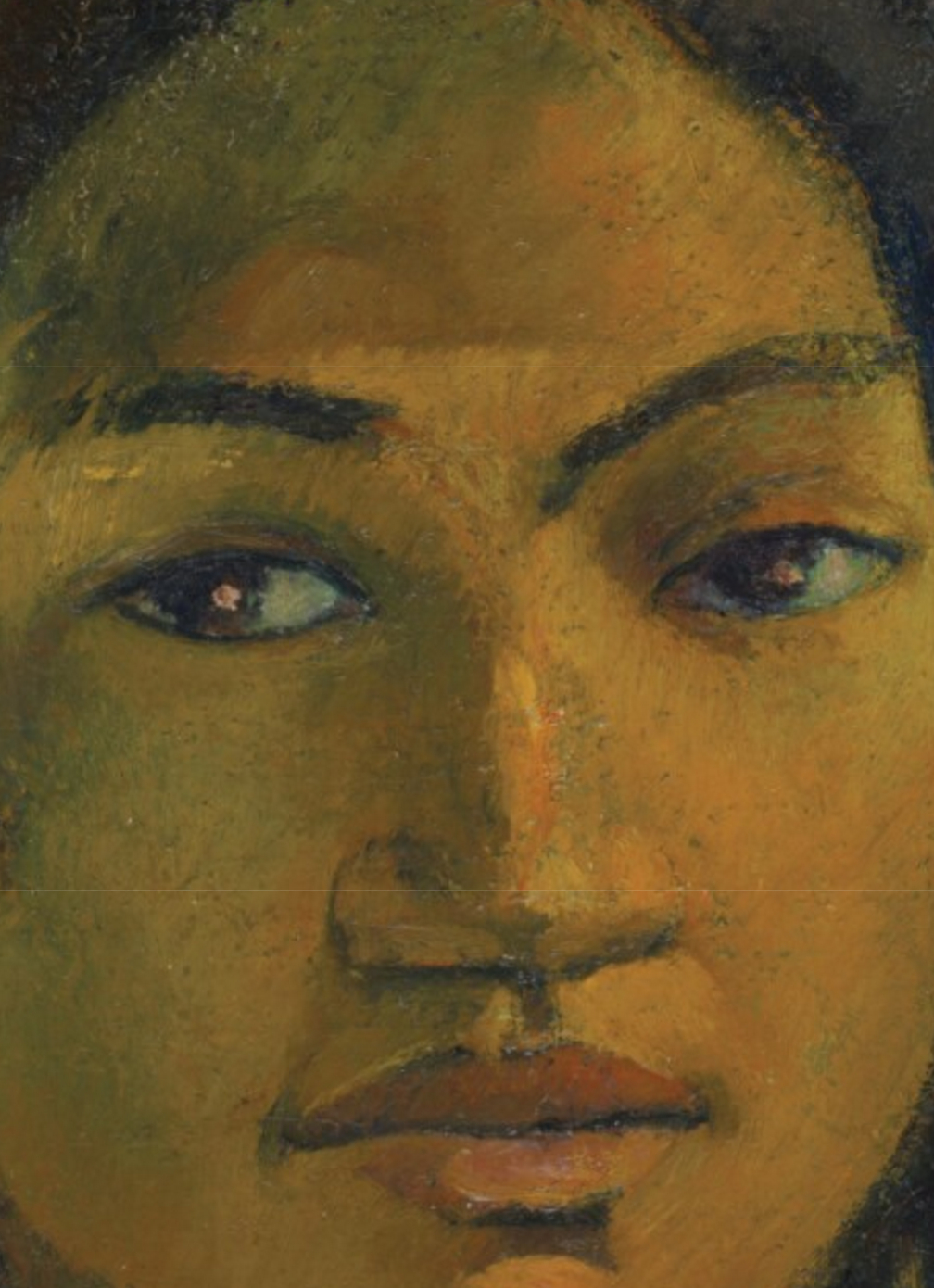
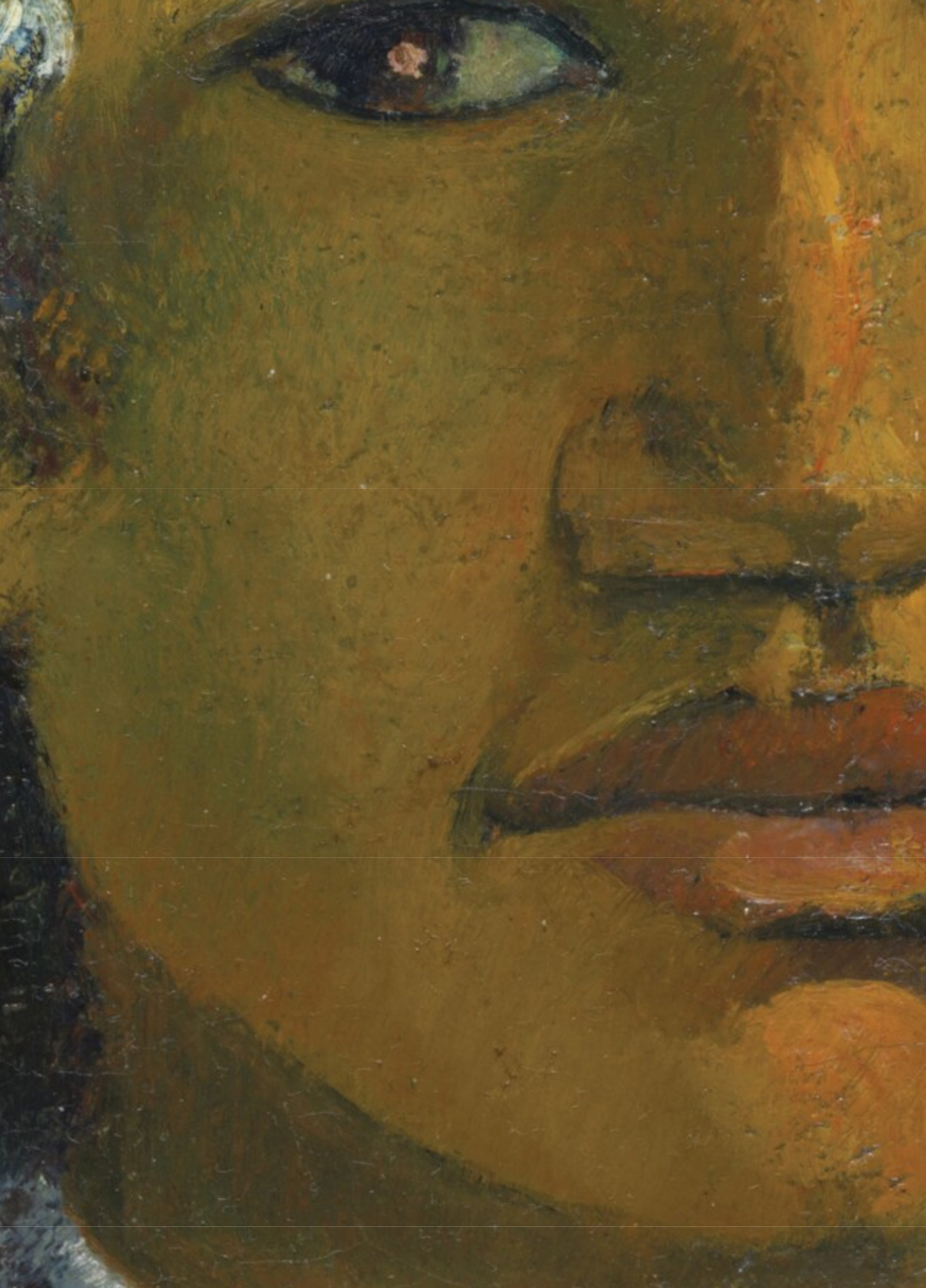
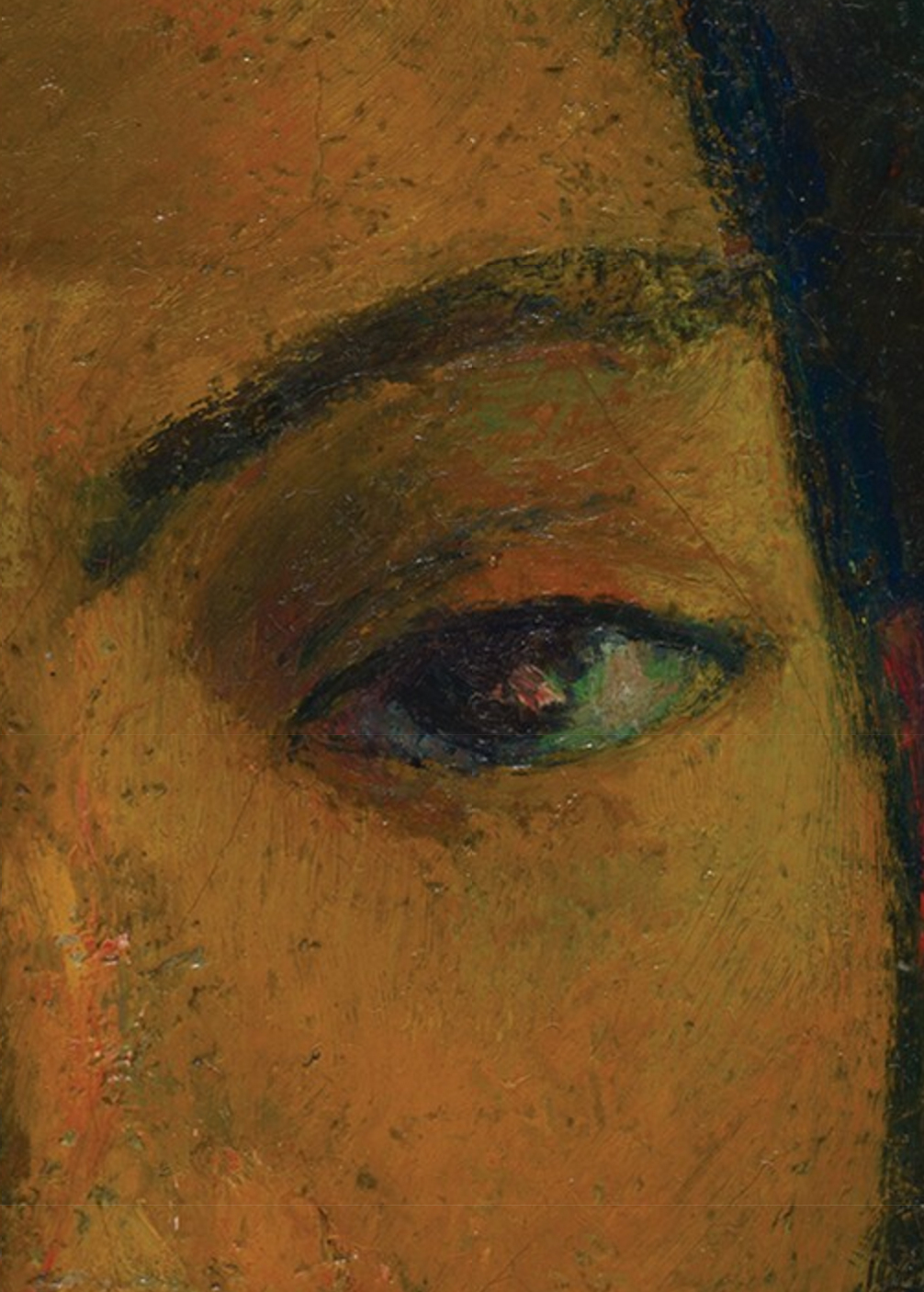
During the painting process, the face of Tehamana was slowly built up in stages, with relatively thick layers that hid the hairy jute fibers. After an initial lay-in of yellow, the artist worked up the face with shades of green and tan with purple-brown shading. Once this layer had dried, Gauguin applied the final orange and yellow tones, blending them carefully, primarily by dry brushing and occasionally wiping, and he also used the [glossary:palette knife] in spots to smooth and blend. The eyes, when first painted, were yellow with orange shading, pink highlights, and delicate red flickers in the irises, as if reflecting firelight, but they are now deep purple with green irises. There is a drawing of Tehamana’s head in the Art Institute of Chicago with an almost exact correspondence to the head in the painting, which Gauguin may have traced and transferred onto the canvas.
Gauguin had first painted Tehamana’s hair not falling behind her shoulders but instead fanning out on the left to hang loosely down the front of her gown. Her hair also rose higher at the top of her head and grew slightly lower on her forehead. Large disks hung from her ears. Gauguin underpainted the earrings with white, and perhaps at the same time applied white in radiating strokes to mask a strip of the dark hair at her crown. Later, Gauguin abandoned the earrings by covering the white preparation with her hair and extended the background to cover the white above her head.
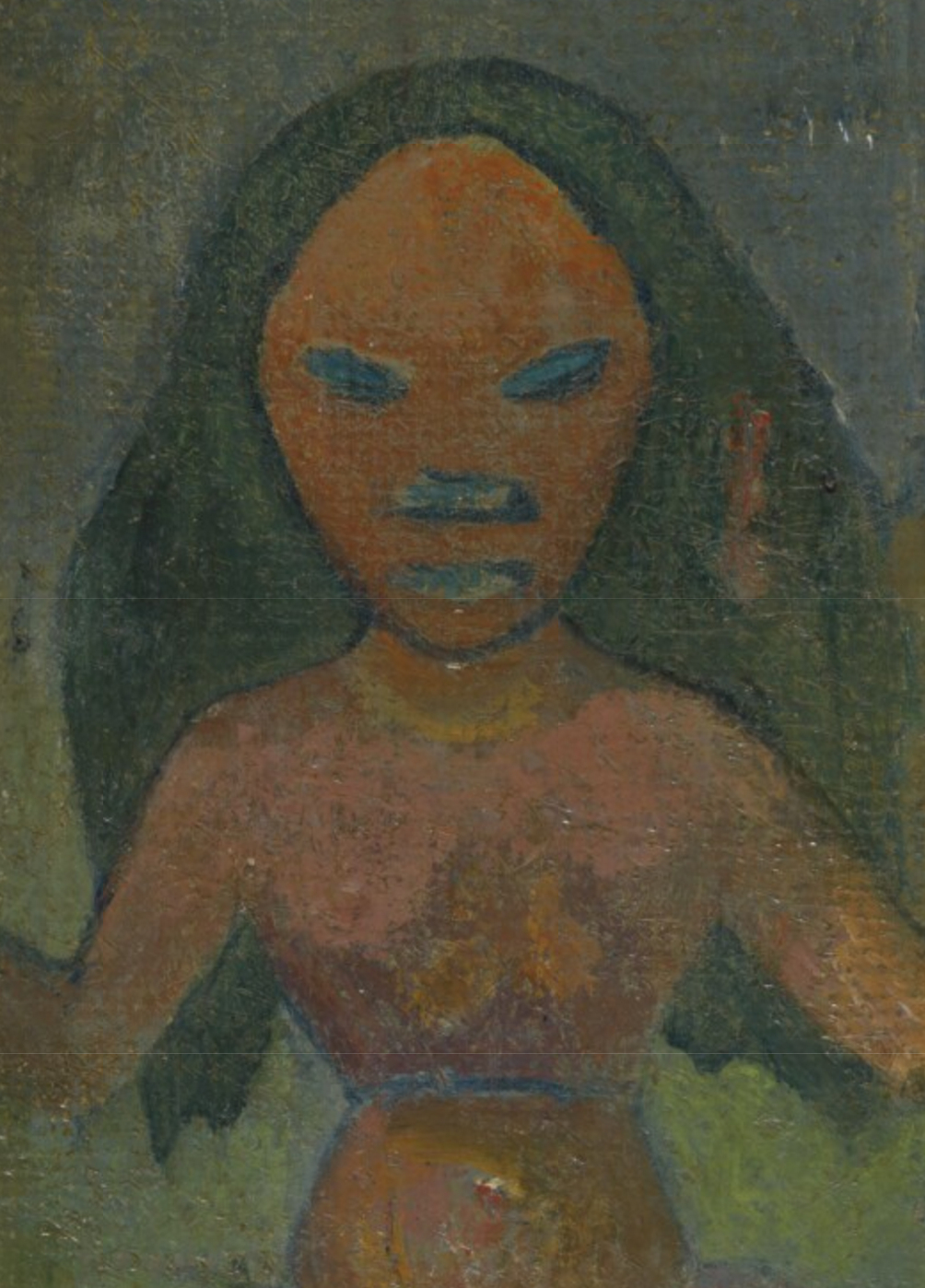
Over the entire background, including the initial drawing for Hina, the artist laid in a translucent layer of olive-tan. He painted the goddess’s loins unclad and then covered them with the thin gray cloth on top. A tall, slender, orange and red headdress sat atop her head, which was painted out with the final pale-blue-green background color. Gauguin first added the two ancestors’ heads to the right and left of Tehamana’s shoulders over the initial tan background. The other orange-faced ancestor to the right of Hina was added still later, painted with a ghostlike thinness over the final pale-blue-green background. At bottom, the fruit on the right was part of the original drawing, while the left one was added later over the background.
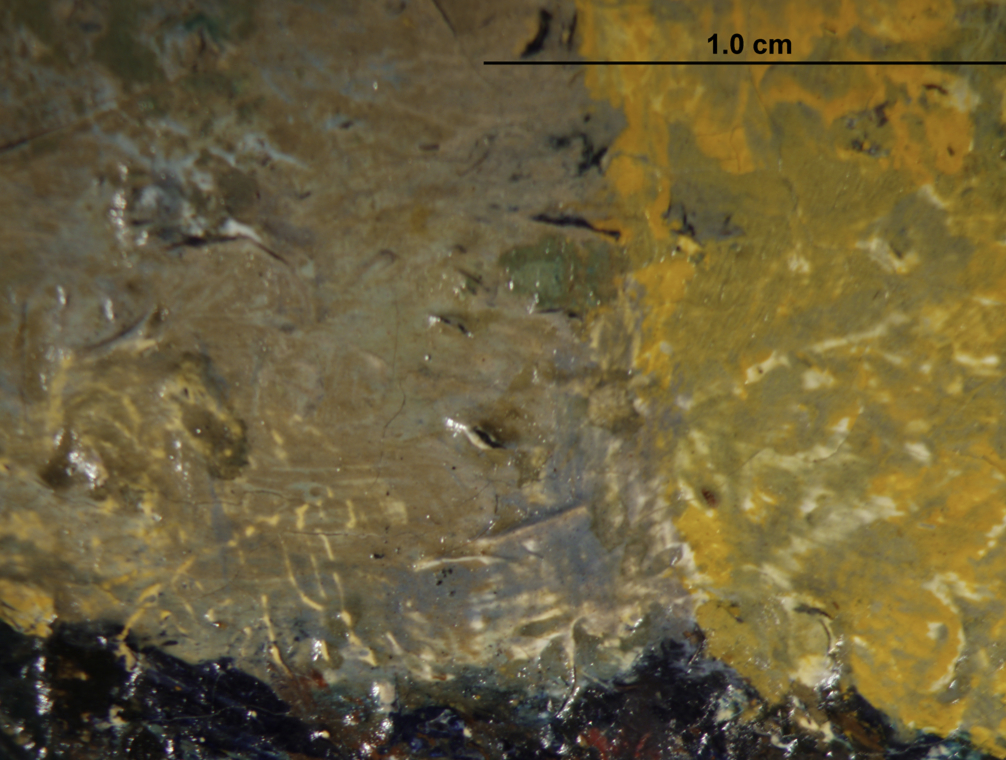
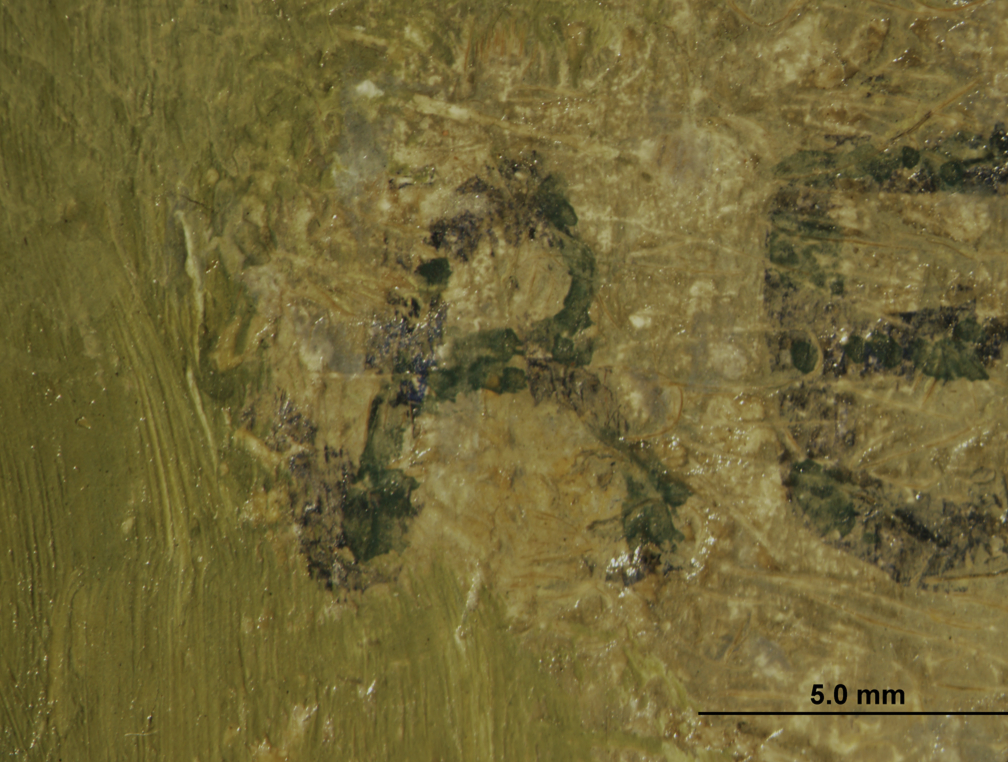
The background glyphs, like the rest of the wall, were made to look aged and worn. They were painted in yellow over the tan lay-in, and the blue-green of the wall was painted around them. Gauguin dulled the wall overall with another uneven layer of tan, then abraded the surface by wiping and scraping to reveal the yellow of the letters very unevenly, so that they seem to glimmer. He added occasional dark touches to serve as scuffs and nicks in the wall. Old [glossary:repaint] mistakenly changed the first letter of the inscription from the M of Merahi to an A.
At some time in the painting’s history, the canvas was stretched onto a smaller, standard-format stretcher. This probably occurred when the rolled canvas first arrived in France. It was later restretched to its original larger dimensions.
Multilayer Interactive Image Viewer
The multilayer interactive image viewer is designed to facilitate the viewer’s exploration and comparison of the technical images (fig. 1.1).
Signature and Inscription
Signature
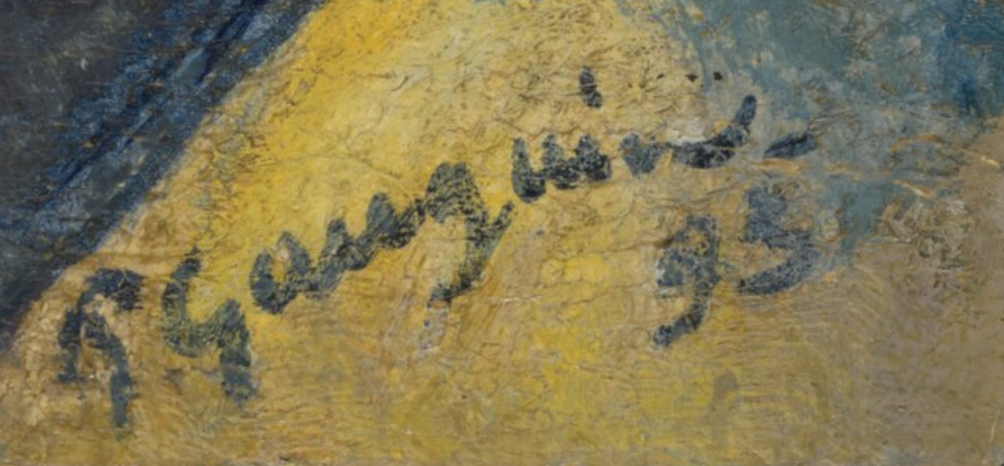
Signed and dated: P. Gauguin - / 93 (near center of bottom edge in dark-blue paint) (fig. 1.2)
Inscription
Inscribed: MERAHI METUA NO / TEHAMANA (lower left, on wall molding in dark-blue paint) (fig. 10.76)
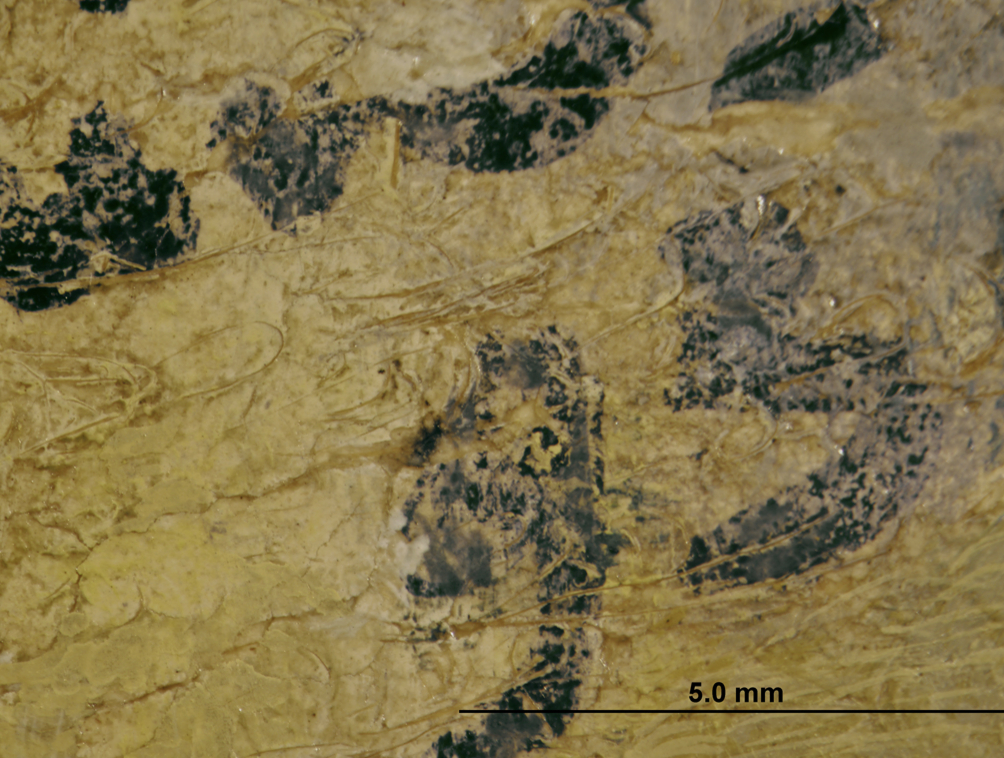
The blue paints of both the signature and inscription were diluted to the point that they reticulated on the underlying oil paint film. They are abraded with interruptions, possibly by Gauguin himself. In the inscription, many of these interruptions and abrasions were inpainted before acquisition by the Art Institute of Chicago. The first letter of the inscription was originally an M, but the initial leg was partially overpainted along with the edges, then misinterpreted by a restorer and turned into an A. Some faint strokes of the M are visible by stereomicroscopic examination (fig. 10.91).
Structure and Technique
Support
Canvas
Jute.
Standard format
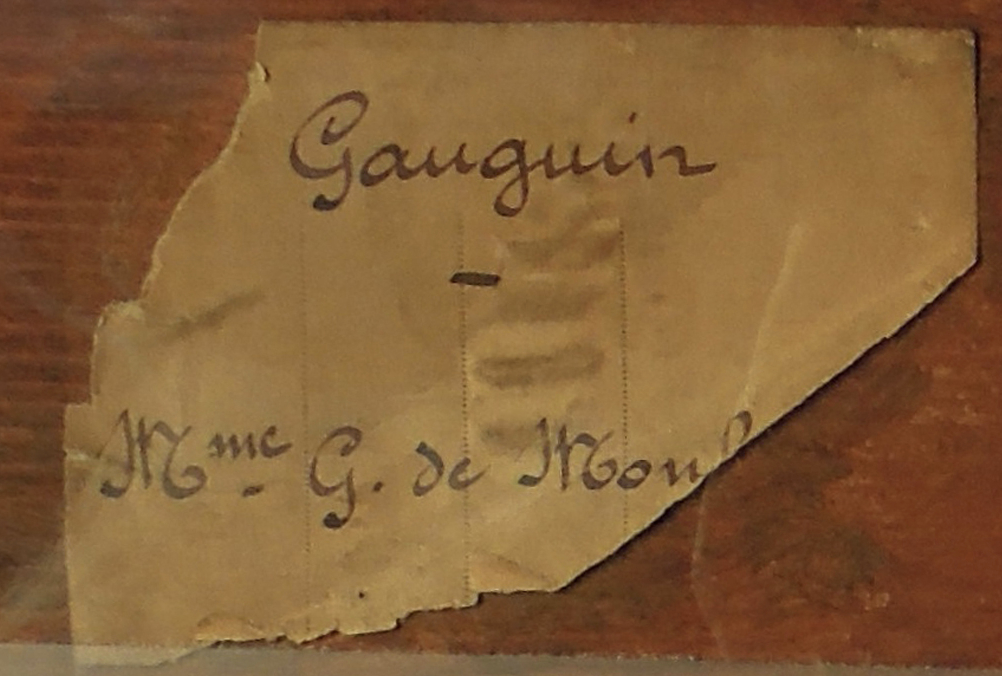
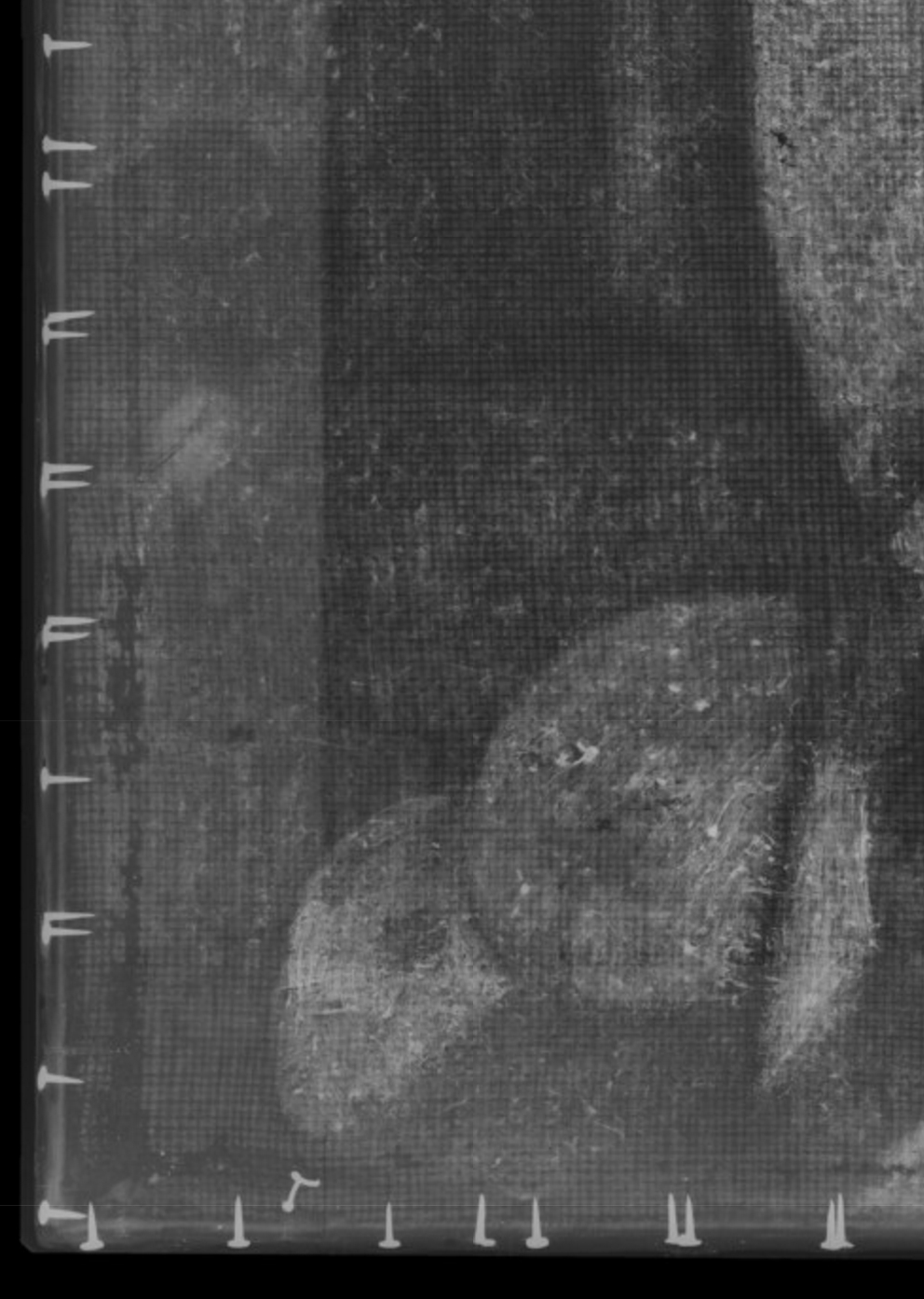
The original size of the canvas was approximately 75 × 53 cm. This is not a standard size. At some point, the painting was stretched onto a smaller stretcher, a no. 20 seascape ([glossary:marine]) standard-format (73 × 50 cm) canvas. This was the standard size closest to that of the painted image if both length and width were reduced. In this smaller format, 2 cm of the painted canvas was folded over the left edge, 1 cm on the right, and 0.5–1.5 cm over the top and bottom edges. When on the smaller stretcher, parts of the hieroglyphs, half of the first letter of the inscription, and part of Hina’s arm (the part repainted brighter orange), as well as the bottom of Tehamana’s dress, and perhaps the bottom of the P in the signature, were folded over the edges. Folding to a smaller format caused paint loss along the fold lines, which is visible on the X-ray (fig. 10.74). Later the canvas was restretched to its original dimensions of 75 × 53 cm and the edges repainted. Gauguin had presented the picture to Georges-Daniel de Monfreid, and a label indicates that when it was subsequently in the collection of Monfreid’s wife, it was already on its present stretcher of the original larger size.
Weave
[glossary:Plain weave]. Average [glossary:thread count] (standard deviation): 4.8V (0.3) × 4.9H (0.3) threads/cm. Based on thread angle maps, the horizontal threads were determined to correspond to the [glossary:warp], and the vertical threads to the [glossary:weft].
Canvas characteristics
The original coarse jute canvas has been completely covered by the lining canvas on the reverse, and by paper tape, gesso, and paint on the front edge and sides, thus preventing direct visual examination except in a few spots. The canvas was cut at the front edge of the stretcher in preparation for lining. On the X-ray, there are short runs of thicker threads in the horizontal (warp) direction. There are many broken fibers protruding through the thin paint and ground layers.
Stretching
Current stretching: The canvas is not stretched square to the stretcher. Currently, the original paint along the top edge is folded over at the right and does not reach to the top edge at the left. There are two layers of paper tape and sets of tacks, from different stretchings, both postdating the lining. Gesso fill material and paper tape cover 0.5 cm of original paint on all edges. The tack holes from the smaller stretcher are visible along the left edge, 5–7 cm apart. The X-ray shows another set of holes in the stretcher underneath the paper tape, which could indicate that the canvas was also stretched on this stretcher before it was lined.
Original stretching: There is weak cusping, probably corresponding to the original stretching, with tacks 7–10 cm apart. There is a fine network of cracks in some areas that lead in all directions. Beyond this, there are a number of wider, short horizontal cracks that could have been caused by rolling.
Stretcher/strainer
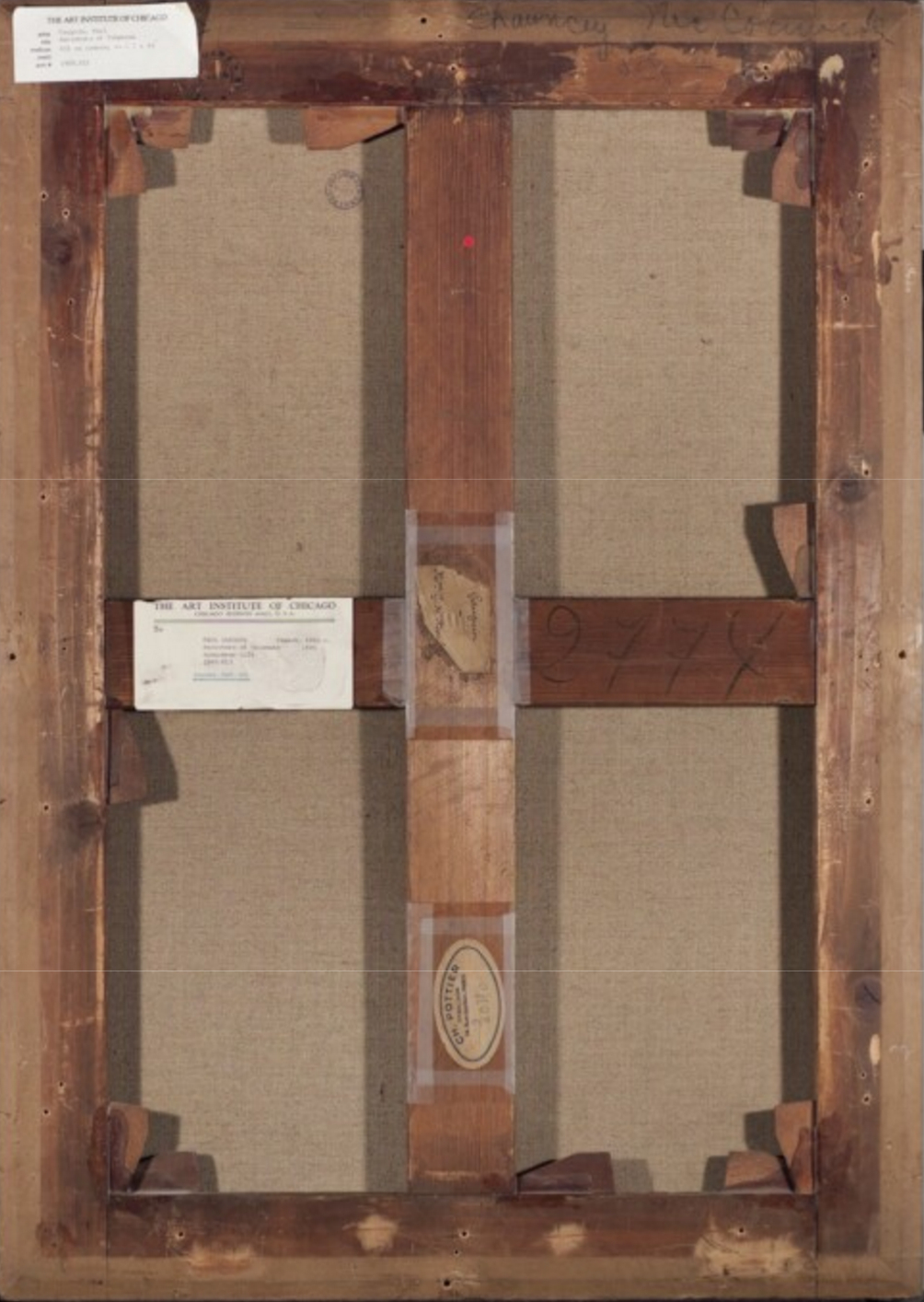
Current stretcher: Six member, keyed stretcher with two crossbars and bevels front and back. The width of the stretcher bars is 6.5 cm, and the depth 2 cm. The wood contains knots (fig. 1.5).
The stretcher is old, but probably not original to the painting’s arrival in France. It was more likely first stretched to the smaller format after transport. The painting was probably restretched from the smaller stretcher back to its original size quite early.
Original stretcher: Undocumented.
Manufacturer’s/supplier’s marks
None observed in current examination or documented in previous examinations.
Preparatory Layers
Sizing
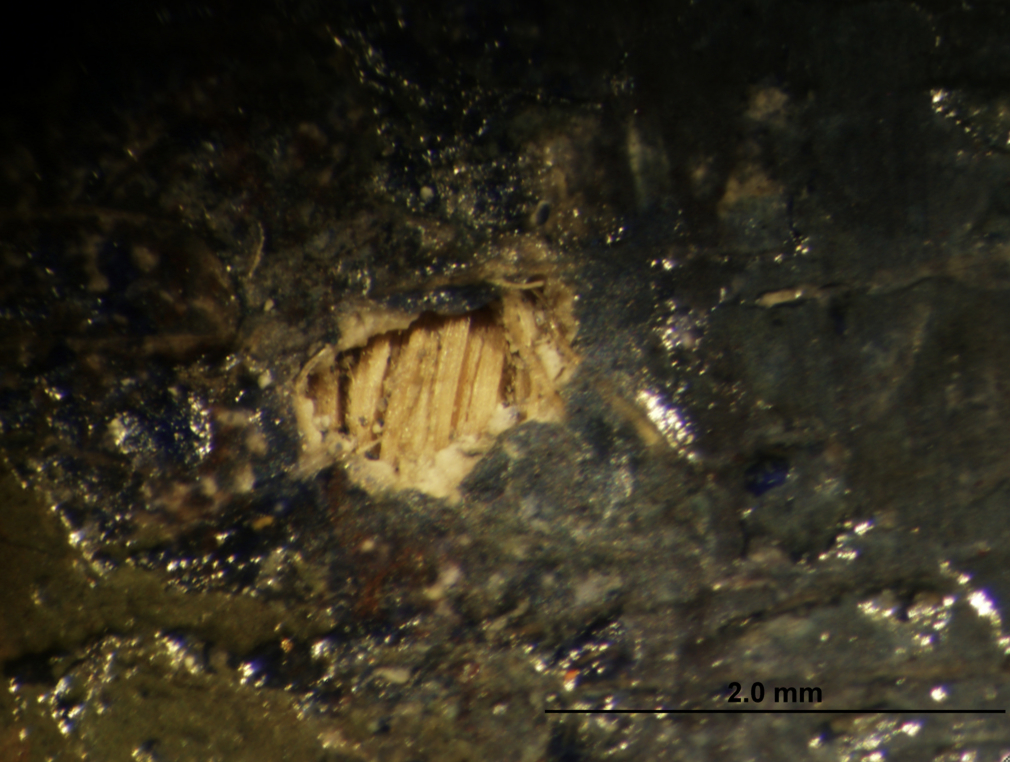
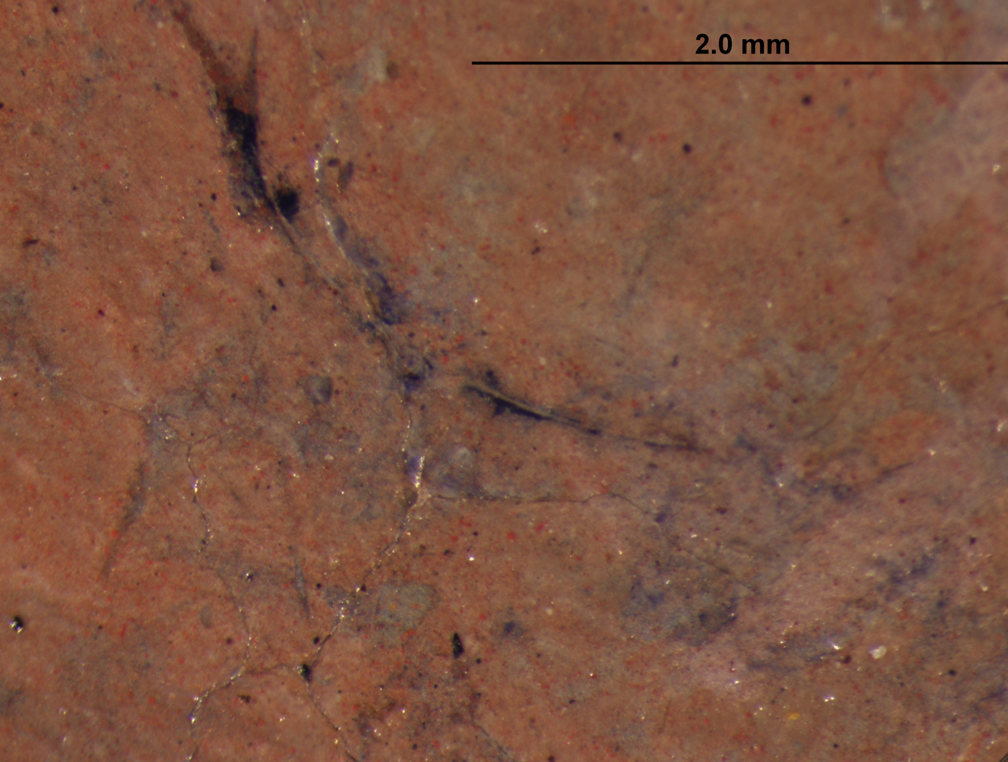
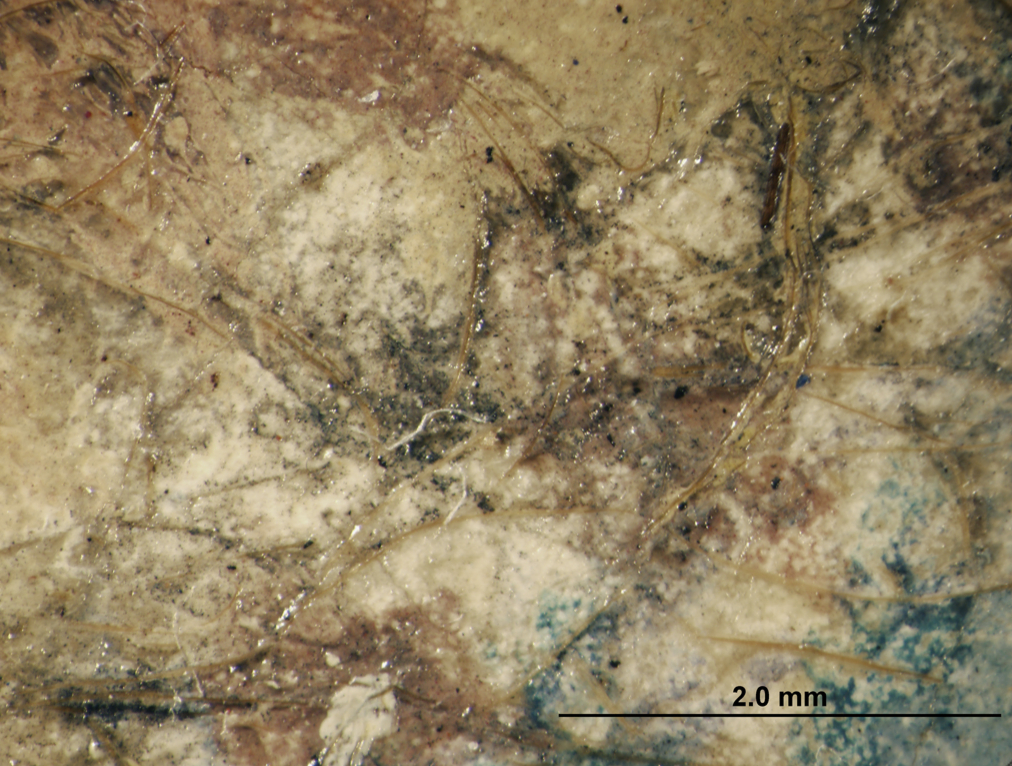
There is no evidence of a glue layer by [glossary:cross-sectional analysis]. Stereomicroscopic examination revealed a glossy material in a small loss that might be glue or the result of consolidation or lining rather than sizing (fig. 1.6).
Ground application/texture
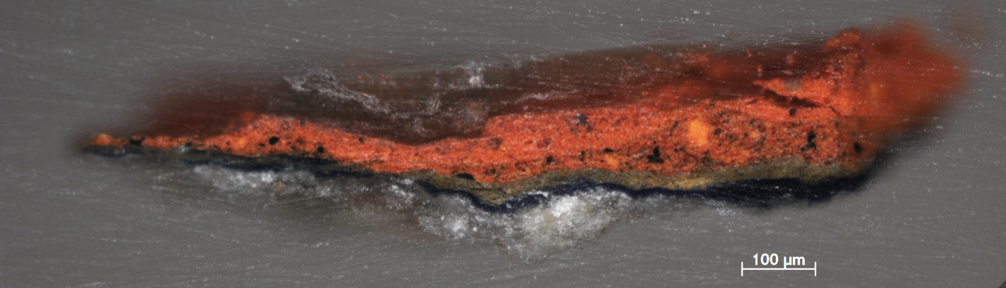
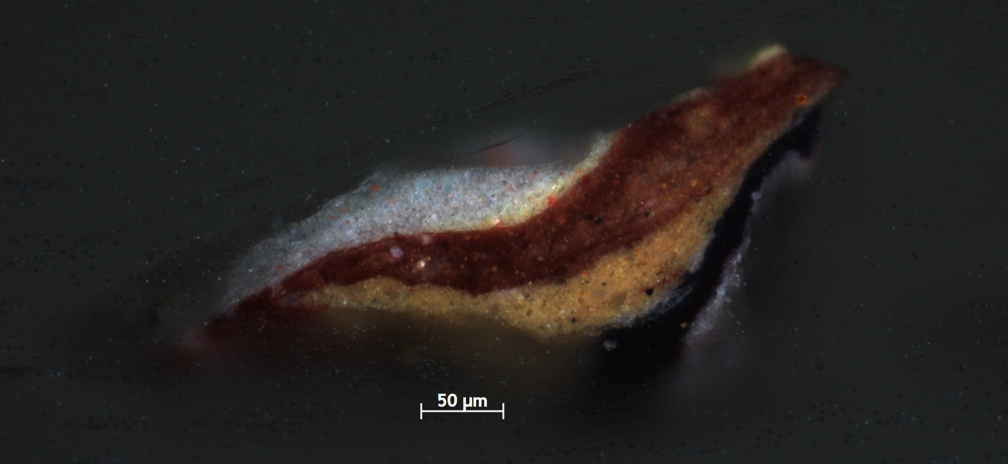
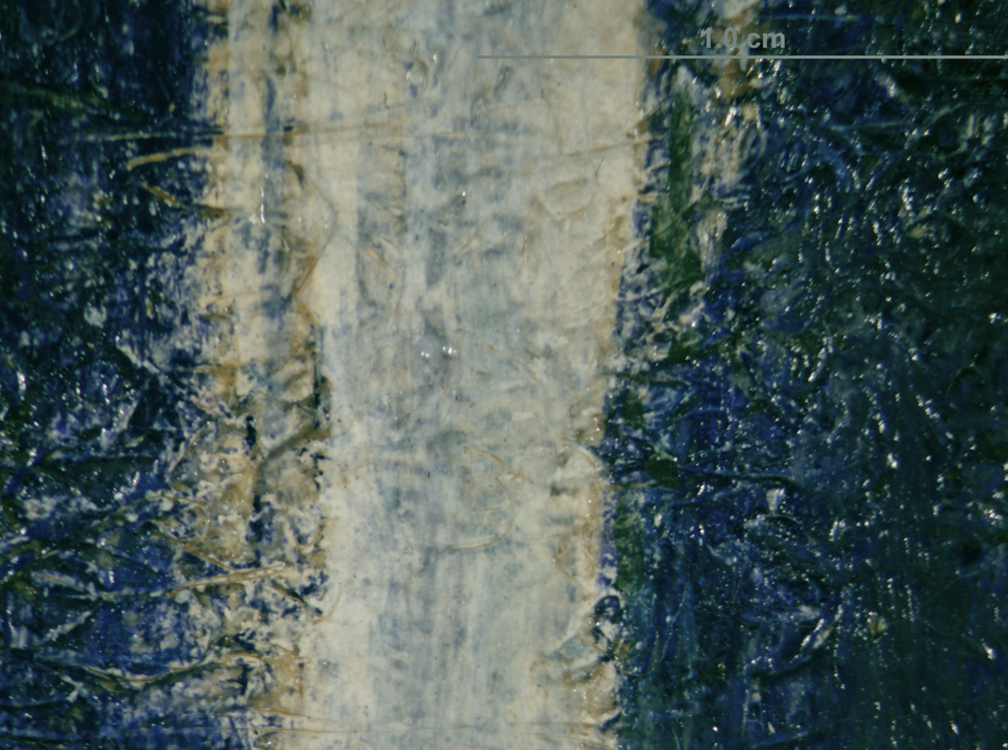
The ground is so thin (36–96 μm) that it does not obscure the coarse texture of the canvas (fig. 1.7). It was probably applied by brush after the canvas was stretched. While many fibers are embedded in the ground, other fibers project through it and are barely covered by the thin paint layers, creating a webbed, hairy surface (fig. 1.8). The ground is still visible at the tip and edge of the fan handle. It is also visible in areas of the white dress stripes, although most of the white stripes have been covered with an additional white paint layer.
Color
White. Appears slightly yellow. Because the ground is so thin, the yellow jute fibers are probably affecting the color. What little ground is visible is also stained by discolored varnish residues (fig. 1.9).
Materials/composition
Analysis identified a calcium carbonate ground in the form of chalk, with microfossils and traces of silicate minerals often associated with natural chalk.
Compositional Planning/Underdrawing/Painted Sketch
Extent/character
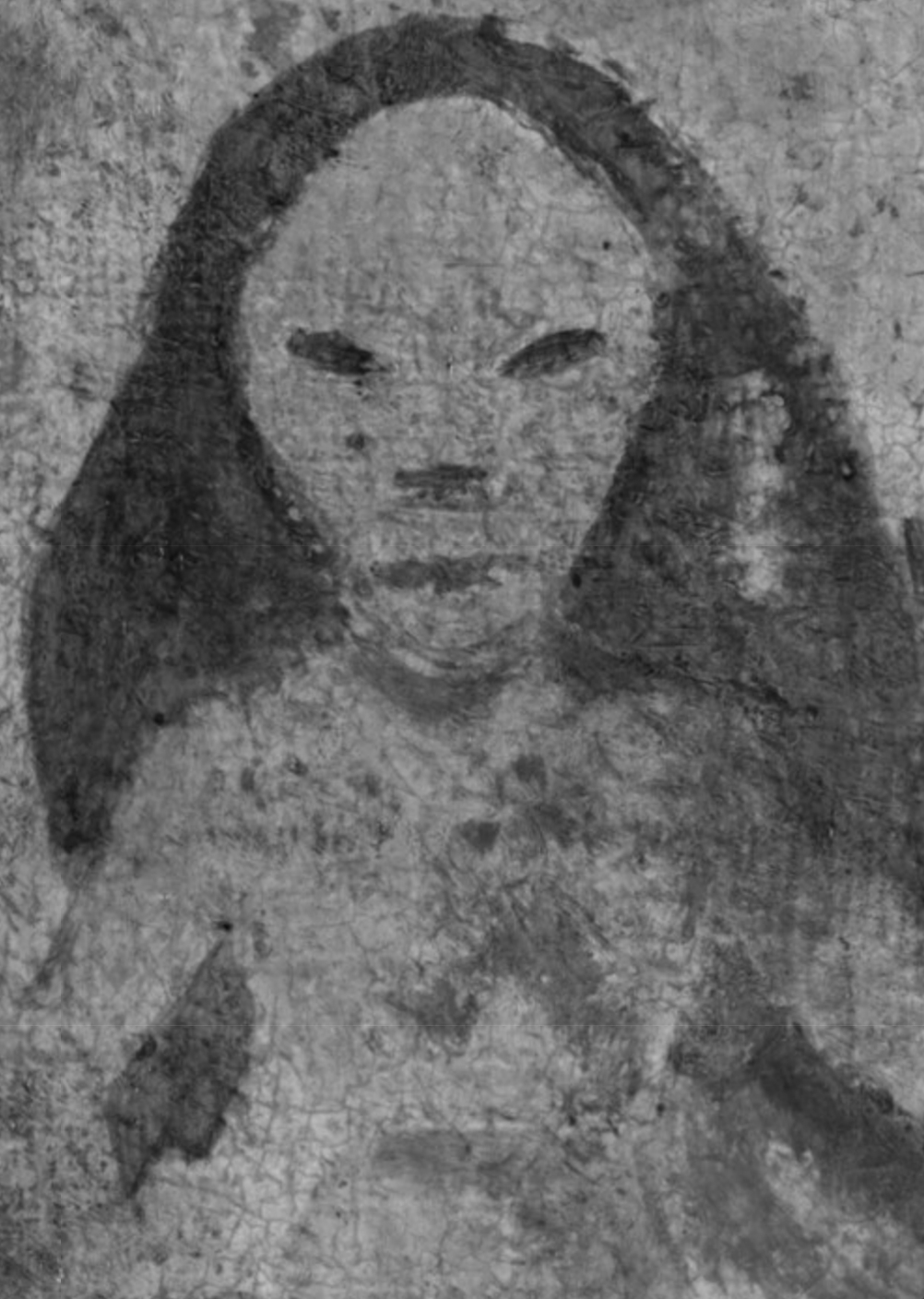
The drawing of the same size Head of Tahitian Women, Frontal and Profile Views (cat. 49) almost exactly matches Tehamana’s head in the painting and was most likely its source, transferred by tracing (fig. 1.10). The only significant differences are the directional gaze, and a higher forehead and top of the head in the drawing, and an ever so slightly rounder jaw and higher eyebrows in the painting.
The [glossary:infrared reflectogram] shows an underdrawing of thin lines in a few spots of the painting marking the contours of major elements. Some lines lie directly on the ground, and others were drawn over the underlayers. Lines drawn directly on the ground are seen in reflected infrared around the outer edge of Hina’s hair (fig. 1.12). Black charcoal particles were picked up by the pale-blue layer painted over these lines, as is visible under [glossary:stereomicroscopic examination], an indication that the artist may have used charcoal for the underdrawing. A drawn line is also revealed over the tan underlayer, outlining the V-shaped ribbon that at some point in the painting process held a round pendant on Hina’s chest. The orange paint of her body covered these charcoal lines, picking up the black particles as well (fig. 1.13).
Dark-blue sketch lines were also painted directly on the ground. Sketch lines are visible at the figure’s left shoulder in different positions (fig. 1.21). The slight ridge centered at Tehamana’s brow was indicated in the blue painted sketch, and the line is still faintly visible (fig. 1.15). The glyphs in the upper background were also part of the initial plan, since both the drawing and blue painted outlines are present on the ground.
In places Gauguin purposefully left the painted sketch lines uncovered, but the initial contours are easily confused with the dark-blue contour lines that Gauguin added later in the painting process. The sketch was left exposed to depict one knuckle on each of Tehamana’s hands, as well as in spots in the dress and at contours. Many of the initial blue lines, such as in the hand, appear oddly reticulated (fig. 1.16).
Medium/technique
The drawn lines appear to be charcoal. The particles dislodged by the ensuing paint explain why so few lines remain visible in reflected infrared (fig. 1.17). Traces of charcoal black particles were found in many of the pigment mixtures identified by [glossary:PLM].
The blue sketch lines were not analyzed, but are most likely painted in dilute oil.
Revisions
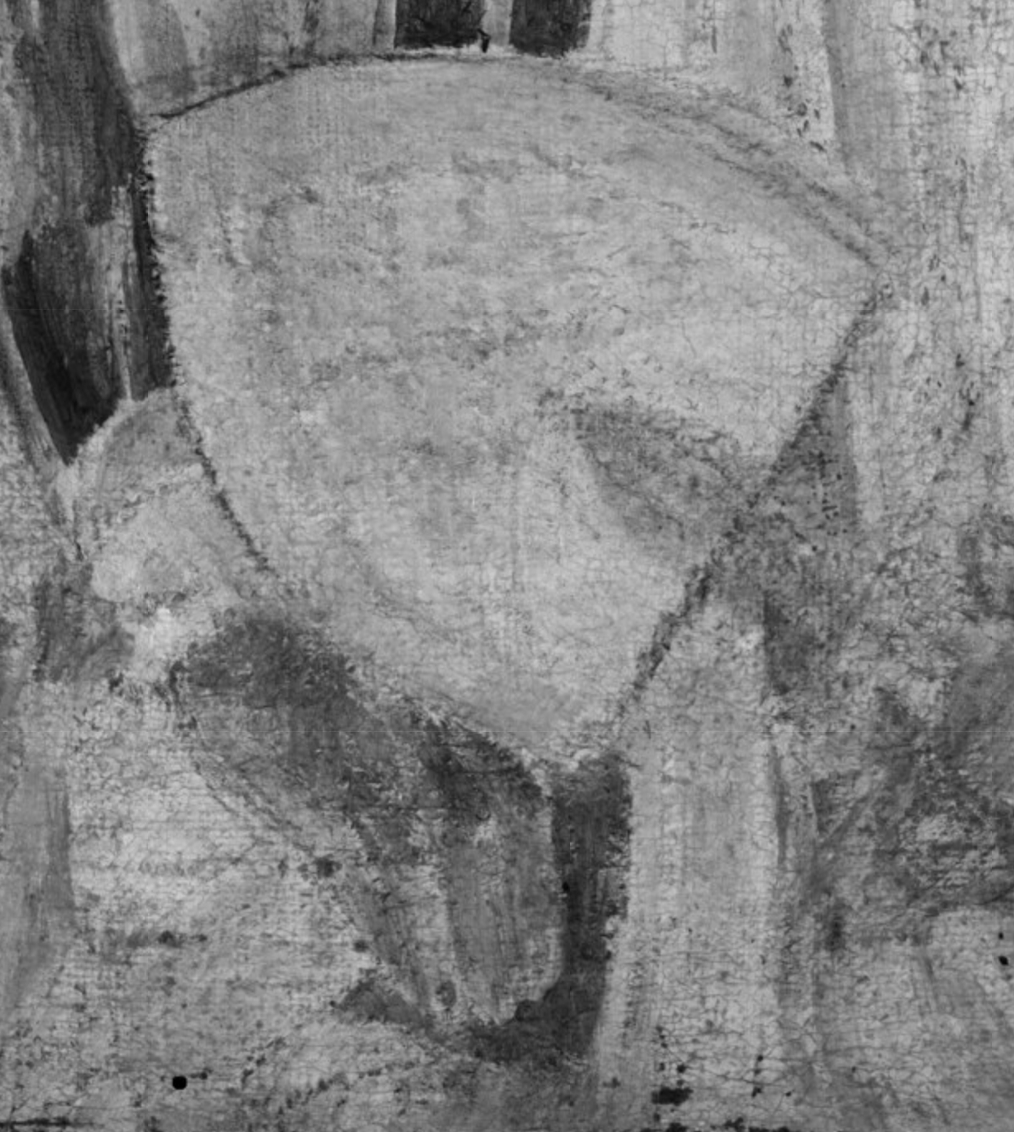
As seen in reflected infrared (1.1–1.4 μm), there are several different contour lines drawn on the ground for the fan (fig. 1.18). It also appears that at one point the fan may have extended considerably lower down the present shaft.
Paint Layer
Application and artist’s revisions
After the initial drawing and painted sketch, Gauguin added thin layers of color to block in the different areas. For example, the entire wall behind the figure was laid in with a thin tan layer that translucently covered the drawings of Hina and the glyphs. Tehamana’s face was underlaid with shades of yellow. Tehamana’s dress had been drawn with stripes from the beginning, reinforced with the painted sketch lines, and did not receive a continuous underlayer.
Tehamana’s brown hair shines with a variety of colors: yellow, orange and red highlights, deep blue-green and red-brown shadows, and pale-green scumbles (fig. 1.19). It originally fell in more luxurious tresses down the front of her gown. With the combined use of stereomicroscopic examination and reflected infrared images it was determined that on the left side Tehamana’s hair fanned out toward her shoulder, falling down over it in strands, and that her hair also covered most of the left collar and yoke of the dress, with wisps hanging 1 cm below the yoke (fig. 1.20). Reflected infrared clearly shows thicker waves above her shoulder, and a shadow across the collar and yolk where the hair was painted. The presence of this mass of hair is corroborated by analysis and by numerous glimpses under the stereomicroscope of the red-brown layer where not completely covered with the background and dress’s stripes (fig. 1.23, fig. 1.21).
Most interesting are the two round shapes that suggest earrings, revealed in the X-ray (see fig. 1.20). Gauguin underpainted these discs with a warm white, covering the hair underneath (fig. 1.26). This underlayer ensured that light would be reflected back out through the color (presumably yellow) to be painted on top, making it brighter, but he abandoned the earrings in this underpainted stage without assigning color to them, and covered them again with hair.
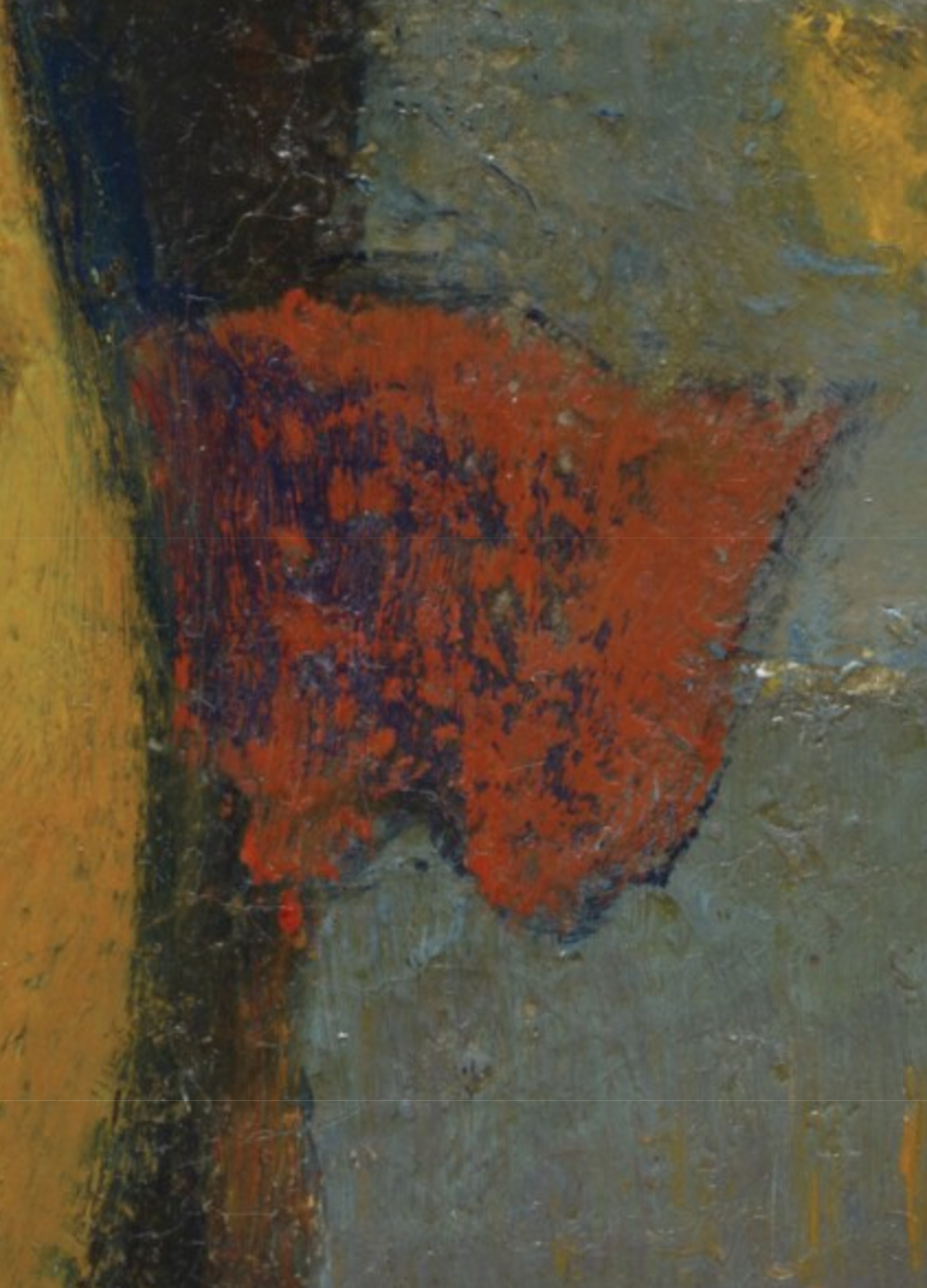
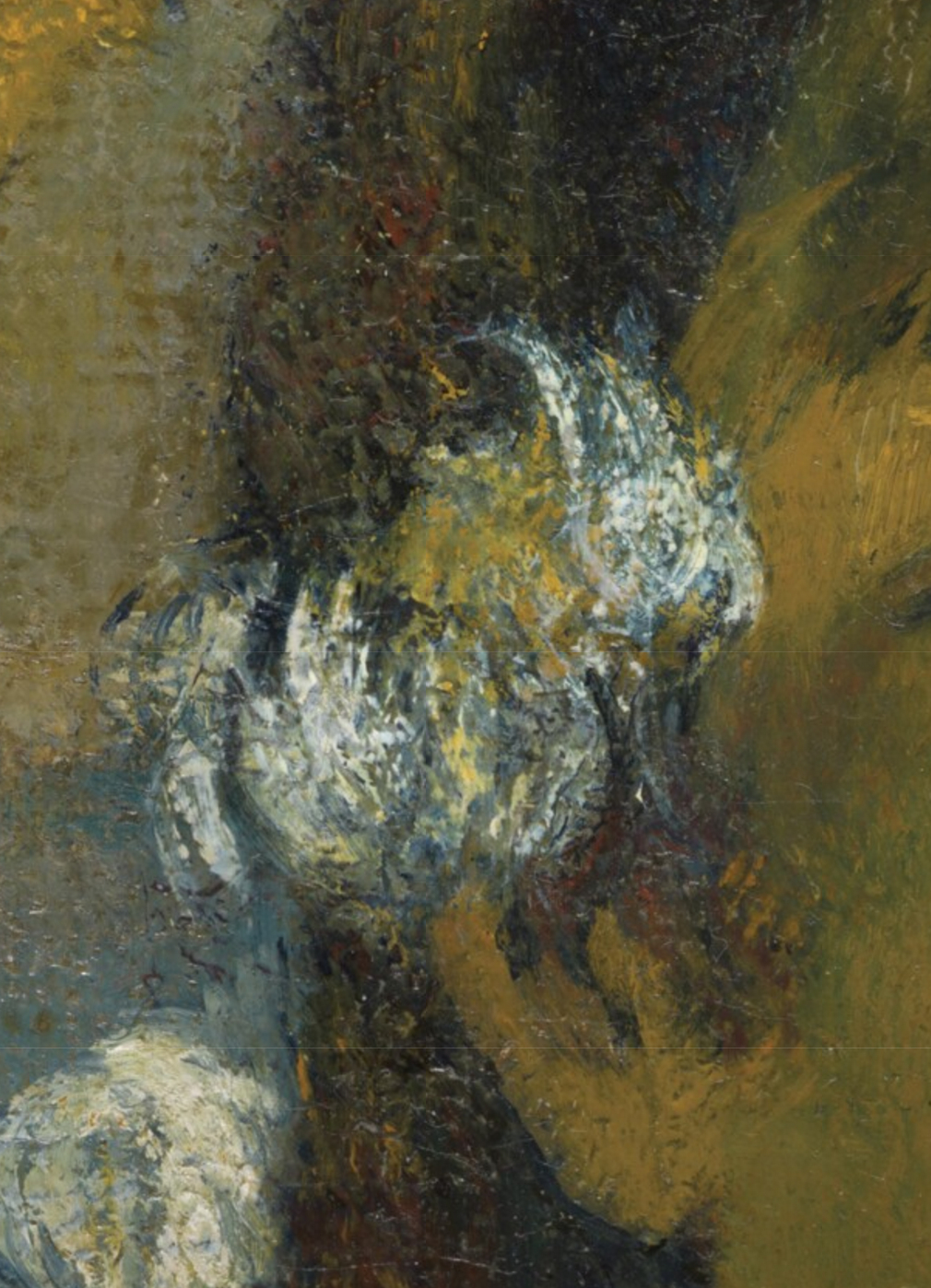
In the X-ray there is a bright halo around Tehamana’s head, painted in radiating white strokes (fig. 50.93). This is where her hair at one point extended higher at the top of her head and was painted out with a dense white layer before the background was extended over it (fig. 1.27). The brown hair also extended a little further down on her forehead. Tehamana’s face was originally approximately 0.5 cm wider on the right side. This is clearly revealed in transmitted infrared for the upper cheekbone and in reflected infrared for below the cheekbone. Her features were also initially painted slightly to the right. It is difficult to read the features in the X-ray, but it clearly shows how her lips extended further on that side, and the dark pupil in the left eye is also placed farther to the right (fig. 1.28). Where on the proper left side a red ribbon projects, the X-ray suggests it might earlier have been a rounded flower. And on the figure’s proper right side, above the flowers at her ear, the X-ray exhibits long curved elements that look very much like a ribbon, or possibly a long leaf, placed on this side instead. Initially, the present red ribbon had more impasto, and Gauguin shaded it with dark blue (fig. 1.30). He later scraped it down, however, leaving remnants of the blue shading in the interstices. The flowers on the left side were also vigorously scraped, revealing the top of Tehamana’s ear between the flower petals.
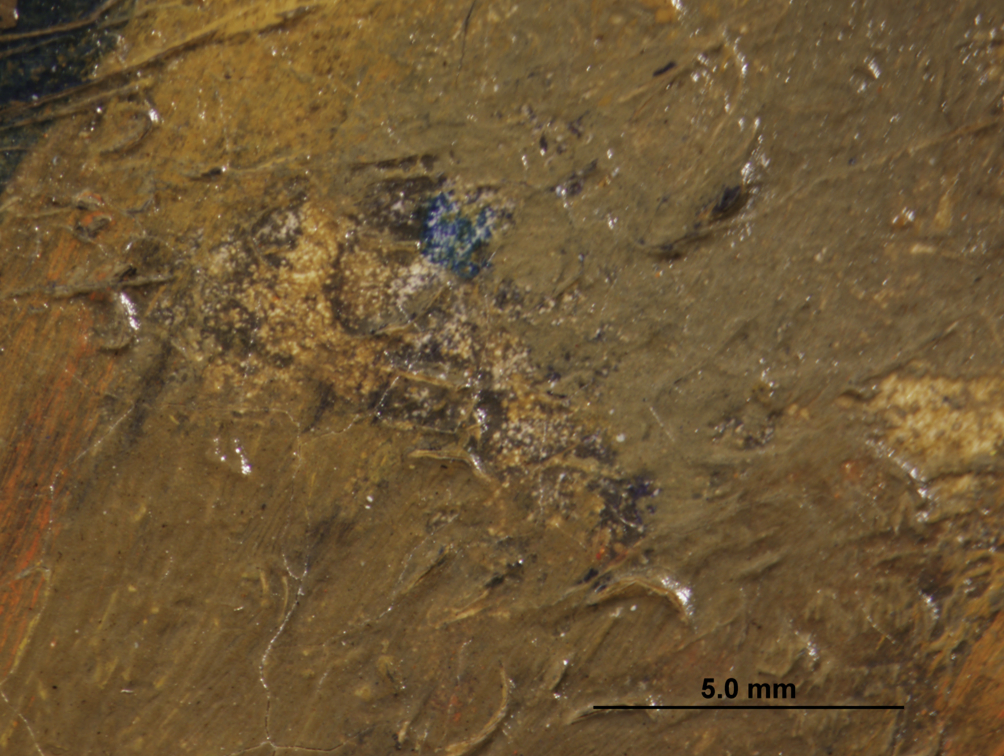
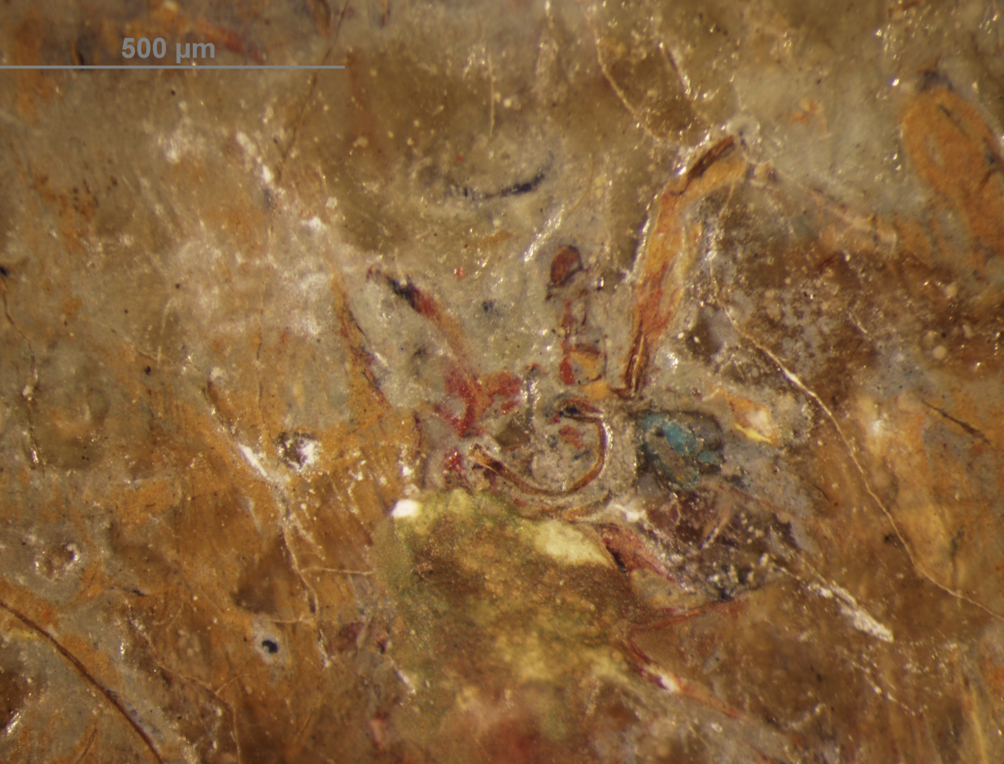
Stereomicroscopic examination reveals that the artist had first painted Hina’s lower belly unclothed, with orange shading and a black triangle, over which he scumbled the thin gray cloth. Gauguin worked up the goddess’s body with diverse shades of orange in a blotchy pattern appearing worn down by time, although her face is more evenly covered and complete, giving it, as does its relatively large size, a strong presence. The goddess’s facial features are revealed in reflected infrared to have been smaller, particularly her nose. Gauguin enlarged them all with new blue contours and filled them in with blue-green, giving the eyes a flat, ghostly aspect and the head a skull-like appearance. The goddess Hina’s hair was initially a brighter green and blue-green but was overlaid with tan, which dulled it (fig. 1.34). Hina was first painted wearing a tall and slender orange and red headdress, spots of which are revealed with the stereomicroscope under the pale-blue second layer of the background (fig. 1.37 and fig. 1.38). The headdress extended up in front of the edge of the molding and down slightly in front of her hair.
While Hina was drawn on the ground, the ancestor head next to Tehamana’s shoulder was drawn and painted on top of the first tan underlayer, and the more translucent and ghostly orange head was drawn and added later still, on top of the pale-blue second layer of the background (see fig. 1.4).
Technique
The artist painted Tehamana’s face in several stages, allowing it to dry between layers. First, Gauguin applied shades of yellow. He then modeled the face with olive-green, tan, and purplish tan. The olive middle layer is visible in the skips between later brushstrokes, and the purple shading is seen below the nose and lips (fig. 1.39). Over this, the face was worked up with different shades of orange, with the addition of green and red-brown shadows and yellow highlights. Yellow reflected light was blended into the shadows. Smoothing and blending with the knife is seen on the bright side of the face, with dry brushing used below each corner of the eye. Then Gauguin broke up the smooth green at the outside corner of the eye with parallel scratches. On the darker side of the face, the artist completely wiped away the green shading in the center to give the cheek a rounder form, and added hot-orange reflected light at the jaw and corner of the nose (fig. 1.40). Gauguin continued to work the surface of Tehamana’s face by manipulating the paint after it was applied. He primarily used dry brushing to produce smooth, [glossary:wet-in-wet] blending of one color into another, while a sense of the artist’s more direct handling is preserved in diagonal hatching and small fillips of the brush. On Tehamana’s proper right side, the neck has a dark-olive shadow only lightly covered with dark orange, the brush barely touching down. The paint was then partially dry brushed away to soften it further. At the cheekbones it appears that some of the overlying orange was wiped away to strengthen the green shadow. The general effect of the paint in the face is smoothly nuanced, with soft, golden light playing across its surface. The thick layering insures that the fibers of the jute canvas are not in evidence here. The eyes, too, have been layered with different colors. In the lower layers, they are yellow with orange shading, pink highlights, and red flickering in the irises. Over this Gauguin painted the irises a deep purple with dark-blue shading, again with pink highlights, and painted the whites pale green and blue, a cool contrast with the warm colors of the face (fig. 1.41).
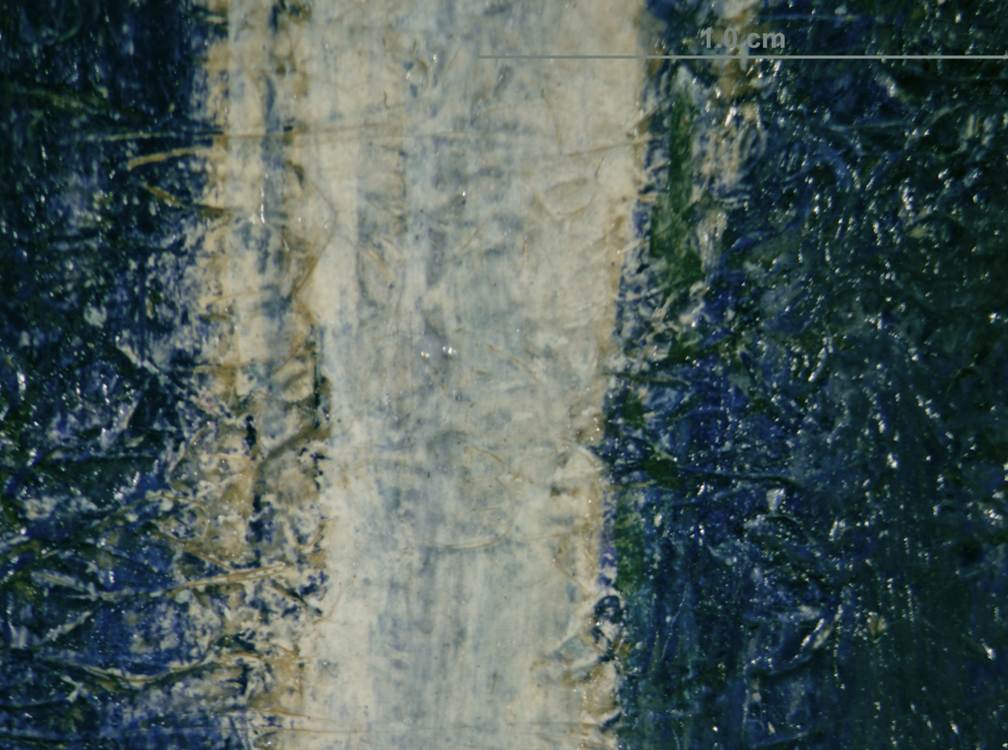
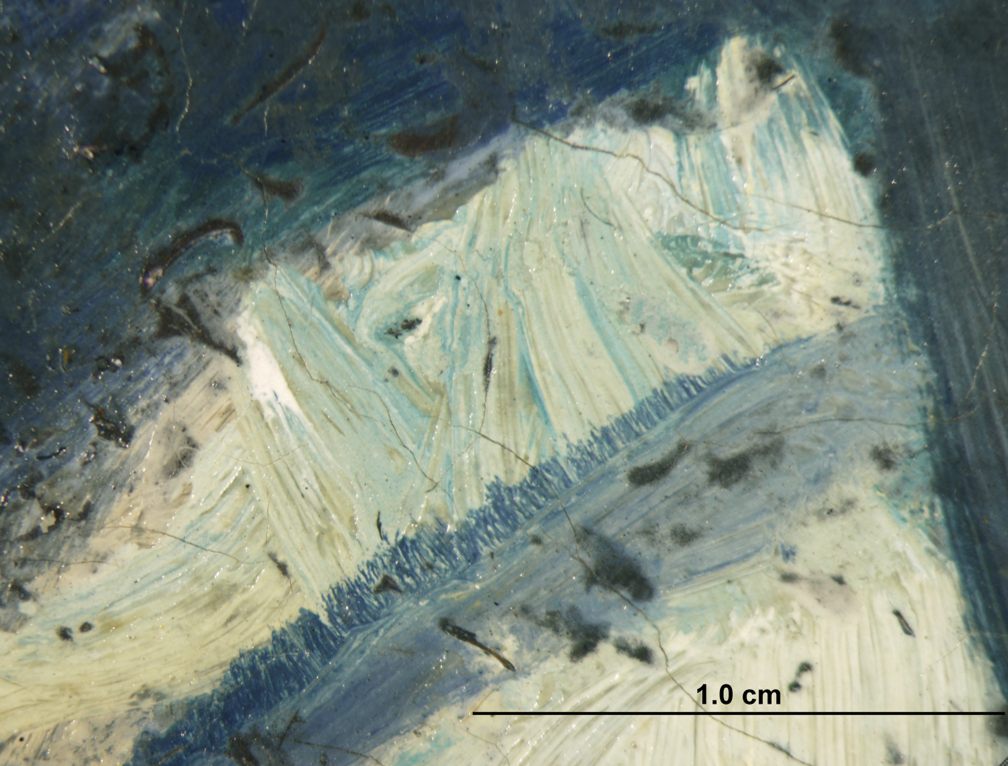
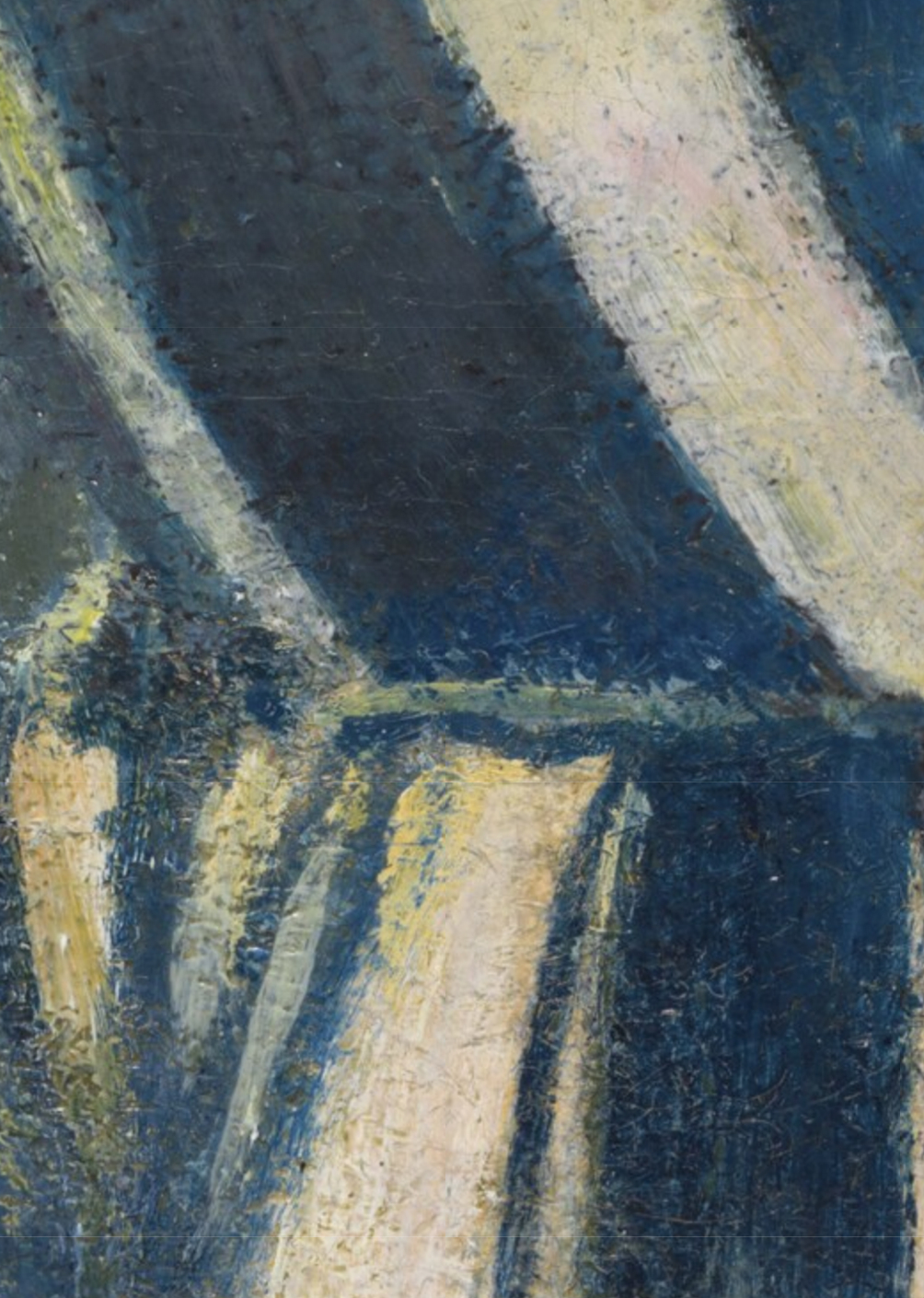
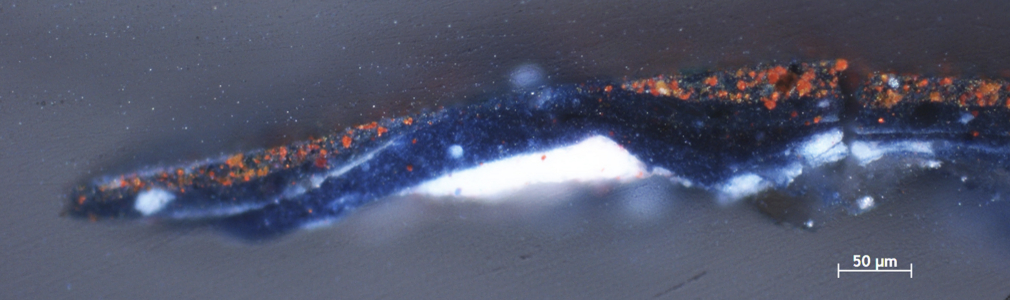
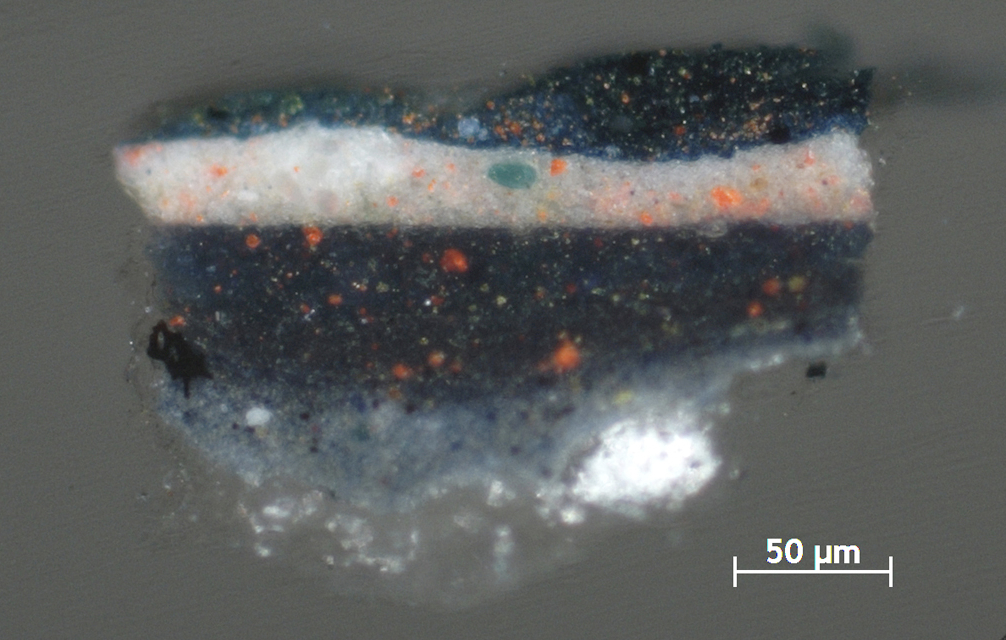
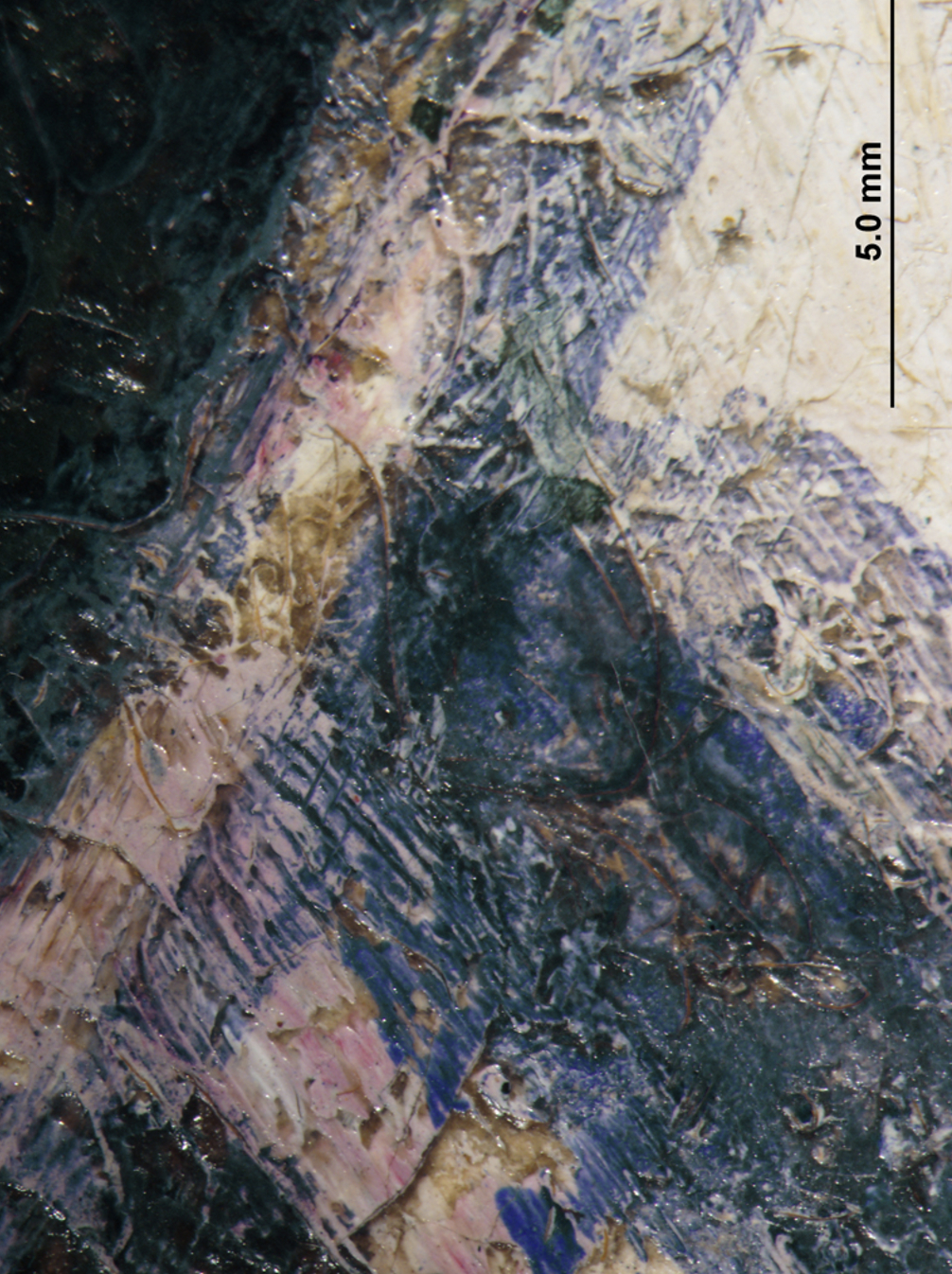
Over the ground, the stripes of the dress were first laid in with transparent dark blue and thin white. The added white layer did not change the color of the ground, but Gauguin also used this white to skim over many blue sketch lines, changing them to a lighter blue, and sometimes added a little white impasto (fig. 1.42). After the blue stripes were laid in transparently, he darkened portions or wiped them back to regain greater transparency. Later he created shadows on the blues with opaque grays and reddish browns. On the whites he added many delicate tones—red, pink, yellow, lavender, blue-green, orange, and green (also seen in the orange and green button), as well as blues and grays (fig. 1.43). These tints are sometimes thinly painted, other times diluted into washes or glazes, often layered one upon another, and sometimes wiped back to soften the intensity (fig. 1.44). There are areas of textured impasto in the whites, and the thinly painted blue stripes exhibit a sense of texture, created by the roughened jute fibers that project through the thin ground and are barely covered by the thin blues (fig. 50.94). In the yoke of the dress, the application of color is generally thicker and more even, perhaps because the artist was covering the previous dark hair, which he first painted out with light blue, after which he changed the stripes slightly. The flatter tones here also serve to set off the punctuated lace and function like a more solid pedestal for the head above. Generally, Gauguin seems to have relished variations rather than an even application in this painting, and the result is fluctuations of color, transparency, and warm and cool tones across the gown’s surface.
In the sleeves, the blue-and-white patterns take on an abstract life of their own, with greater complexity on the figure’s proper right sleeve and an abstract angularity on her proper left (fig. 1.4). Below the shoulder, the figure’s right sleeve was overpainted completely with a white layer. After the white layer, he painted the blue stripes freehand, without an underlying sketch. These stripes were determined by the brushstrokes as they were applied rather than by a preliminary drawing (fig. 1.45). The stripes seem to expand and contract in an illogical manner, but this produces a sense of shifting bulges and lends volume to the sleeve. In the body of the dress, on the other hand, the drawing defined discrete shapes that were later filled in with the brush (fig. 1.46). In the proper left sleeve, a comparison of the X-ray and the final state reveals that different folds were painted earlier, but were changed during the painting process, as Gauguin experimented with portraying concave dips and puckers in the fabric (fig. 1.47).
For the glyphs in the upper background, Gauguin used a technique that produced an aged, worn quality. The glyphs were drawn and then reinforced with painted blue sketch lines. Over this and the entire background, he laid in a thin, translucent olive-tan underlayer. He then painted the glyphs with yellow and surrounded them with a blue-green wall layer, sometimes straying over the letters. This blue green is more intense on the right side of the composition, while on the molding strip below the color is stronger on the left side, the more intense horizontal band switching positions at Tehamana’s head (see fig. 1.4). The artist lightly added a few purple contour lines around the letters and a few streaks of black to simulate old nicks or stains on the wall. Similar black lines were added on the wall next to the fruit. Last, Gauguin added another intermittent tan layer over the yellow glyphs and blue-green surround. This he wiped, scraped back, and abraded in many areas, giving the whole frieze a worn appearance. Where the tan was wiped off the yellow to reveal its intensity, it glitters like gold (fig. 1.48).
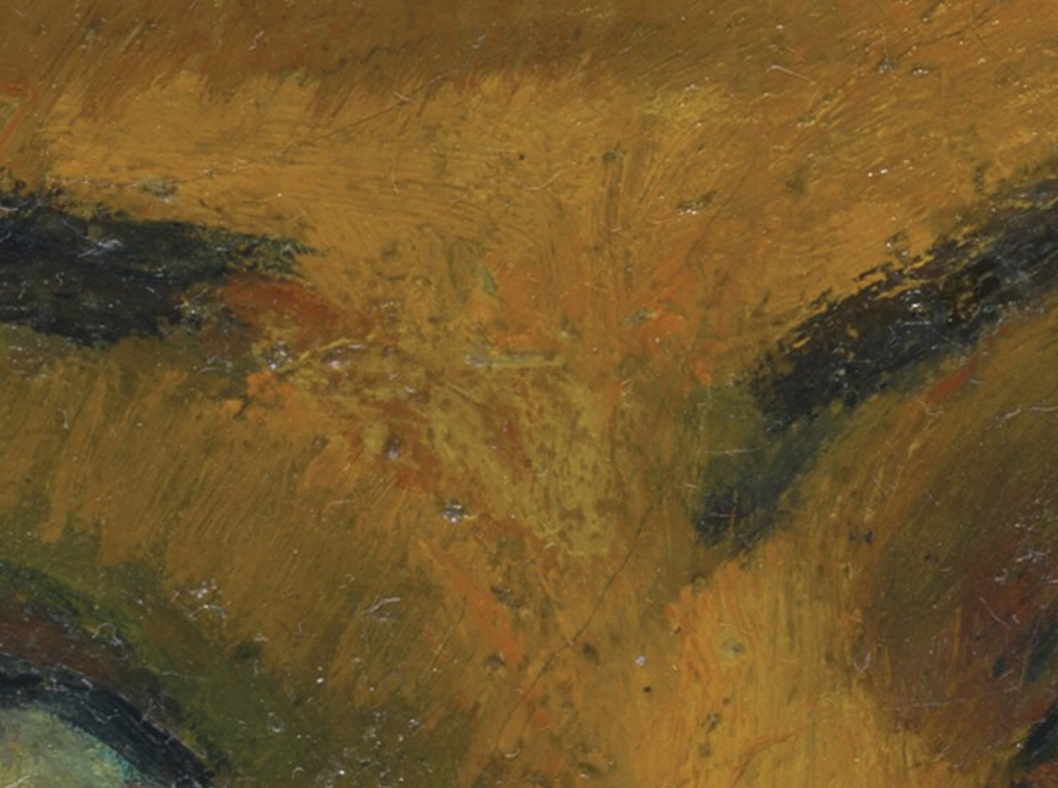
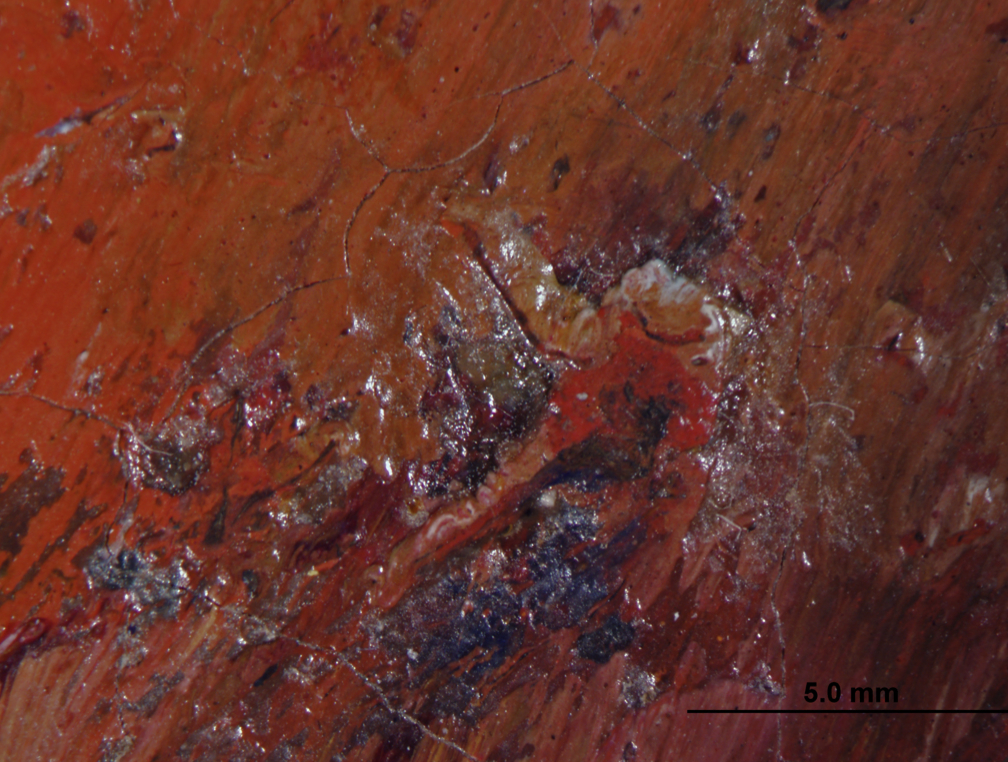
There is a underdrawing for the rightmost fruit directly on the ground, which indicates that it was part of the initial composition. In painting it, Gauguin relied on a technique he had first used in early paintings. As in the orange tankard in Still Life: Wood Tankard and Metal Pitcher (cat. 1), he laid down a thick, white impasto for the highlight, which he covered with a thin layer of orange. In this way he created a tactile surface with impasto without having to use the more costly vermilion pigment as thickly while retaining the more reflective layering of a thin color over white (fig. 1.49). In Merahi metua no Tehamana he added wet-in-wet diagonal hatching around the impasto on the fruit in different colors, similar to his copy of Cézanne’s fruit in Portrait of a Woman in front of a Still Life by Cézanne (cat. 23) (fig. 1.50). He adjusted the fruit’s top edge to make it rounder. The left fruit was painted later, on top of the background layers.
Painting tools
Gauguin used small brushes, generally 0.3 and 0.5 cm in size, and a 0.1 cm brush for his signature, inscription and some contour and dress lines (based on width of brushstrokes).
A palette knife was used in the face to blend and flatten the paint and in several areas throughout the painting. He also used a knife to scrape and abrade layers. He used a pointed tool to make scratches in the paint, and a cloth to wipe areas thinner or smoother.
Palette
Analysis indicates the presence of the following pigments: lead white, zinc white, chrome yellow (both light and medium), iron oxide yellow with associated silicate minerals, burnt sienna, possibly iron oxide red, vermilion, red lead, red lake (possibly two types), ultramarine blue, Prussian blue, cobalt blue, viridian, emerald green, silica, calcium carbonate, barium sulfate, silicates, and a little black.
The salmon-colored fluorescence in [glossary:ultraviolet] light suggests the use of a red lake pigment in the fan details, flesh, and touches in the dress.
Binding media
Oil (estimated)
Surface Finish
Varnish layer/media
The painting’s varnish and the underlying waxy material were analyzed in 1997 and were found to be a [glossary:natural-resin varnish] over a beeswax coating. The wax coating on the paint surface was possibly applied by Gauguin rather than at his request. Since this work was probably completed in early 1893, soon before Gauguin departed for France in July, and he likely would have prepared it for the Durand-Ruel exhibition in November 1893, it is possible that he himself waxed it. The overlying varnish was not applied by the artist, and its gloss and discoloration were visually disturbing. In 1997 the varnish was removed to the degree possible. It was thinned but could not be completely removed because of paint solubility issues. After cleaning, a thin spray of Winsor & Newton matte varnish (ketone resin with a wax matting agent) was applied to reduce gloss remaining from the varnish residue.
Conservation History
1980: When the painting entered the collection, it already had an aqueous lining and a discolored natural-resin varnish. The picture’s borders had been filled, overpainted, and edged with two layers of paper tape. The discolored repaint around the edges extended about one inch into the painting, and small touches were scattered elsewhere. Some areas of abrasion, particularly in the blues of the dress, and losses, particularly along the bottom and left edges, were noted.
1997: The lifting and losses along the bottom and left edges were consolidated. The discolored natural-resin varnish was thinned to remove most of the discoloration and gloss. Old repaints were insoluble and could not be removed, so they were corrected with toning. Small losses were filled and inpainted. Abrasion, particularly in the hair and blues of the dress, was also inpainted. The original wax was not removed, although it had gone cloudy in some areas. These cloudy areas were toned to minimize the disruption of form. A matte spray varnish was applied (see Varnish layer/media) to further reduce the surface gloss.
Condition Summary
The painting is in a very good condition. The lining performed prior to entering the Art Institute collection in 1980 caused flattening and [glossary:skinning] of the paint in some areas. The heat of lining may have caused wax to enter the paint layers, making them more soluble and subject to abrasion. A possible previous cleaning may also have caused some abrasion. Gauguin himself wiped and scraped back the paint, and this technique was accompanied by abrasion that can be seen to continue under subsequent paint layers (fig. 1.44). There is abrasion in the inscription, and the missing spots were inpainted at some point before the picture was acquired by the Art Institute .
The cleaning and [glossary:inpainting] of 1997, were finessed to bring back as much of the original appearance as possible while maintaining the integrity of the whole without embarking on aggressive cleaning and retouching.
Kristin Hoermann Lister
Frame
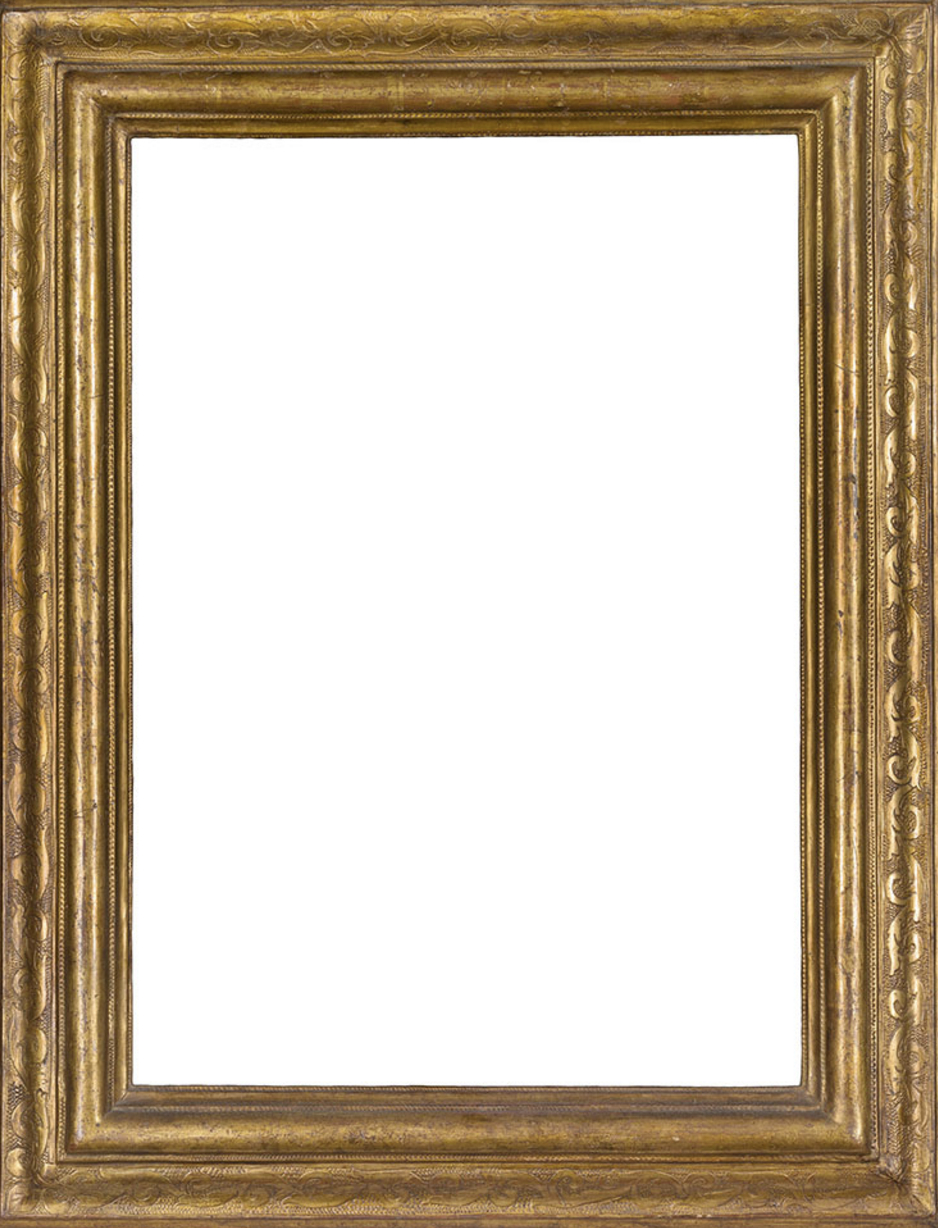
Current frame (installed 2002): The frame is not original to the painting. It is a late-seventeenth–early-eighteenth-century, French (Provençal), late Baroque frame with a bolection profile with engraved foliate scrolling and fleur-de-les miters on a rocked recut bed. The frame has water gilding on red bole over gesso and is burnished throughout. The carved poplar moldings are mitered and joined by sliding angled dovetails. The molding, from perimeter to interior, is straight exterior side; fillet with rocked recutting; reverse ogee; fillet; ogee with engraved foliate scrolling with fleur-de-les miters on a rocked recut bed; fillet with rocked recutting; torus; fillet with rocked recutting; cove; and cove with rocked recutting at the sight edge (fig. 50.95).
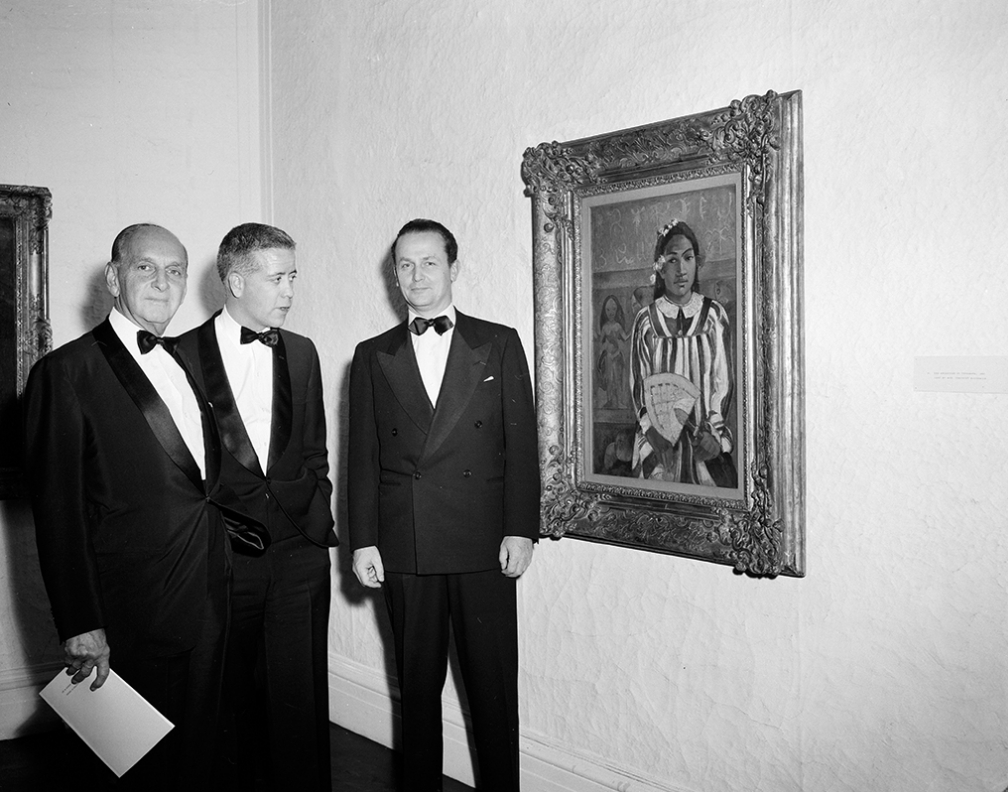
Previous frame (installation date unknown, removed in 2002): The work was previously housed in what appears to be a first-half-of-the-twentieth-century, American, stylized Régence Revival, straight-sided ogee frame with projecting scroll bracketed fleur-de-lis corner cartouches connected by incised foliate scrolls on a quadrillage bed with an independent painted liner. The frame appears to have been water gilded with a cast plaster ornament. The hollow frieze and ornament and incised pattern on the ogee were all burnished. The molding, from perimeter to interior, is straight outside edge; ovolo; scotia side; ogee face with cast plaster projecting scroll bracketed fleur-de-lis corner cartouches connected by incised foliate scrolls on a quadrillage bed; fillet; hollow frieze; convex sight edge with cast leaf tip ornament. The frame also has a independent fillet-and-cove-painted liner (fig. 50.96).
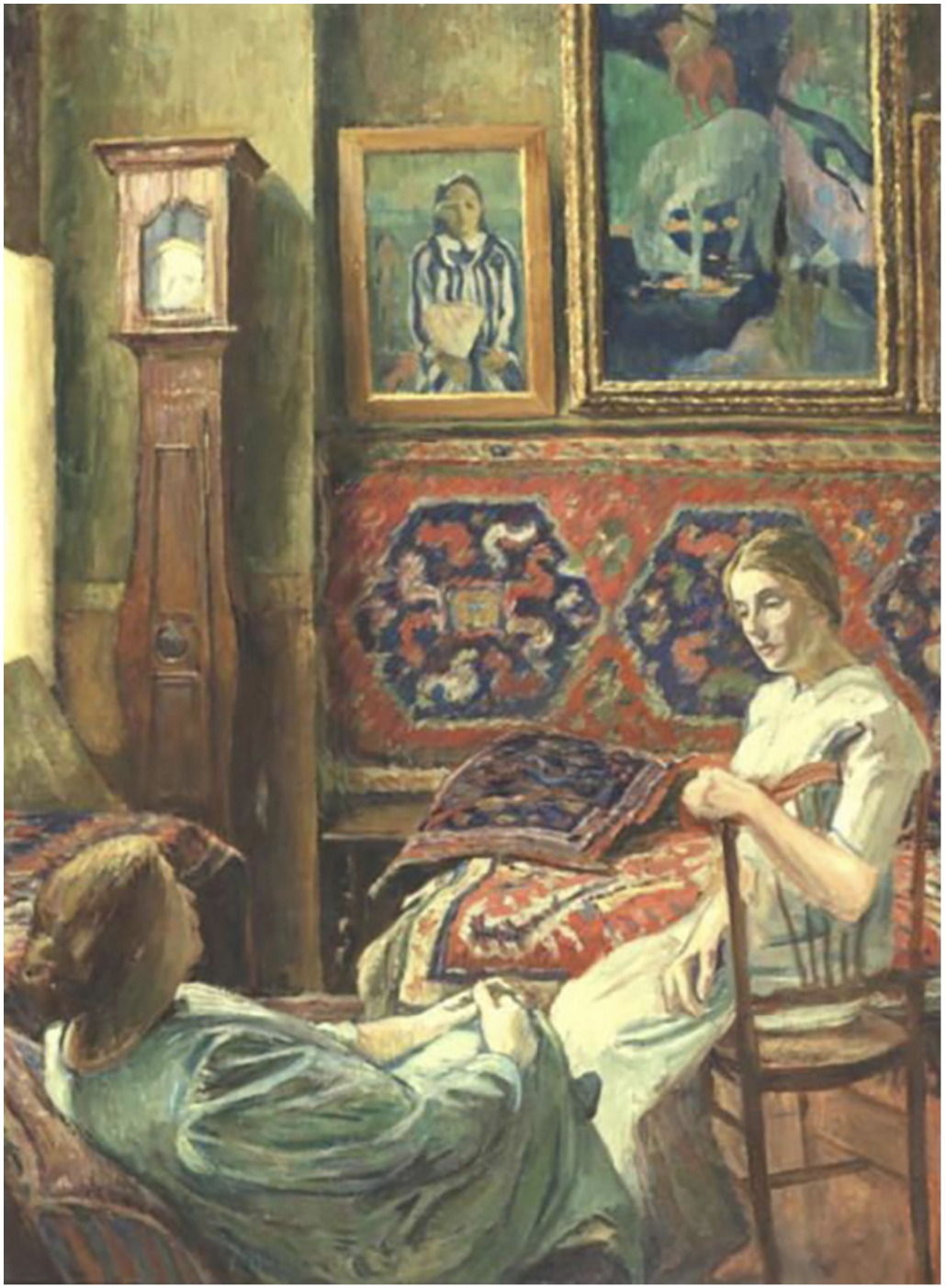
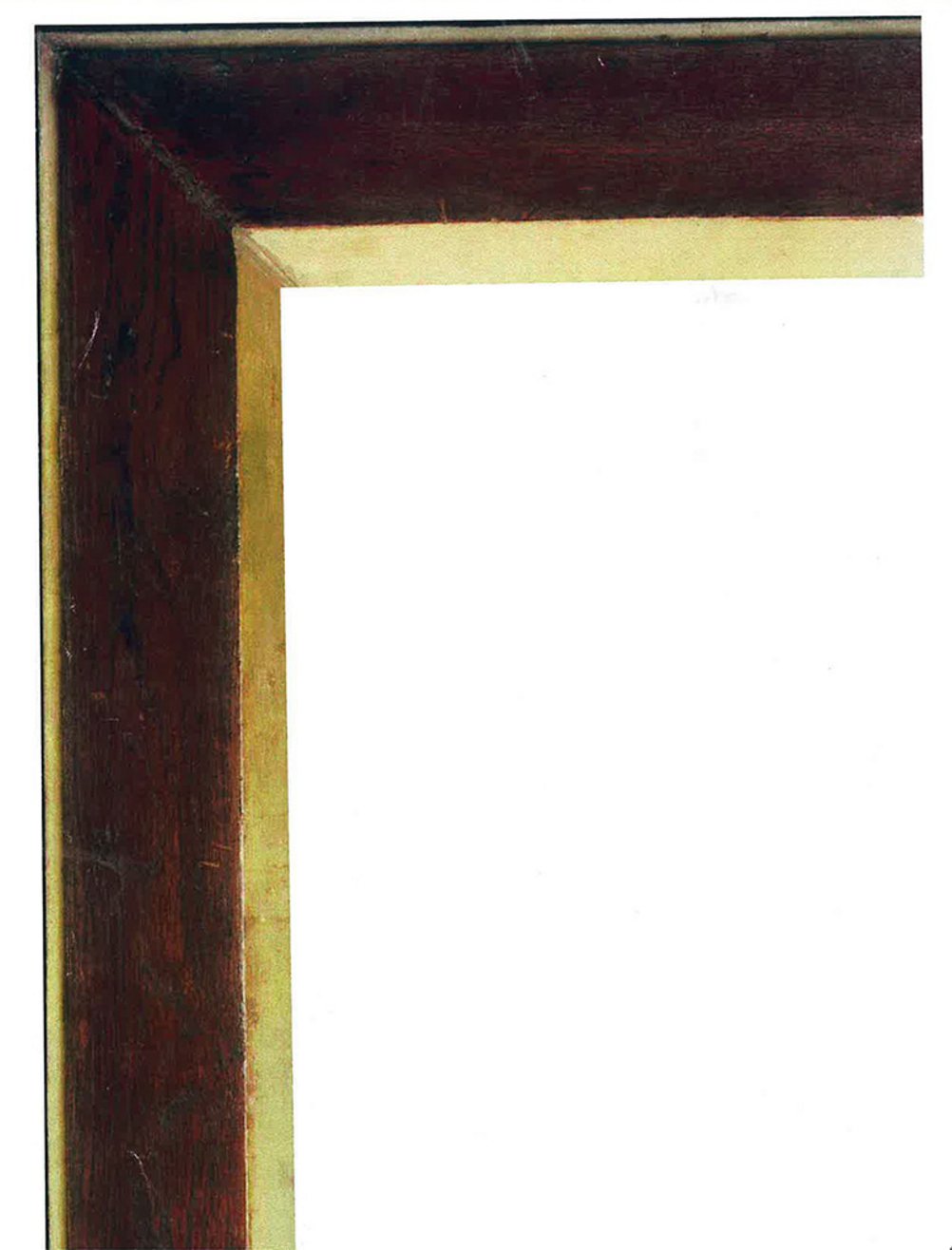
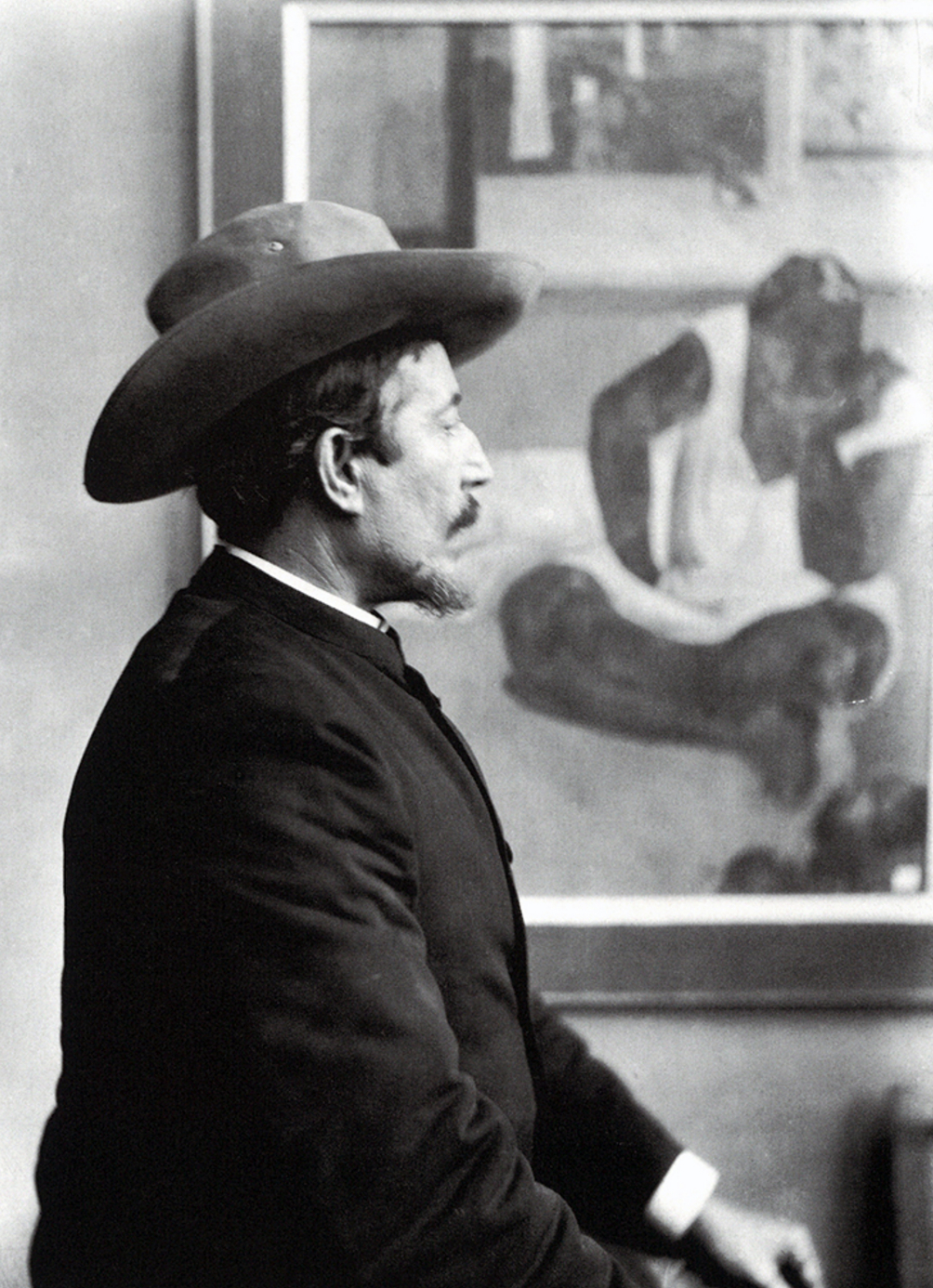
Previous frame: In Georges-Daniel de Monfreid’s painting Conversation in the Studio of Corneilla-de Conflent, the painting appears in what was probably its original frame. The work was brought in by Gauguin at his sale at the Hôtel Drouot, Paris, on February 18, 1895, and subsequently given by the artist to Monfreid. The frame appears somewhat flat in profile in the painting, but more likely it was slightly beveled, increasing in thickness toward the painting, and then beveled down the sight edge. Although it would be difficult to definitively identify this frame, there are French late nineteenth-century frames with this double-bevel profile, often of walnut with a gilded inner bevel at the sight and an outer gilded fillet. These profiles would match frames that appear in photographs of Gauguin circa 1893–1894. (fig. 50.97, fig. 50.98, fig. 50.99, and fig. 50.100).
Kirk Vuillemot
Other Documentation
Labels and Inscriptions
Undated
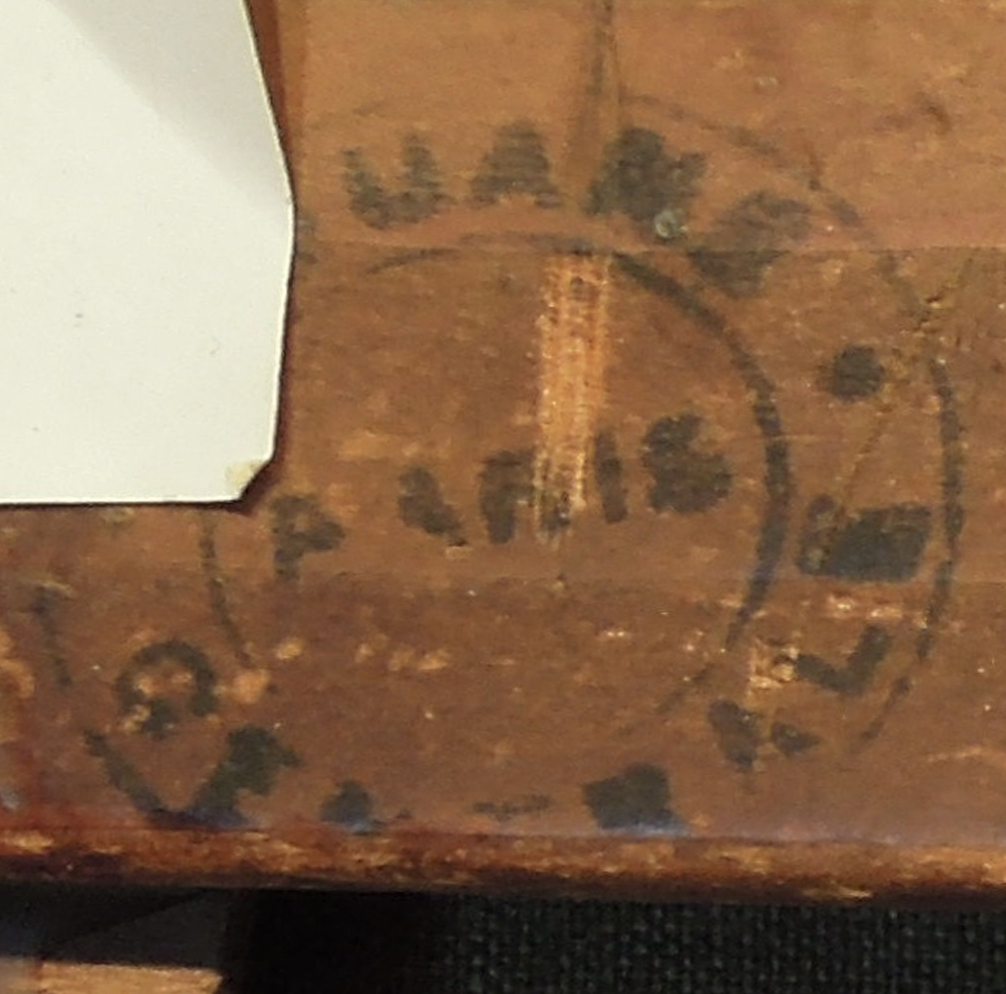
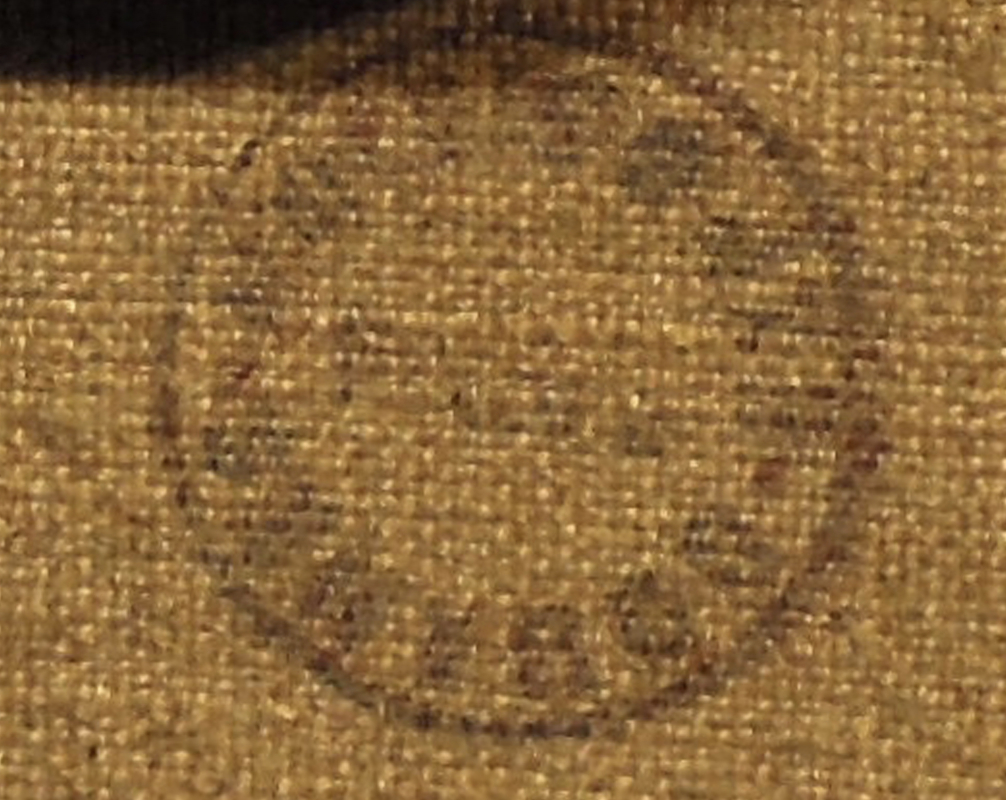
Stamp
Location: canvas verso
Method: circular stamp in black ink
Content: PARIS [through center] / DOUANE [around top] [rest illegible] (fig. 10.71)
Stamp
Location: Paper tape on stretcher
Method: circular stamp in black ink
Content: PARIS [through center] / DOU[ANE] [around top] [rest illegible] (fig. 23.92)
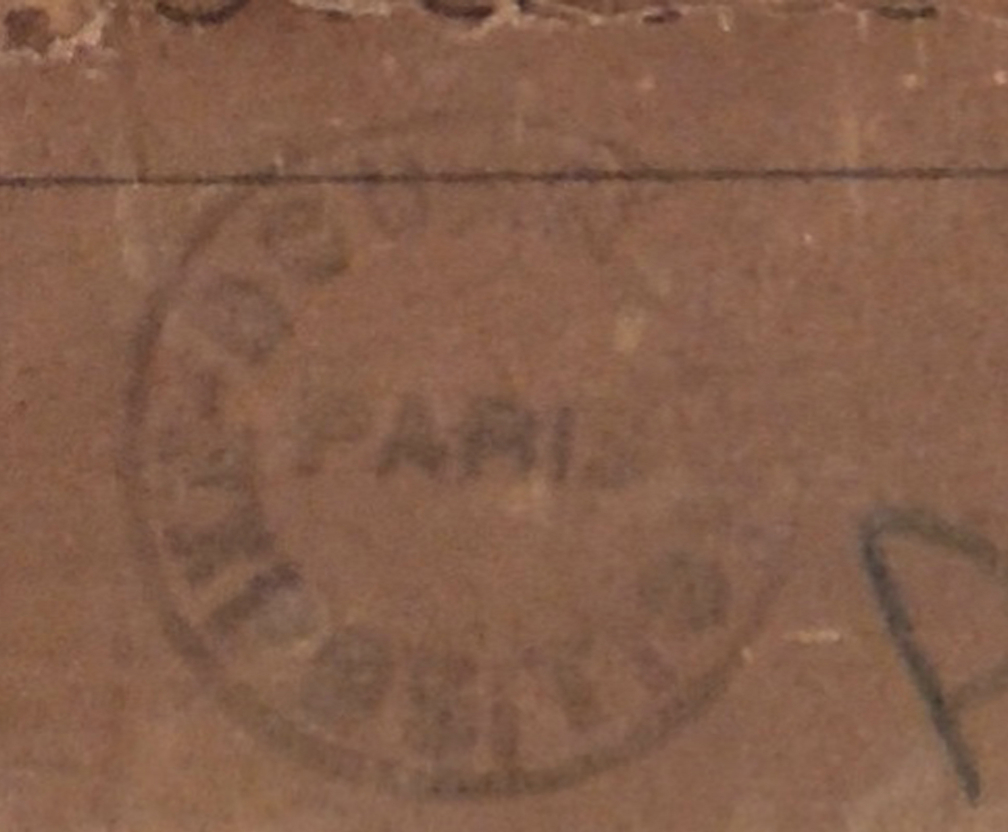
Stamp
Location: paper tape on stretcher, partially cut, partially covered
Method: circular stamp in black ink
Content: PARIS [through center] / [DO]UANE [across top] / GE[NE]RALE [across bottom] (fig. 10.69)
Inscription
Location: paper tape on stretcher
Method: handwritten script in pencil
Content: Chauncy Mc Cormick (fig. 10.72)
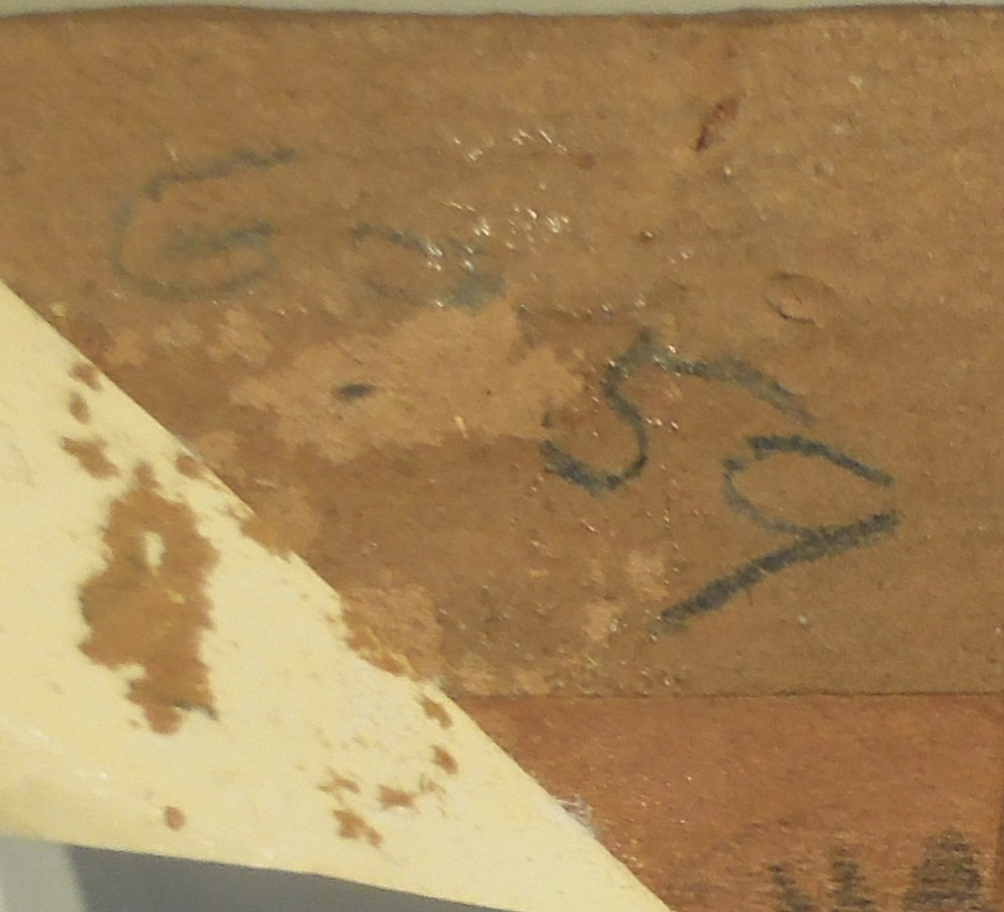
Inscription
Location: paper tape on stretcher
Method: handwritten script in blue pencil
Content: 6[9] 59 (fig. 10.70)
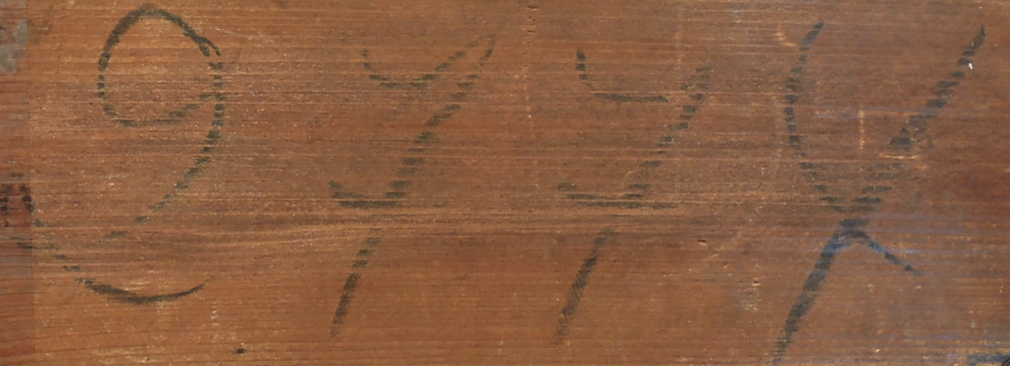
Label
Location: stretcher
Method: handwritten script in blue pencil
Content: 2774 (fig. 10.80)
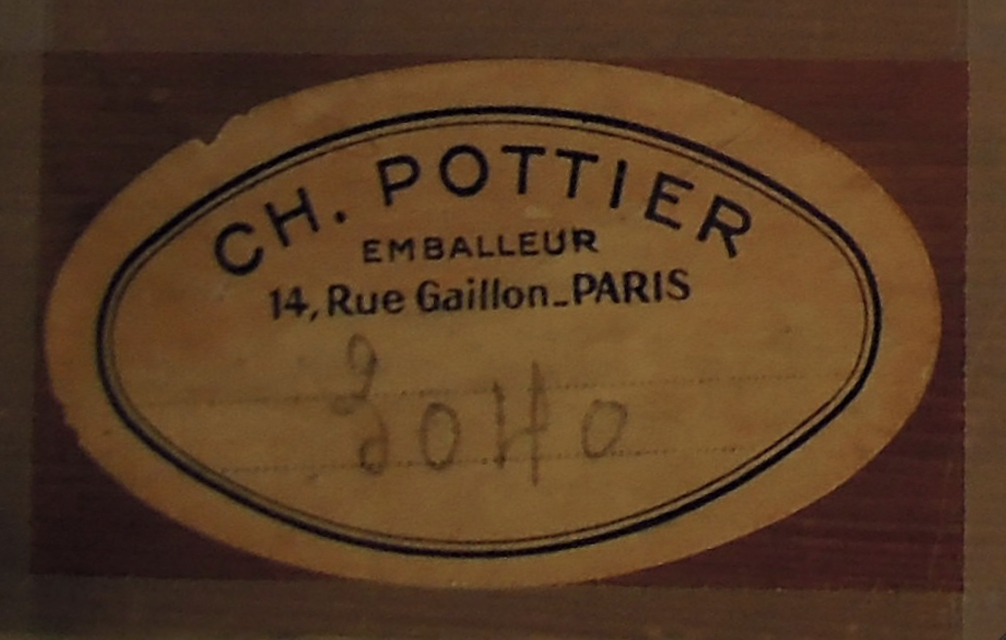
Label
Location: stretcher
Method: printed oval label with number in handwritten script
Content: CH. POTTIER / EMBALLEUR / 14, Rue Gaillon_PARIS / 3040 (fig. 10.84)
Stamp
Location: paper tape
Method: stamp in black ink
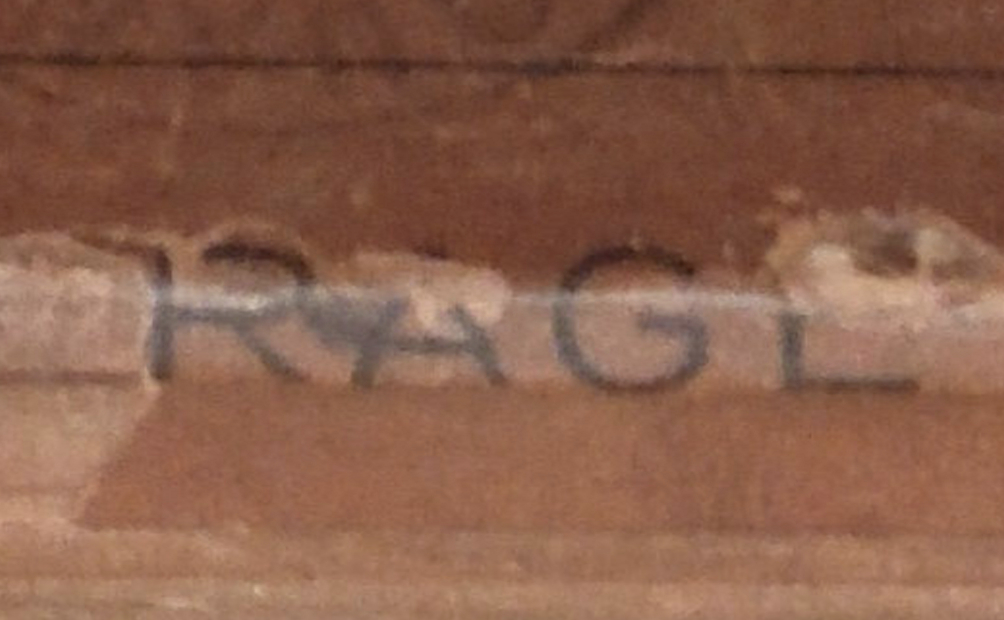
Content: RAGL (fig. 10.86)
Label
Location: stretcher
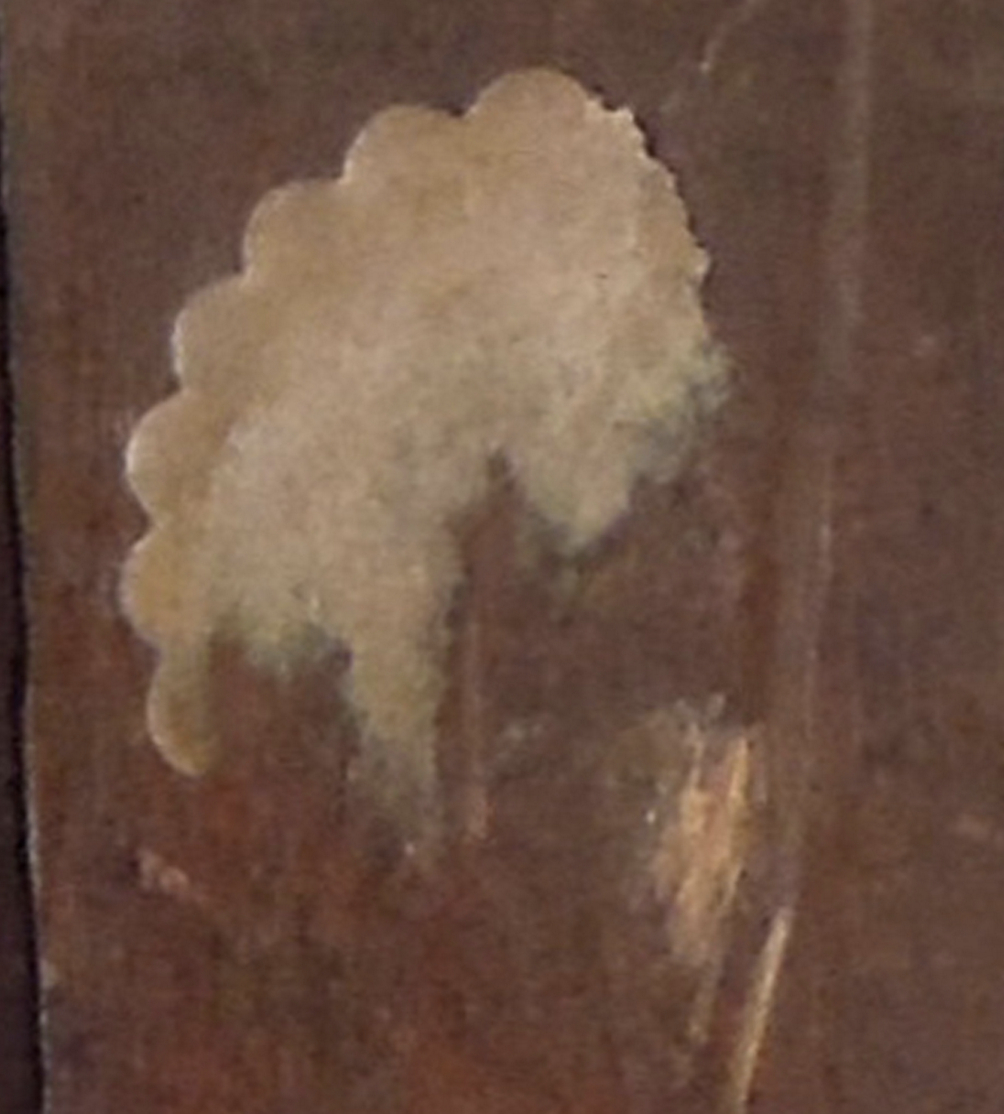
Method: white scalloped circular label, torn
Content: [none] (fig. 10.87)
Label
Location: stretcher
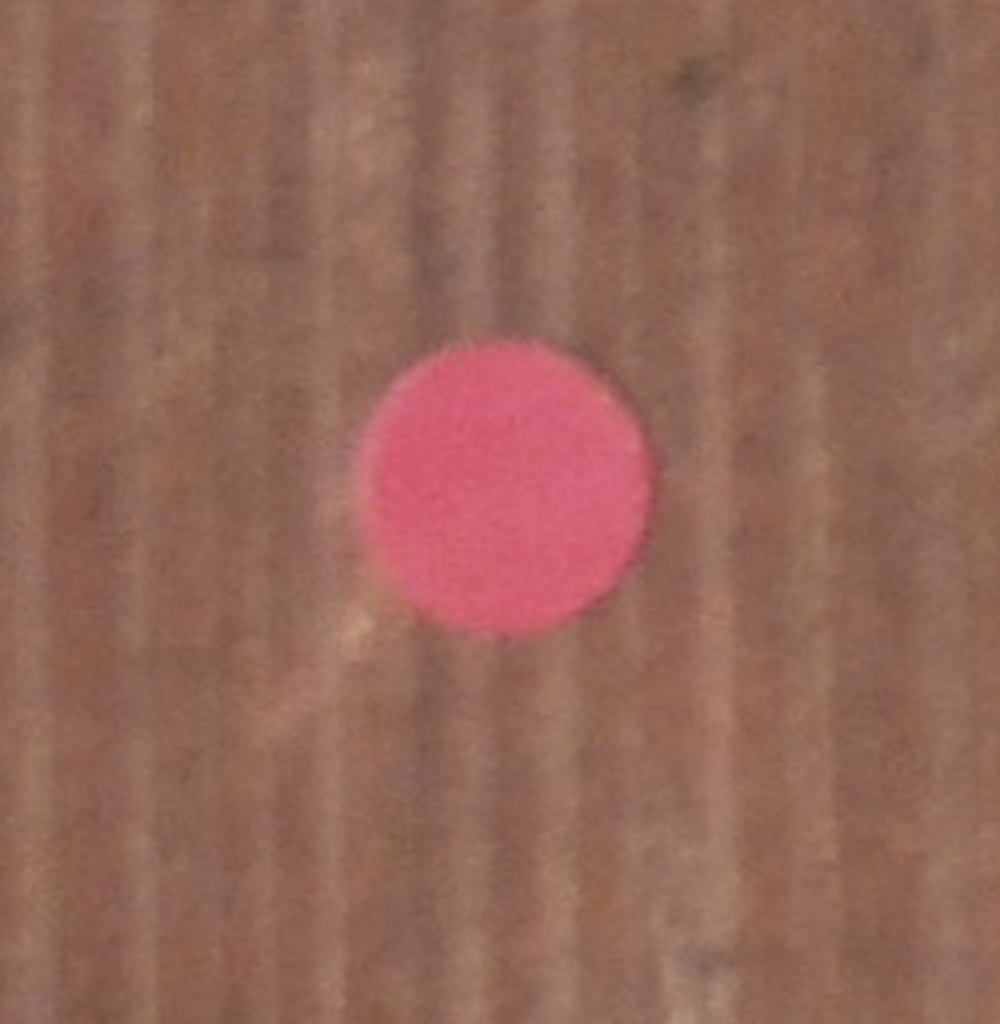
Method: red circular label
Content: [none] (fig. 10.77)
Inscription
Location: stretcher
Method: indentation from handwritten script
Content: [illegible] . . . RO . . [36] (fig. 10.73)
Pre-1980
Label
Location: stretcher
Method: handwritten script with pen and ink
Content: Gauguin / - / Mme G. de Mon[freid] (fig. 10.83)
Post-1980
Label
Location: backing board
Method: printed label
Content: [logo] National Gallery of Art / Washington, D.C. / X.36699 Dex ID 48 / Exhibit: Gauguin: Maker of Myth / Dates: 30 Sep 2010 – 5 Jun 2011 / Attrib.: Paul Gauguin / Title: Merahi Metua no Tehamana (Tehamana Has Many Parents) / Lender: The Art Institute of Chicago (fig. 10.90)
Label
Location: backing board
Method: printed label with red stamp
Content: Gauguin: Maker of Myth / Tate Modern (London, UK) / National Gallery of Art (Washington, USA) / GAUGUIN, Paul 1848-1903 / Merahi Metua no Tehamana (Les Aieux de Tehamana / The Ancestors of Tehamana or Tehamana Has Many Parents), 1893 / Oil on canvas 763 x 543 mm / Art Institute of Chicago (Chicago, USA) / X27377 / TATE (fig. 10.89)
Label
Location: backing board
Method: printed label in black and red
Content: [logo] / Museum of Fine Arts, Boston / Avenue of the Arts / 465 Huntington Avenue / Boston, Massachusetts 02115-5597 / Exhibition / Catalogue #: / 099 / zNew408263 Art of Europe / Paul Gauguin (French, 1848-1903) / The Ancestors of Tehamana (Merahi metua no tehamana), 1893 / Oil on canvas / The Art Institute of Chicago. Gift of Mr. and Mrs. Charles Deering / McCormick, 1980.613 / Gauguin – Tahiti / 29 February 2004 – 20 June 2004 / 30 Sep ’03 – 19 Jan ’04 Galeries Nationales du Grand Palais / 29 Feb ’04 – 20 Jun ’04 Museum of Fine Arts, Boston (fig. 10.88)
Label
Location: stretcher
Method: printed label with typed information and stamp in blue ink
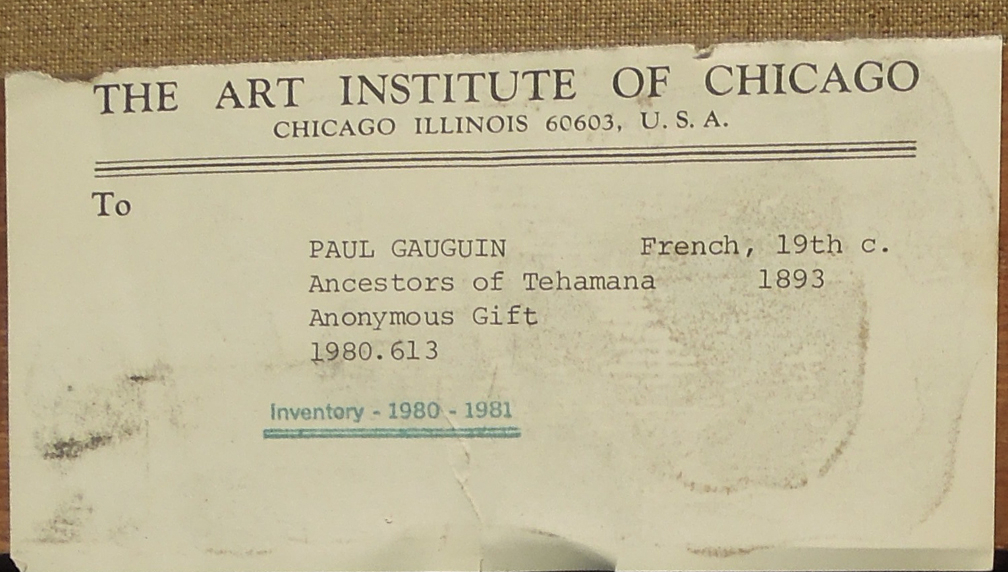
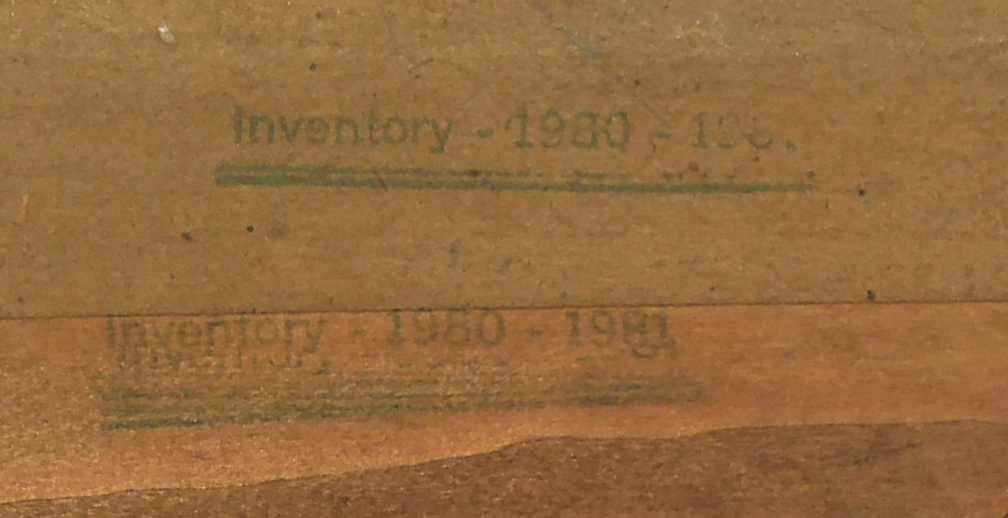
Content: THE ART INSTITUTE OF CHICAGO / CHICAGO ILLINOIS 60603, U.S.A. / To / PAUL GAUGUIN French, 19th c. / Ancestors of Tehamana 1893 / Anonymous Gift / 1980.613 / Inventory – 1980 – 1981 (fig. 10.78)
Label
Location: backing board
Method: printed label with printed information and number in handwritten script with blue ballpoint pen
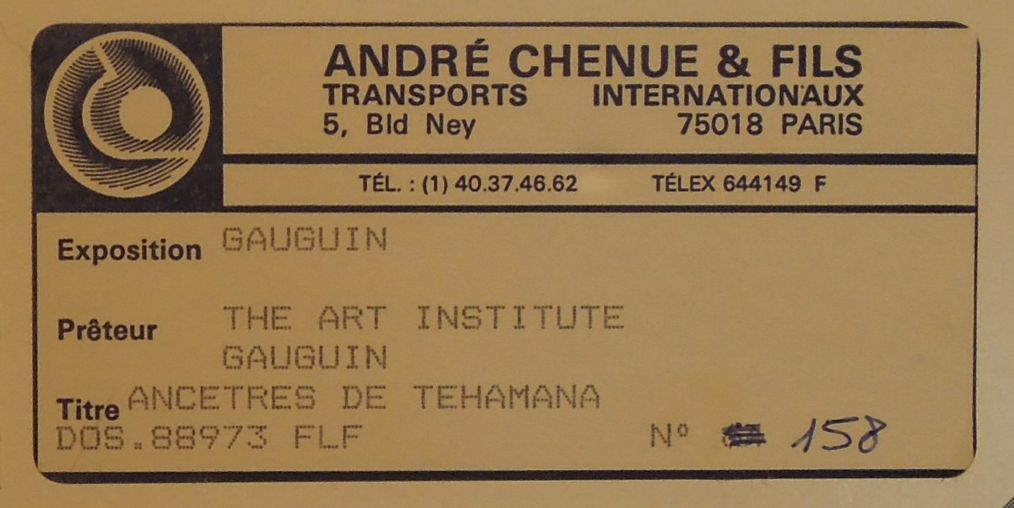
Content: [logo] ANDRÉ CHENUE & FILS / TRANSPORTS INTERNATIONAUX / 5, Bld Ney 75018 PARIS / TÉL.: (1) 40.37.46.62 TÉLEX 644149 F / Exposition GAUGUIN / Prêteur THE ART INSTITUTE / GAUGUIN / Titre ANCESTRES DE TEHAMANA / DOS.88973 FLF No. 158 (fig. 10.79)
Label
Location: backing board
Method: printed label
Content: [logo] / Réunion des musées nationaux / Exposition: Gauguin – Tahiti, l’atelier des Tropiques / Lieu: GNGP – Paris Dates: 30/09/2003-19/01/2004 / Titre de l’oeuvre: Les ancêtres de Tehamana (The Ancestors of Tehamana; Marahi metua no Tehamana) / Auteur: Gauguin Paul No Cat.:99 / Propriétaire: The Art Institute of Chicago (fig. 10.82)
Label
Location: backing board
Method: printed label with typed information
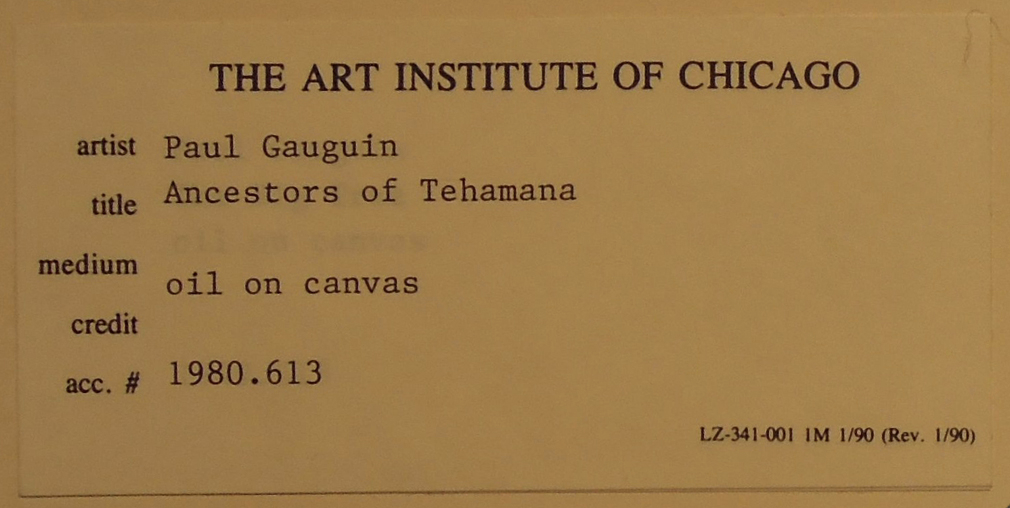
Content: THE ART INSTITUTE OF CHICAGO / artist Paul Gauguin / title Ancestors of Tehamana / medium oil on canvas / credit / acc # 1980.613 / LZ-341-001 lM 1/90 (Rev. 1/90) (fig. 10.81)
Stamp
Location: paper tape and stretcher
Method: stamp in blue ink
Content: Inventory – 1980 – 1981 [stamped twice] (fig. 10.85)
Examination and Analysis Techniques
X-radiography
Westinghouse X-ray unit, film scanned on an Epson Expressions 10000XL flatbed scanner. Scans digitally composited by Robert G. Erdmann, Rijksmuseum, Amsterdam, University of Amsterdam, and Radboud University, Nijmegen.
Infrared Reflectography
Fujifilm S5 Pro with X-Nite 1000B/2 mm filter (1.0–1.1 µm); Goodrich/Sensors Unlimited SU640SDV-1.7RT H filter (1.1–1.4 µm).
Transmitted Infrared
Fujifilm S5 Pro with X-Nite 1000B/2 mm filter (1.0–1.1 µm).
Visible Light
Normal-light, raking-light, and [glossary:transmitted-light] overalls and macrophotography: Fujifilm S5 Pro with X-NiteCC1 filter.
Ultraviolet
Fujifilm S5 Pro with X-NiteCC1 filter and Kodak Wratten 2E filter.
High-Resolution Visible Light (and Ultraviolet)
Sinar rePro with 86H back (Kodak Wratten 2E filter, PECA 918 UV/IR interference cut filter).
Microscopy and Photomicrographs
Sample and [glossary:cross-sectional analysis] using a Zeiss Axioplan 2 research microscope equipped with reflected light/[glossary:UV fluorescence] and a Zeiss AxioCam MRc5 digital camera. Types of illumination used: [glossary:darkfield], differential interference contrast ([glossary:DIC]), and [glossary:UV]. In situ photomicrographs were taken with a Wild Heerbrugg M7A StereoZoom microscope fitted with an Olympus DP71 microscope digital camera.
Polarized Light Microscopy (PLM)
Zeiss Universal research microscope.
Scanning Electron Microscopy/Energy-Dispersive X-ray Spectroscopy (SEM/EDX)
Cross sections were analyzed after carbon coating with a Hitachi S-3400N-II VPSEM with an Oxford EDS and a Hitachi solid-state [glossary:BSE]. Analysis was performed at the Atomic and Nanoscale Characterization Experimental (NUANCE) Center, Electron Probe Instrumentation Center (EPIC) facility, Northwestern University, Evanston, Illinois.
Electron Microprobe
Applied Research Laboratories (ARL) electron microprobe analyzer. Analysis was carried out at McCrone Associates, Westmont, Illinois.
Fourier Transform Infrared Microspectroscopy (FTIR)
Instrument used: Spectra Tech, IRμS Microspectrophotometer. Conducted by Mary Miller, MVA Inc., Burr Ridge, IL
Automated Thread Counting
[glossary:Thread count] and [glossary:weave] information were determined by Thread Count Automation Project software.
Image Registration Software
Overlay images registered using a novel image-based algorithm developed by Damon M. Conover (GW), Dr. John K. Delaney (GW, NGA), and Murray H. Loew (GW) of the George Washington University’s School of Engineering and Applied Science and the National Gallery of Art, Washington, D.C.
Image Inventory
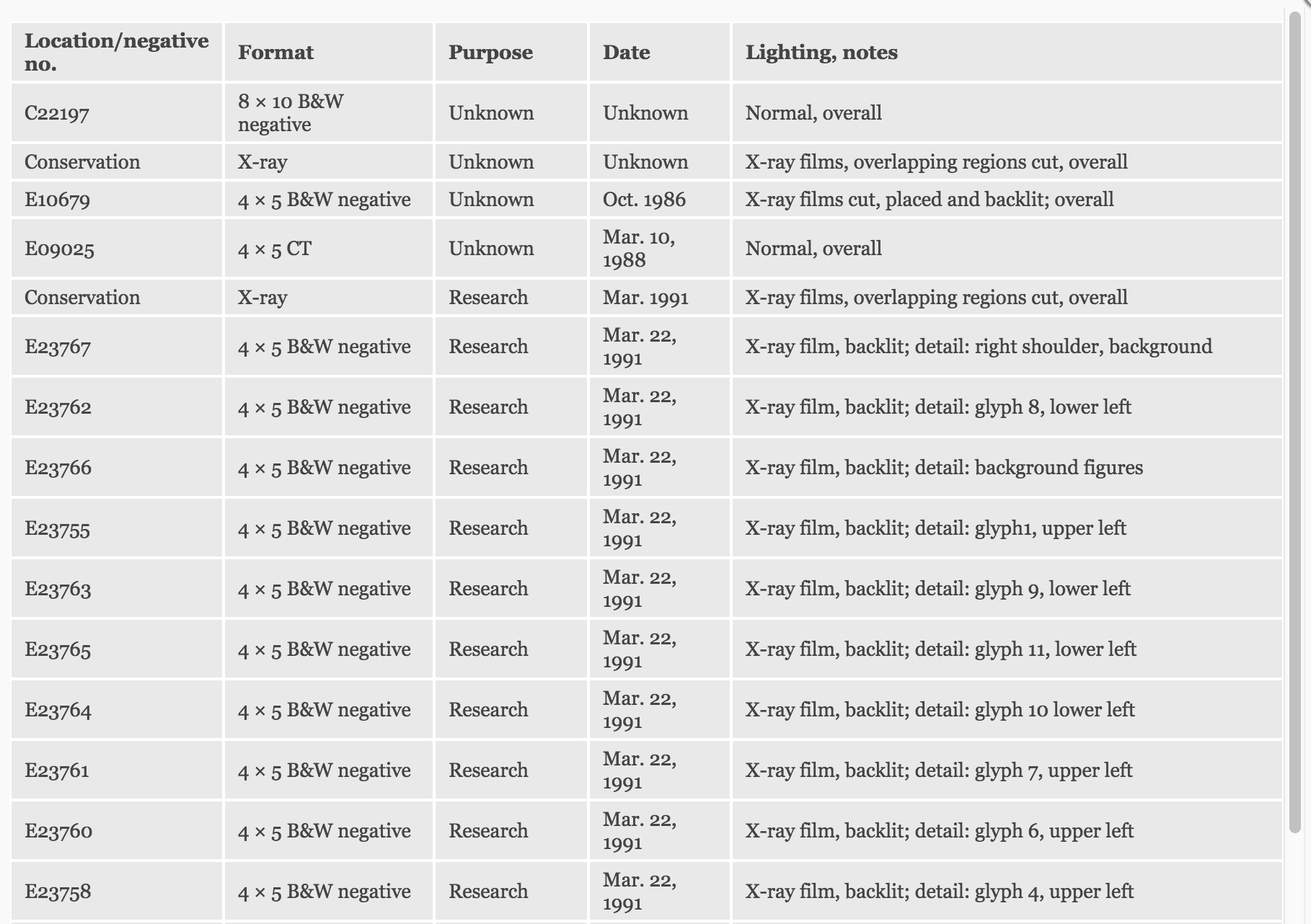
The image inventory compiles records of all known images of the artwork on file in the Department of Conservation and Science, the Imaging Department, and the Department of European Painting and Sculpture at the Art Institute of Chicago (fig. 50.101).